Best Basketball for Outdoor Concrete Court: What to Look for

For rough concrete, choose an outdoor basketball with a tough rubber cover, deep pebbled texture, and a butyl bladder. Skip thin composite covers, and favor the ball that keeps grip and bounce after abrasion. Pick wrong, and the cover scuffs smooth fast, the grip fades, and you end up replacing a ball that leaks or slips. This guide shows what to check for abrasion resistance, grip retention, and air-holding performance before you buy.
Best pick for concrete courts
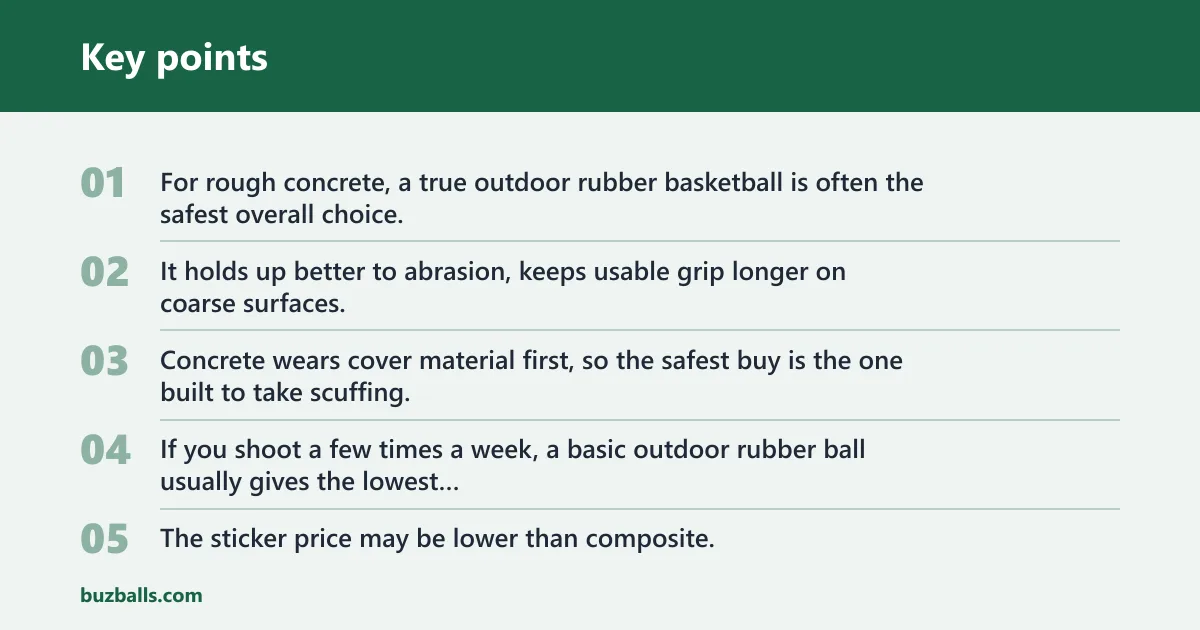
For rough concrete, a true outdoor rubber basketball is often the safest overall choice. It holds up better to abrasion, keeps usable grip longer on coarse surfaces, and is less likely to turn slick or scuffed after repeated sessions than a softer cover made for indoor floors.
Top choice for rough concrete
Pick rubber when durability matters most. Concrete wears cover material first, so the safest buy is the one built to take scuffing, seam wear, and repeated bounce impact without going dead early.
Best budget choice for casual play
If you shoot a few times a week, a basic outdoor rubber ball usually gives the lowest replacement risk. The sticker price may be lower than composite, and the ball often lasts longer on rough courts, which matters more than a softer feel.
Best feel choice for players who want more grip
If hand control matters more than maximum life, composite is the better feel-first option. It usually gives better grip and a cleaner catch than plain rubber, but it gives up some outdoor longevity on rough concrete.
Quick picks by need
Match the ball to how hard the court works on it. Concrete courts are commonly reported to wear basketballs faster than indoor courts, so a ball that feels pleasant for one session may wear more quickly after a few more.
- Rough concrete durability: rubber outdoor ball with a deep pebble pattern.
- Better grip and handling: composite outdoor ball with pronounced channels.
- Lowest replacement risk: rubber first, then a tough outdoor composite only if feel matters more.
- Indoor-outdoor compromise: hybrid ball if you split time between gym floors and outdoor courts.
Concrete basketball decision table
This table compares the three cover types by what concrete actually damages first: abrasion, grip, and the risk of having to replace the ball sooner.
| Cover type | Abrasion resistance | Grip and feel | Replacement risk | Best use |
|---|---|---|---|---|
| Rubber | Highest on rough concrete | Good, but usually less refined | Lowest | Daily outdoor play, rough courts, high wear |
| Composite | Moderate | Best for hand feel and control | Medium to high | Players who want more grip and softer touch |
| Indoor-outdoor hybrid | Moderate to low outdoors | Balanced, but less durable than true outdoor balls | Medium | Mixed indoor and outdoor use |
On a concrete court, the score that matters most is not softness. It is how long the cover keeps its pebble texture, how well the seams hold shape, and whether the ball still bounces cleanly after abrasion.
Is rubber or composite better for outdoor concrete?
Rubber is better when the court is rough and you want the ball to last. Composite is better when you want a cleaner feel and stronger grip, but it usually gives up some outdoor life on coarse concrete. Leather is the weakest fit outside because it wears out quicker.
Why rubber lasts longer on rough concrete
Rubber handles abrasion better because it is built for abuse from gritty surfaces. It is the safer choice for concrete courts, driveways, and other rough outdoor surfaces where the cover gets scuffed, the seams flatten, and the surface texture wears down fast.
Where composite still makes sense
Composite still works if you care more about grip and shooting feel than maximum lifespan. That tradeoff makes sense for lighter outdoor use, especially if the court is smoother or you also take the ball indoors.
Why leather is a weak outdoor choice
Leather is the least-used outdoor material because it wears out quicker. On concrete, it is a poor value choice unless the ball will stay mostly indoors. For rough outdoor courts, it is hard to justify the faster wear.
How size, weight, and grip affect play
Choose size first, then check weight and texture. A ball that is the wrong size or feels too heavy will handle poorly long before the cover wears out.
Choose the right size
Ball size should match the player. Size 7, or 29.5 inches, is the standard men’s size. Smaller sizes are better for kids and many women. Match the ball to age and sex rather than buying one oversized model for everyone.
Keep weight near standard
Most players should stay near standard weight. A ball that feels unusually heavy can make long outdoor sessions harder on the hands and wrists. Weight is tied to material and inflation, so a ball that feels off may be overinflated, underinflated, or built with a denser cover.
Look for pebble texture and channel depth
Grip depends on pebble texture, channel depth, and how the cover feels in sweaty or damp hands. Deep channels help with dribbling control. A clear pebble pattern helps on passes and shots. A slick or flattened surface is a warning sign on concrete.
Say your main use is solo shooting on a rough concrete court after work. A size 7 rubber ball with deep channels is the safer buy than a softer composite model, because the surface will wear the cover before you ever feel the difference in touch.
How to judge air retention and wear
A good outdoor basketball should hold air for a long time before needing a refill. Some balls need refilling daily, while others last weeks or months. On concrete, air loss and cover wear often show up together, so both matter.
What air loss looks like
A ball that feels dead at the start of play, sits lower on the floor, or needs frequent top-ups is costing you time and consistency. Inflate it to the correct pressure, then check whether it still feels firm after repeated sessions.
What pebble wear and seam flattening mean
Once the pebble pattern starts smoothing out, grip drops fast. Flattened seams can make the ball feel less lively on dribbles and rebounds. If the surface looks polished or the channels no longer help your fingers, the ball is moving toward replacement.
When replacement makes more sense than another top-up
If the ball needs air often and the cover has already gone slick, another refill is only delaying the real problem. On concrete, a ball that loses grip and bounce together is usually cheaper to replace than to keep patching with air.
How often will you need to reinflate?
That depends on bladder quality, inflation level, and how hard the ball is being used. A good outdoor basketball should hold air for a long time before needing a refill, but some balls need daily top-ups while others stay usable for weeks or months.
What causes pressure loss
Pressure loss can come from a weak bladder, a poor valve, or simple wear from repeated outdoor use. Correct inflation matters too. Overinflated balls can feel harsh and lose playability faster, while underinflated balls feel sluggish and make bounce control harder.
What to check after the first two sessions
Check the ball after the first two sessions, then again after a few days. If it loses noticeable firmness, you may be looking at a poor bladder or a valve that does not hold air well. That is especially important on concrete, where hard use exposes weak construction early.
When frequent top-ups signal a poor buy
If a ball needs air every day, that is generally a bad sign for outdoor use. Frequent top-ups become annoying fast, and they often point to a ball that will age badly on rough courts even if the cover still looks decent.
Suppose a composite ball feels great on day one but is soft again after two sessions on concrete. That is not a small inconvenience. It is a sign that the ball may cost more per session than a tougher rubber model that stays playable for weeks.
What should you inspect after first use?
Use the first two sessions as a quick field check. You are looking for early wear, not perfection. Concrete tells the truth fast, and the earliest signs usually predict how soon the ball will need replacement.
- Check scuffing on the cover. Look for fast smoothing, raw patches, or surface wear on the contact points.
- Check pebble wear and grip fade. Run your fingers over the cover and note whether the texture still helps control.
- Check seam flattening. Seams that start to flatten early can hurt feel and signal weak outdoor durability.
- Check bounce consistency. Dribble in place and compare the ball’s return height and sound across multiple bounces.
- Check air holding. Confirm whether it still feels firm after two sessions without needing a top-up.
The ball that passes these checks is usually the better buy, even if it looked ordinary on the shelf. The one that fails them may be fine for light indoor-outdoor use, but it is rarely a smart concrete-court choice.
How to choose
Start with the court, not the logo. For rough concrete, choose rubber first. Move to composite only if you want better feel and can accept faster outdoor wear. Avoid leather for regular outdoor use. Then match size to the player, keep weight near standard, and inspect grip, seams, and air holding after the first two sessions.
Shortlist by need
Best for rough concrete: a true outdoor rubber ball.
Best for grip and feel: a composite outdoor ball with deep pebbling and clear channels.
Best for mixed use: an indoor-outdoor hybrid, but expect less durability than a true outdoor ball.
Best long-term value: the ball that keeps its texture, bounce, and air the longest on your court.
Frequently asked questions
What should I look for in a basketball for a concrete court?
Look for a durable rubber cover, strong pebble texture, clear channels, and a bladder that holds air well. Concrete wears basketballs faster than indoor flooring, so the ball should resist scuffing, seam wear, and bounce drop before anything else. Comfort matters, but durability comes first.
Does a concrete court wear out basketballs faster?
Yes. Concrete is harsher than indoor courts and usually harsher than smoother outdoor surfaces too. That can mean faster cover scuffing, more pebble wear, more seam flattening, and a greater chance of air loss becoming noticeable sooner.
What size basketball should I buy for outdoor play?
Buy the same size you would choose for the player indoors. Size 7, or 29.5 inches, is the standard men’s size. Smaller sizes are better for kids and many women. Size should fit the player, not the court.
How important is grip on outdoor basketballs?
Very important. Grip affects dribbling, catching, and shooting control, especially if hands are sweaty or the court is dusty. Pebble texture and channel depth matter most. Once those features wear smooth, the ball becomes harder to control on concrete.
How often will I need to reinflate an outdoor basketball?
That depends on the bladder and valve quality. Some balls need daily top-ups, while others hold air for weeks or months. If a ball needs frequent refills after only a few sessions, that is a warning sign for outdoor use.