Golf Club Sizing Chart by Height: How to Use It Correctly

Use a golf club sizing chart by height as a first check only: many charts place golfers under 5’4″ at about -1 inch, 5’4″ to 6’0″ at standard length, and above 6’0″ at about +1 inch. Height alone can send you into clubs that sit too flat or too upright, which hurts contact and hides the real fit issue. This guide shows how to read the chart, then check it with wrist-to-floor, club type, and lie angle.
What you’ll need
- Your height measured in golf shoes.
- A tape measure for wrist-to-floor.
- The club type you are sizing: irons, woods, or driver.
- Notes for any borderline result or unusual setup.
Club sizing decision table
This table gives a screening fit, not a final build spec. Use height first, then let wrist-to-floor show whether the starting length should move by half an inch or a full inch.
| Height band | First-pass club length | Wrist-to-floor correction | When to get a fitting |
|---|---|---|---|
| Under 5’4″ | -1 inch from standard length | Long arms or a low wrist-to-floor number may move you back toward -0.5 inch or standard | If the change affects lie angle, or if you use a very upright or very bent setup |
| 5’4″ to 5’8″ | Standard length | Short arms or a high wrist-to-floor number may call for +0.5 inch | If your wrist-to-floor is outside the typical range for your height band |
| 5’8″ to 6’0″ | Standard length | Often stays standard; a long or short arm span can still shift you by 0.5 inch | If your posture changes a lot between clubs, or if contact is inconsistent |
| Over 6’0″ | +1 inch from standard length | Long arms can bring you back toward +0.5 inch or standard | If the club feels long, toe-heavy, or hard to square at impact |
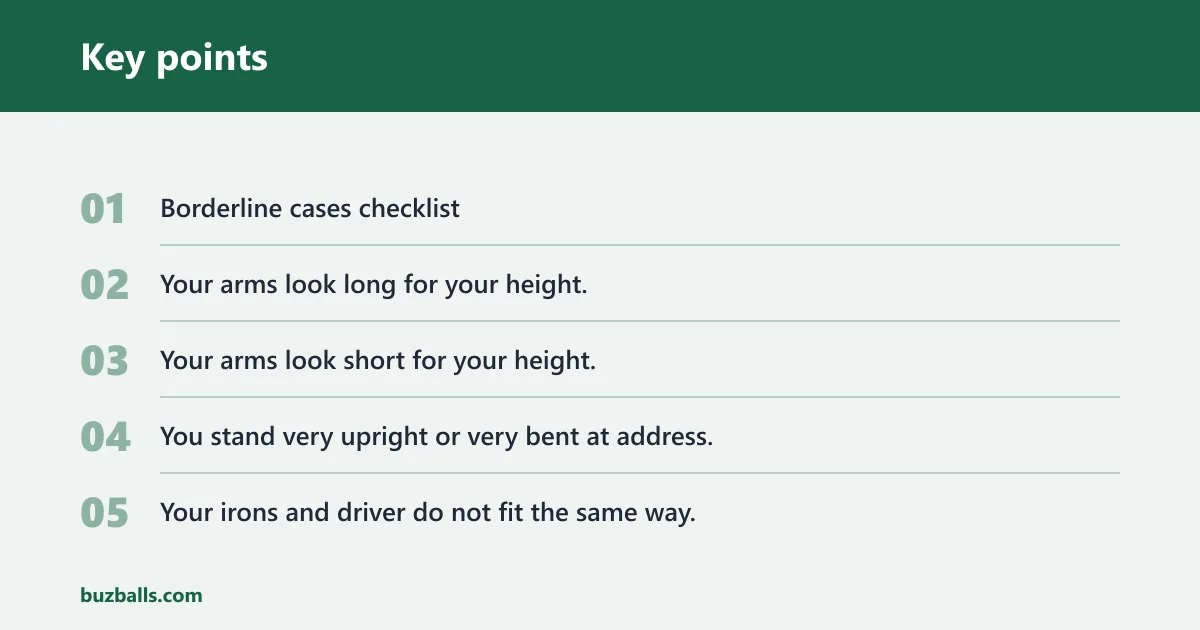
- Borderline cases checklist: you are between two height bands.
- Your arms look long for your height.
- Your arms look short for your height.
- You stand very upright or very bent at address.
- Your irons and driver do not fit the same way.
How do I use a golf club sizing chart by height correctly?
Start with height, then treat the result as a starting point for length, not a final answer. Use the chart to place yourself in a likely band, check wrist-to-floor next, and then separate irons from driver because standard lengths differ. That order keeps height from giving you false confidence.
Start with height as a first pass
Height charts work best as a screening tool for beginners and casual golfers who need a fast starting point. A common rule of thumb is shorter players often begin around -1 inch, average-height players at standard, and taller players around +1 inch, but the exact baseline changes by manufacturer and club type.
Check club type before you choose a length
Do not apply one number to every club. Driver length is much longer than iron length, so a height chart may translate differently for each. A set of irons can be built around one baseline, while a driver often needs its own check because small length changes alter control more sharply.
Treat the result as screening, not final fitting
A chart can tell you which clubs are worth trying first. It cannot confirm posture, strike location, or lie angle. If the first-pass result is borderline, or if your arms and posture do not match your height band, move straight to a fitting rather than guessing.
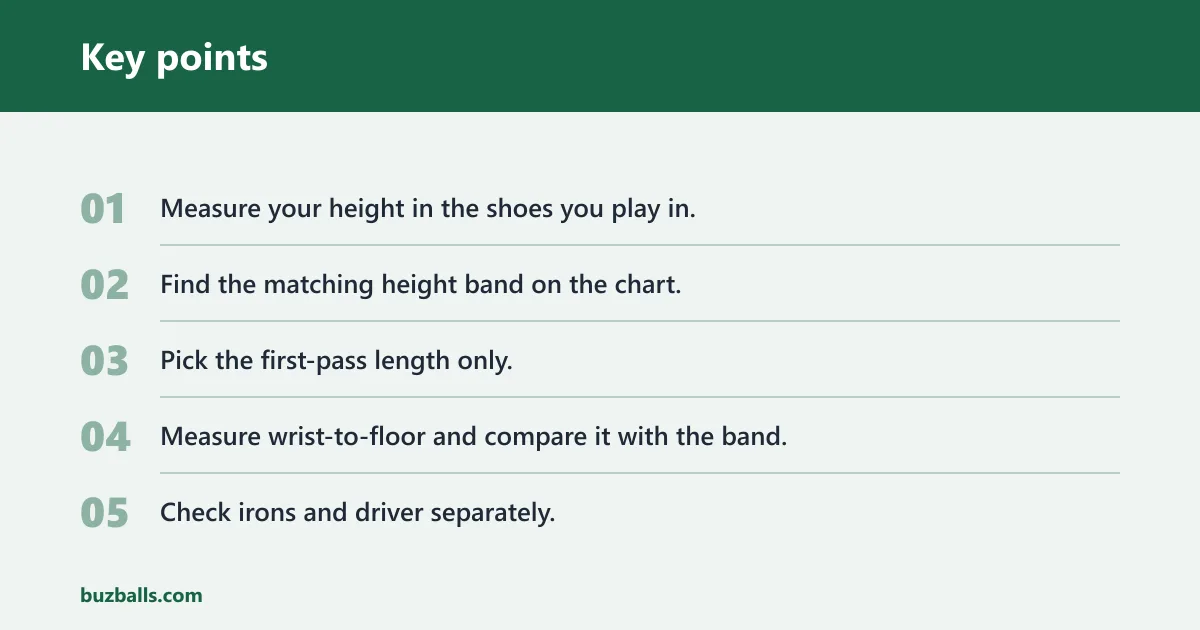
- Measure your height in the shoes you play in.
- Find the matching height band on the chart.
- Pick the first-pass length only.
- Measure wrist-to-floor and compare it with the band.
- Check irons and driver separately.
- Change length by 0.5 inch before making a second judgment.
- Recheck lie angle after any length change.
What golf club length should I use for my height?
For many golfers, under 5’4″ starts near -1 inch, 5’4″ to 6’0″ starts at standard, and above 6’0″ starts near +1 inch. That is only a first pass. If wrist-to-floor runs long or short for your height, shift the starting length by 0.5 inch before assuming the chart is right.
Use standard length as the baseline
Standard length is the reference point for both men and women, but it can vary by manufacturer and club type. A standard iron from one brand may differ slightly from another. Use the chart’s standard line as a baseline, then confirm the actual club spec before ordering.
Adjust for irons, woods, and driver
Irons usually need the tightest length control because they affect turf interaction and center contact. Woods and driver are longer and more sensitive to control loss when length changes. A driver that feels only a little too long can still hurt strike location more than an iron with the same error.
Say a golfer is 6’2″ with long arms and a low wrist-to-floor number. The chart may point to +1 inch, but the arm length can pull the fit back toward +0.5 inch or even standard, which is why height alone would be misleading.
Do I need to adjust for wrist-to-floor measurement too?
Yes. Wrist-to-floor is the practical tie-breaker when height alone leaves two possible sizes or when posture and arm length do not match the height band. Measured correctly, it helps decide between standard, half-inch, and one-inch changes, which is often more useful than height alone.
Measure wrist-to-floor in golf shoes
Stand naturally in the shoes you play in, with your arms hanging straight down and your palms facing your thighs. Measure from the crease at the wrist to the floor. Keep the posture relaxed. Do not reach down or bend the knees, because that changes the number and can push you into the wrong length.
Use wrist-to-floor to refine the chart result
A longer wrist-to-floor measurement usually supports a longer club; a shorter measurement usually points shorter. The adjustment is often 0.5 inch, not a full inch. That matters because half-inch changes can preserve posture while still improving contact and control.
Suppose two golfers are both 5’9″. One has long arms and a low wrist-to-floor measurement, while the other has shorter arms and a higher wrist-to-floor measurement. The height chart gives the same first-pass answer, but the wrist-to-floor check separates them into different starting lengths.
What if I’m between two sizes?
If you sit between two height bands, use wrist-to-floor, arm length, and address posture to choose the safer starting length. When the numbers disagree, the safer move is the club that lets you stand naturally and strike the center more often, even if it is not the taller player’s default recommendation.
Check for long arms or short arms
Long arms often make a golfer play shorter than height suggests. Short arms can do the opposite. That is why two golfers of the same height can need different shafts. A chart cannot see arm length, but a wrist-to-floor measurement usually reveals it.
Choose the safer starting length
When torn between two fits, start with the length that keeps posture neutral and contact centered. If the choice is between standard and +0.5 inch, many golfers are better served by the shorter of the two until a fitting confirms otherwise. A too-long club is harder to control than one that is slightly short.
How does lie angle change with length?
Changing length changes how the sole sits at address and through impact, so lie angle often needs to change too. Longer clubs can play more upright at the same static setting, while shorter clubs can play flatter. That matters because lie angle helps determine where the ball starts.
Why longer clubs can move lie upright
When a club gets longer, the toe can sit higher if the lie angle is not adjusted. That can push start direction left for a right-handed golfer. A longer shaft also changes posture and hand height, so the same lie setting may no longer match the swing.
Why shorter clubs can move lie flat
A shorter club can bring the toe down and make the club play flatter. For a right-handed golfer, that can send the ball right if the lie becomes too flat. If you shorten a club by 0.5 inch or 1 inch, the lie angle should be checked again.
When lie-angle fitting matters most
Lie-angle fitting matters most after any length change, for players who miss consistently one side, and for golfers with unusual posture. It also matters for taller golfers who do not need the full height-chart length, because the extra length can create lie problems even if the club feels comfortable.
Common mistakes

The biggest mistake is treating height as the whole fit. The next mistake is skipping wrist-to-floor, then wondering why the club feels wrong at address or sends the ball off line. A chart should narrow the search, not end it.
Using height alone
Height alone misses long arms, short arms, and unusual posture. It can also miss the difference between irons and driver. Use it to start, then verify with the tape measure and a lie check.
Ignoring slouched posture
If a golfer stands more upright or more bent than average, the chart result can be off. Slouched posture especially makes a club seem too long on paper when the real issue is setup. Measure in a natural golf stance, not at random standing posture.
Mixing adult and junior charts
Junior golf clubs use age- and height-specific sizing with shorter shaft options. Do not apply adult height bands to a junior player, because the scale and the priorities are different. Junior sets are built for growth and control, not just static height.
Assuming every brand matches the same standard
Standard length varies by manufacturer and by club type. One brand’s “standard” iron may not match another’s exactly. If you switch brands, check the listed club specs before treating the chart result as final.
How do I know if my clubs are too short or too long?
Clubs that are too short often force a golfer to hunch, crowd the ball, or strike the heel more often. Clubs that are too long often push the player into a taller posture, make the toe sit high, or send contact toward the toe. Repeated miss patterns and uncomfortable address positions are the clearest clues.
Look for repeated setup changes first. If the golfer keeps reaching for the ball, standing up through impact, or choking down every shot, the current length may be wrong. If the club feels hard to square, the lie angle may be part of the problem too.
Frequently asked questions
Is a height chart enough to fit golf clubs?
No. It is a screening tool. A full fit also checks lie angle, posture, and how the golfer delivers the club. If the chart suggests a borderline size, or if the golfer uses a very upright or very bent setup, a fitting is the better next step.
What if I am between two heights on the chart
Use wrist-to-floor and arm length to decide which side is safer. If the result still feels split, start with the shorter option and verify on a launch monitor or with a dynamic test. That keeps the player from getting trapped in clubs that are too long to control.
Does the chart work the same for men and women?
The height logic is similar, but the baseline is not identical across every set. Standard length varies by manufacturer and by club type, and some women’s sets use different reference specs. Use the chart as a starting point, then compare the listed club length before buying.