Do Golf Balls Make a Difference for Beginners?

Yes, golf balls can matter for beginners, but only when they change launch, spin, and how often you lose balls. If they do not, buy the cheaper ball. Ignoring that can mean shorter shots, more slices, and money wasted on premium balls that will not fix poor contact. This guide gives a simple beginner buying rule for distance, feel, and when ball choice is worth paying for.
How ball design affects beginner performance
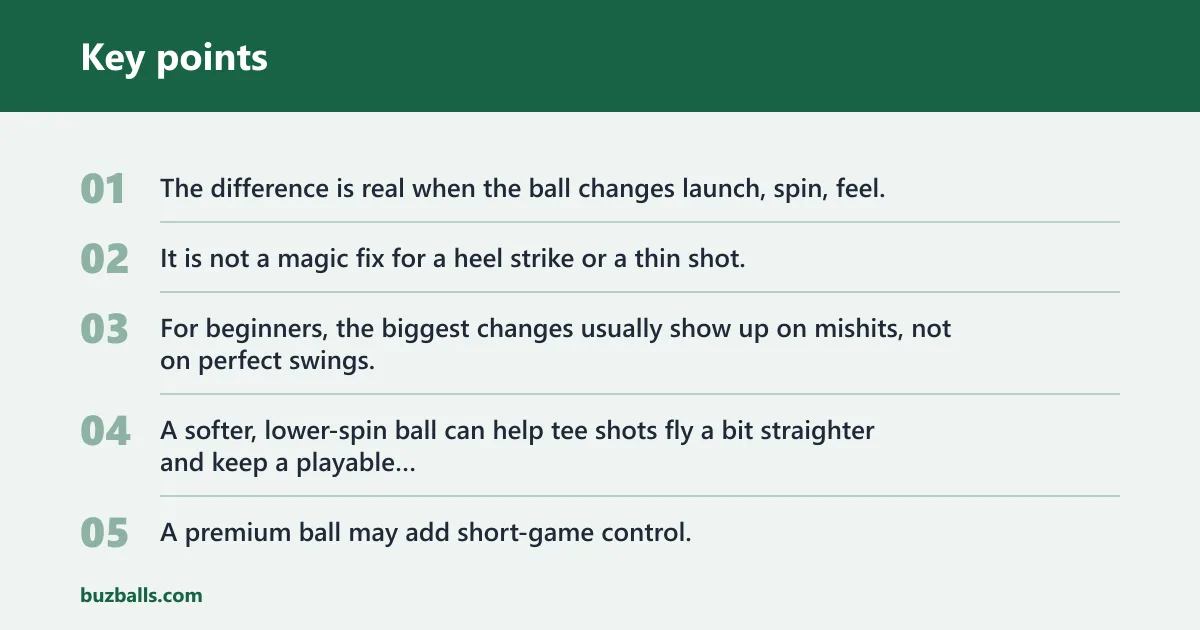
Yes. The difference is real when the ball changes launch, spin, feel, or durability enough to affect your score and confidence. It is not a magic fix for a heel strike or a thin shot, but the right ball can help mishits travel a little better, scuff less, and feel easier to trust.
What changes for new golfers and what does not
For beginners, the biggest changes usually show up on mishits, not on perfect swings. A softer, lower-spin ball can help tee shots fly a bit straighter and keep a playable ball in the air longer. A premium ball may add short-game control, but that benefit is easy to miss if you are spraying shots or losing balls often.
What does not change much is the basic fact that contact quality still matters most. A ball cannot correct a pop-up, a heavy slice, or a shot struck far from center. It can only change how much those mistakes cost.
How ball design affects your shots
Compression is the ball’s resistance to being squeezed at impact. Lower compression suits slower swing speeds because it is easier to compress, which can help launch and distance. Higher compression needs more force to compress, so a beginner with modest speed may get a firmer feel and lose some efficiency.
Layers, cover material, and dimples all matter too. A two-piece golf ball has a solid core plus a durable cover, and it is commonly recommended for beginners. Multi-layer golf balls, meaning 3-piece, 4-piece, or 5-piece designs, add spin and control, which usually suits advanced players better. The average golf ball has between 300 and 500 dimples, and those dimples shape aerodynamics, reduce drag, and influence flight and distance.
Cover material changes the tradeoff. Surlyn and other ionomer covers are more durable and provide less spin. Urethane covers are typically found on higher-end golf balls and are often paired with more greenside control. That control can matter later, but it is not the first place most beginners should spend extra money.
Spin, launch, and feel
Spin rate affects both backspin and sidespin. More spin can help skilled players stop the ball near the hole, but it can also make slices and hooks worse. Lower spin is often easier for beginners because the ball curves less and stays more predictable off the tee.
Feel matters too. A soft-feel ball often gives clearer feedback on chips and putts, which can help confidence. A firmer ball can feel harsher and less informative. That does not make it unusable, but it can make the game feel less steady when you are still learning solid contact.
Why beginners notice the difference
Distance changes are usually modest, but they can still matter. Golf Digest research cited by a competitor says compression can affect driving distance by up to 5 yards. That is enough to notice on a well-hit tee shot, but it will not rescue a swing that loses contact quality.
Slices, hooks, heel strikes, thin shots, and pop-ups are where beginners feel ball choice most. Lower spin can trim some side curvature, while a durable cover can survive more of the contact errors that beginners produce. A common first-timer mistake is buying a premium ball for “more control,” then watching the ball scuff up after a few mishits and cost more without giving better scores.
Picture a beginner with a driver swing under about 100 mph who already tends to hit a fading tee shot. A low-compression, two-piece ball is more likely to help than a tour ball, because it can launch more easily, spin less, and keep the shot from bending as much.
Beginner ball decision table
This table gives a quick way to match ball type to the most common beginner patterns. The best choice is usually the one that fits your swing speed, survives mishits, and keeps the gap between “good enough” and “premium” from being too small to matter.
| Ball type | Typical swing speed fit | Common miss pattern it handles best | Expected benefit | Durability | When the difference is too small to matter |
|---|---|---|---|---|---|
| Two-piece, low-compression, Surlyn-covered ball | Slower speeds, often under 100 mph | Heel strikes, thin shots, pop-ups, heavy slices | More usable distance, less spin, fewer costly scuffs | High | When you already strike the center often and want more short-game spin |
| Multi-layer ball, usually 3-piece or more | Moderate to faster speeds | Better strike patterns, fewer wild misses | More spin and control, especially into greens | Medium | When your main problem is contact, not short-game control |
| Urethane-covered ball | Faster speeds or stronger short game | Players trying to shape shots and stop the ball quickly | More greenside control; Titleist research is cited to support stronger short-game control with urethane-covered balls | Lower than Surlyn | When you lose a lot of balls, scuff them often, or do not need extra greenside bite |
What kind of golf balls should a beginner use?
The best default for most beginners is a two-piece, low-compression ball with a durable cover. That combination gives usable distance, lower spin, and better resistance to scuffs, which matters when contact is still inconsistent. It is the safest choice unless your swing speed is clearly higher and your short game is already a priority.
Best default: two-piece, low-compression, durable cover
Two-piece golf balls are commonly recommended for beginners. They usually prioritize distance and durability, which lines up with the problems most new golfers face. If you are buying one sleeve to start, this is the category to start with.
Surlyn or another ionomer cover is the better fit for most beginners because it is tougher and gives less spin. That lower spin can reduce overcurve on slices and hooks, while the tougher cover handles cart-path taps, tree hits, and other rough contact a little better.
When a softer ball makes sense
Should beginners use low-compression golf balls? In most cases, yes. Lower compression suits slower swing speeds because the ball compresses more easily at impact. If your driver speed is below 100 mph, a softer ball usually makes more sense than a firm tour ball.
Suppose your shots feel hard to launch and you tend to leave drives short and right. A softer, low-compression two-piece ball is more likely to help than a high-compression model, because the fit is closer to your speed and the ball is less likely to add unnecessary spin.
When to skip premium urethane
Skip urethane as the default if you lose several balls a round, miss the center often, or still need simple distance and straighter flight more than short-game bite. Urethane covers are typically found on higher-end golf balls, and while they can add control, that benefit is often too small for a beginner to pay extra for every round.
Multi-layer golf balls do add spin and control, but they are usually better suited to advanced players who can already contact the center often enough to use that extra spin well.
Do golf balls make a difference in distance?
Yes, but the difference is usually smaller than swing changes. Ball compression and spin can affect how far the ball goes, especially for slower swing speeds and on imperfect contact. The realistic gain is often modest, and the better result is usually a cleaner launch and less wasted distance from too much spin or a poor fit.
Swing speed and compression fit
Swing speed is the simplest way to narrow the choice. If you are below about 100 mph with driver, a softer ball often compresses more efficiently and can feel easier to launch. That does not mean every slower swinger needs the softest ball available, only that very firm balls are less likely to help.
High-compression balls need more force to compress. When a beginner does not supply that force, the ball can feel firmer and may give up some distance. The effect is not massive, but it is enough to matter when you are choosing between two otherwise similar options.
Lower spin and easier launch
Lower spin can help beginners by reducing side curve and keeping the ball from ballooning. That is especially useful on tee shots. It is less about raw “technology” and more about fitting the ball to a swing that already creates enough spin on its own.
Dimples matter here too, but they are rarely the first buying factor for a beginner. Dimple pattern affects aerodynamics and flight, yet the bigger decision is still compression, cover, and spin profile.
What distance gains are realistic
Do golf balls make a difference in distance? Yes, but the effect is often in the low single digits on a given shot rather than a dramatic jump. Golf Digest research cited by a competitor puts the compression-related difference at up to 5 yards. That is noticeable, but it is not the kind of gap that justifies a premium ball if you are losing many of them.
Distance gain also depends on whether the ball reduces your side spin or launch problems. A straighter ball that finishes in play can be more valuable than a longer ball that ends up in the trees.
Is there really that much difference between golf balls?
There is a difference, but not every difference matters to a beginner. Cheap and expensive golf balls can behave differently in spin, feel, and durability, yet price alone does not tell you which one will score better for you. The gap matters most when your swing speed, miss pattern, or short-game needs match the ball.
Cheap versus expensive balls
Is there a difference between cheap and expensive golf balls? Yes. Premium balls often use urethane covers and more complex construction, which can add greenside control and more approach-shot spin. Premium golf balls can generate up to 30% more spin on approach shots.
That sounds impressive, but it matters most to golfers who can already use that extra spin. If you are still fighting big slices or topping the ball, the added short-game spin is usually not the best place to spend.
When the gap is noticeable
The gap becomes noticeable when you have enough contact quality to benefit from it. Better players can see more check on chip shots and more control on approach shots. Beginners are more likely to notice durability, feel, and whether the ball curves less on full swings.
Higher-end urethane balls can help around the green, and Titleist research is cited to support that stronger greenside control. But that does not change the fact that a beginner often gains more from a durable, lower-spin ball than from extra spin that shows up only on a few shots.
When the gap is too small to matter
If you lose a sleeve quickly, hit several mishits per round, or cannot tell the difference in short-game spin yet, the gap is too small to justify premium pricing. In that case, focus on a two-piece ball with low compression and a Surlyn cover, then move up only if your contact and short game improve.
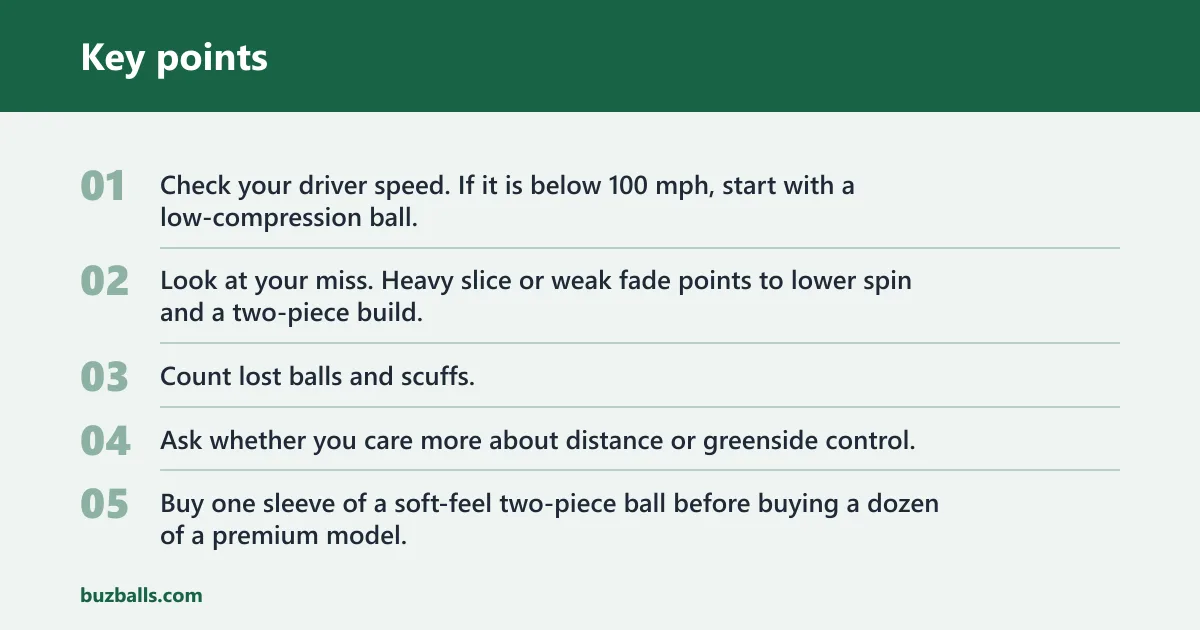
- Check your driver speed. If it is below 100 mph, start with a low-compression ball.
- Look at your miss. Heavy slice or weak fade points to lower spin and a two-piece build.
- Count lost balls and scuffs. If you lose several, durability matters more than urethane spin.
- Ask whether you care more about distance or greenside control. Beginners usually need distance and forgiveness first.
- Buy one sleeve of a soft-feel two-piece ball before buying a dozen of a premium model.
- Play the same ball for a few rounds so you can tell whether feel, distance, and curve actually change.
Frequently asked questions
Do golf balls make a difference for beginners?
Yes, but the difference is practical rather than dramatic. Beginners usually see the biggest effects in launch, spin, feel, and durability. The right ball can make shots easier to trust and keep mishits from costing as much, while the wrong one can add spin or waste money without fixing poor contact.
Are two-piece golf balls better for beginners?
Usually, yes. Two-piece golf balls are commonly recommended for beginners because they prioritize distance and durability. They are a good default when you want fewer scuffs, less spin, and a simple fit for slower to moderate swing speeds.
Should beginners use low-compression golf balls?
Most beginners should at least try them. Lower compression suits slower swing speeds because the ball is easier to compress, which can help with launch and feel. If you swing faster and already strike the ball well, the advantage may be smaller.
What type of golf ball is best for beginners?
A soft-feel, low-compression, two-piece ball with a durable cover is often a safe choice for many beginners. It gives a good mix of distance, forgiveness, and durability, without paying for extra spin that may not help yet.
What golf ball should I use for my swing speed?
If your driver speed is below 100 mph, start with a softer, lower-compression ball. If your speed is higher and you already want more short-game control, a multi-layer ball may make more sense. Match the ball to speed first, then to your miss pattern.
Do golf balls make a difference for beginners?
Yes. The right ball can change launch, spin, feel, and how often you replace a scuffed one. The wrong ball is usually not disastrous, but a good beginner fit can make the game easier to manage and a little more enjoyable.
Do golf balls make a difference?
They do, but the size of the difference depends on skill level and contact quality. A beginner will usually notice fit, not fine detail. That is why the best first choice is usually a low-compression, two-piece ball with a durable cover.