
How to Care for an English Willow Bat vs a Kashmir Willow Bat

Care for an English willow bat with lighter knocking-in, more frequent oiling, and careful drying; care for a Kashmir willow bat with firmer knocking-in, less oil, and the same dry, ventilated storage. Skip the right routine and you risk cracks, dents, face damage, and a bat that loses performance early. This guide compares prep, oiling, storage, cleaning, and match-day handling for both willow types.
| Decision factor | an English willow bat | a Kashmir willow bat | Winner |
|---|---|---|---|
| Responsiveness and rebound | Soft, less dense wood that is usually pressed to feel springier and reach peak response faster when prepared well. | Denser, harder wood that often takes longer to wake up and usually feels less lively early on. | an English willow bat |
| Maintenance sensitivity | Needs more careful knock-in, light oiling, and close attention to moisture loss and surface cracks. | Handles hard use better, but still needs proper knocking-in, drying, and crack checks. | a Kashmir willow bat |
| Edge, toe, and face wear | More prone to surface cracking if neglected, especially at the toe and edges. | Usually tougher under rough use, though dents and splits still need monitoring. | a Kashmir willow bat |
| Break-in demand | Longer knock-in period is typically needed, especially for premium bats and higher grades. | Still needs knocking-in, but the routine is usually less delicate than for English willow. | a Kashmir willow bat |
| Best fit for player type | Often better for club players who value response and are willing to maintain the bat properly. | Often better for juniors and casual players who want a tougher bat for regular or rougher use. | tie |
Care differences by wood type
The trade-off is direct: an English willow bat usually gives you better response and a larger, more forgiving sweet spot, but it asks for more careful prep and moisture control. A Kashmir willow bat is denser and harder, so it can handle heavier use, yet it still needs proper knocking-in and drying to avoid early damage.
Why the wood type changes the routine
Willow is compressed under immense pressure before sale, and that pressing affects how quickly the face settles, how the bat rebounds, and how the fibres react to impact. Because English willow is softer and less dense, neglect shows up faster as surface cracking or edge wear. Kashmir willow is more resistant to rough handling, but under-preparation can leave it feeling dead longer and can still cause splits at the toe or edges.
The main care trade-offs at a glance
Use lighter oiling on English willow because too much oil can soften the surface and shorten the bat’s life. Use the same drying routine for both bats: no damp kit bag, no hot boot, no wet blade left wrapped overnight. The difference is how carefully you pace the first few sessions and how often you inspect the face and edges.
Willow care matrix
This matrix gives the practical sequence. The actions differ in intensity, not in purpose: both bats need controlled preparation, moisture control, and repeated crack checks through the first sessions.
| Care stage | an English willow bat | a Kashmir willow bat | Risk if skipped | Visible changes to watch for |
|---|---|---|---|---|
| First oiling | Apply a very light coat before first use, then let it absorb fully before the next session. | Apply a light coat only if the bat is dry or the maker recommends it; do not saturate the blade. | Faster moisture loss, face dryness, and early surface checking. | Dry, pale face; fibres lifting; toe and edge dryness. |
| Knock-in | Use gradual mallet work across face, edges, and toe, with extra care on the edges. | Use the same sequence, but you can build impact a little faster if the bat is not taking marks deeply. | Edge damage, toe dents, and premature cracking. | Ball marks that cut in too sharply; small edge bruises; dull thud that does not settle. |
| First 10 innings | Start with short, controlled innings and avoid repeated full-power hits from the start. | Use a gradual ramp-up too; do not assume harder wood needs no bedding-in. | Splits at the toe or edges, and poor rebound later. | New marks forming near the sweet spot; feathering on the face; edge bruises. |
| After wet play | Wipe dry immediately, remove surface moisture, and air the bat away from heat. | Do the same drying routine; denser wood is not a reason to leave moisture trapped. | Warping, swollen fibres, and seam-induced cracking. | Duller face finish; raised grains; darkened toe or shoulder patches. |
| Monthly storage | Store in a cool, dry place with steady airflow, away from heaters and damp kit bags. | Use the same dry storage, especially if the bat is used only occasionally. | Moisture imbalance, warping, and loss of rebound. | Hairline checking, rough face texture, and uneven dryness. |
| Crack-checking | Inspect toe, edges, and face after heavy net sessions and after any wet match. | Inspect the same areas, especially if the bat is used for hard hitting or junior practice. | Small splits spread into larger cracks. | Lines along the edge, lifted fibres, or a crack that opens when the bat flexes. |
Do these bats need different care?
The care sequence is broadly the same, but the intensity differs: an English willow bat generally needs more careful oiling and a slower knock-in, while a Kashmir willow bat can usually tolerate firmer preparation. Both still need gradual impact, controlled moisture, and regular inspection.
First oiling and knock-in
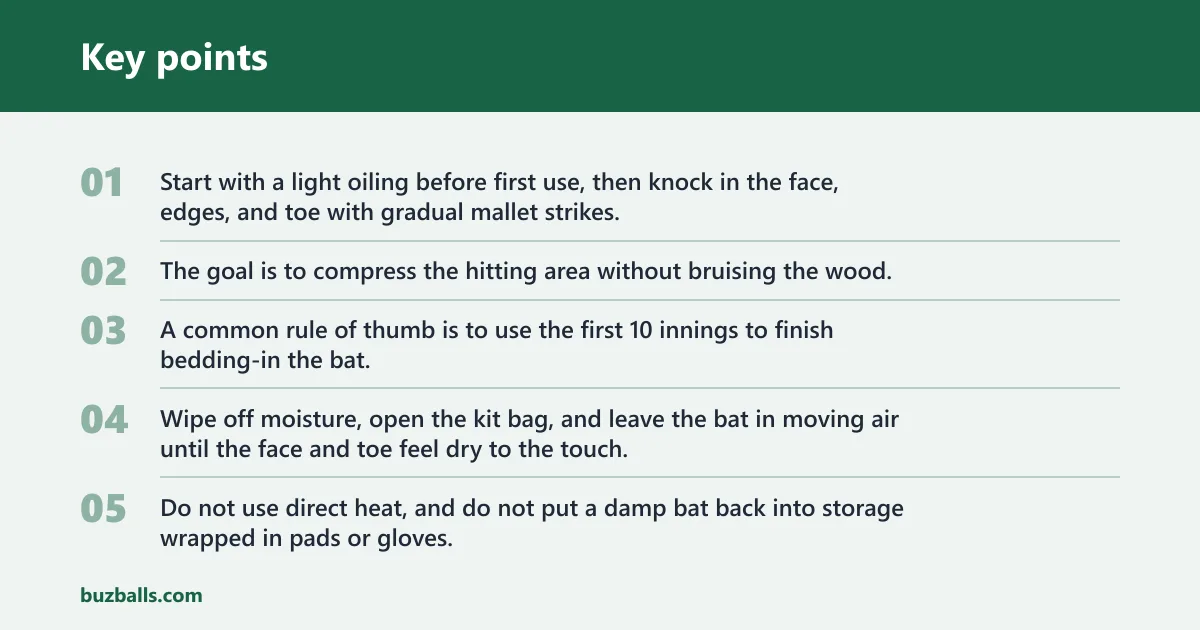
Start with a light oiling before first use, then knock in the face, edges, and toe with gradual mallet strikes. English willow benefits from a longer knock-in period because its softer fibres mark more easily; Kashmir willow still needs preparation, but it is usually less touchy about the pace of that work. The goal is to compress the hitting area without bruising the wood.
First 10 innings
A common rule of thumb is to use the first 10 innings to finish bedding-in the bat. Keep stroke intensity controlled, rotate contact across the face, and avoid treating either bat as fully ready straight away. A common first-timer mistake is to take an unprepared Kashmir willow bat straight into hard net batting and assume its denser face will protect it from all damage.
After wet play
Dry both bats immediately after wet play. Wipe off moisture, open the kit bag, and leave the bat in moving air until the face and toe feel dry to the touch. Do not use direct heat, and do not put a damp bat back into storage wrapped in pads or gloves.
Monthly storage and crack-checking
About once a month, check the face, edges, and toe for raised grains, hairline splits, or soft spots. Use the same inspection after any rain-affected session. Picture a club player leaving a lightly oiled English willow bat in a damp bag for a week; the first visible clue is often a dry face and a line of fine checking near the toe, not a dramatic break.
How often should you oil each bat?
Use oil sparingly on both bats. English willow usually needs more attention because it loses moisture more readily, while Kashmir willow needs less frequent oiling and should never be soaked. The right amount is a light film, not a glossy layer.
English willow oiling schedule
Oil before first use, then recheck the blade after periods of dry storage or sustained match play. A very light top-up is enough when the face looks dry or the grains start to feel rough. Over-oiling can soften the surface, add weight, and slow the bat’s response.
Kashmir willow oiling schedule
Oil only when the bat is dry enough to need it, or when the manufacturer recommends a light coat. Because Kashmir willow is denser and harder, it does not need frequent oiling to the same degree as English willow, and too much oil can still dull the face and add unwanted softness. Keep the application even and thin.
What oil to use and what to avoid
Use linseed-based bat oil or a product made for cricket bats. Avoid cooking oil, heavy varnish, and anything that leaves a sticky film. The aim is moisture control, not sealing the blade shut.
-
Clean the surface.
Brush off dust and wipe away dirt before oiling. A clean face takes an even coat and helps you spot existing cracks.
-
Apply a thin coat.
Use only enough to lightly cover the blade face and the vulnerable lower areas. Do not soak the splice, toe, or edges.
-
Let it absorb.
Allow the bat to rest until the oil is fully absorbed and the surface is dry to the touch. That reduces slickness and avoids a heavy, softened face.
Which willow bat cracks faster?
An English willow bat usually cracks faster if it is not maintained properly, because its softer, less dense wood is more sensitive to impact and moisture loss. Kashmir willow is tougher under heavy use, but it can still split if it is under-prepared, stored damp, or struck hard before the fibres have settled.
English willow surface cracks and dents
Small dents can be normal compression, especially after the bat has been pressed and begins to take impact. What matters is whether those dents stay shallow or turn into line cracks along the edges or face. If the bat has been neglected, English willow tends to show this earlier than Kashmir willow.
Kashmir willow wear patterns
Kashmir willow often shows more blunt wear: bruising, toe marks, and slower surface change rather than immediate fine checking. That does not make it maintenance-free. If the bat is left wet or under-prepared, the tougher exterior can hide internal stress until a split opens along an edge.
What damage needs closer monitoring
Watch for any crack that opens when the blade flexes, any split that travels from the edge into the face, and any toe damage that deepens after each session. A few dents are common. A spreading split is not.
How do you protect the face, edges, and toe?
Protect the face, edges, and toe with light surface protection, dry storage, and disciplined drying after wet play. These are the areas that take the most impact, collect the most moisture, and show the earliest signs of neglect.
Anti-scuff sheets and face protection
An anti-scuff sheet or similar face protection can reduce surface wear, especially on the hitting area and upper edges. It should sit on a prepared, dry blade, not on a wet or heavily oiled surface. Use it as a shield, not as a substitute for knock-in.
Drying after wet play
After a wet match, wipe the bat dry with a soft cloth and leave it in open air. Do not store it in a sealed kit bag, and do not warm it on a radiator or in direct sun. Heat and trapped moisture are a poor combination for both willow types.
Storage away from heat and damp
Keep the bat in a cool, dry place with airflow around it. Avoid basements, hot car boots, and damp changing-room corners. If the bat lives in a bag between sessions, open the bag after play so moisture can escape.
Suppose a junior player uses a Kashmir willow bat for backyard practice on a damp outfield, then puts it back into a closed bag. The next day, the face may still look fine, but the toe can feel softer and the first crack often starts where moisture sat longest. Drying the bat at once would have changed that outcome.
Choose an English willow bat if… / Choose a Kashmir willow bat if…
Choose an English willow bat if you want the higher-response option and you are ready to maintain it with lighter oiling, slower knock-in, and regular crack checks. Choose a Kashmir willow bat if you want a denser bat that handles harder use more readily, especially for juniors and casual players, but still needs proper preparation and drying.
Club players who train and play often
An English willow bat is the better fit if you play often, want a more responsive sweet spot, and are willing to give the bat the care it needs. Grade 1 English willow bats are positioned for domestic first-class cricketers and ambitious club players, and the cited guide says they need 40-50 playing hours to reach peak performance. Grade 2 bats are listed with a 50-65 hour break-in period, and Grade 3 English willow is priced at about USD 120-200 in the cited guide.
Juniors and casual players
A Kashmir willow bat is the better fit if you want a tougher bat for less frequent or less controlled use, or if you prefer a lower-cost entry point. CricCounty says Kashmir willow bats typically cost £25-£70, while English willow bats start around £80-£100 for Grade 3-4, which helps explain why many juniors and casual players begin with Kashmir willow before moving up.
Frequently asked questions
How do you care for an English willow bat differently from a Kashmir willow bat?
Care for English willow with lighter oiling, a more gradual knock-in, and tighter moisture control because it is softer and more prone to surface cracking. Care for Kashmir willow with the same basic routine, but you can usually move through the early preparation a little more firmly. Neither bat should be left wet or stored in heat.
Does Kashmir willow need less knocking-in than English willow?
Usually, yes, but not by much in principle. Kashmir willow is denser and harder, so it generally tolerates firmer preparation, while English willow needs a longer knock-in period and more gradual impact. Both bats still need proper bedding-in before serious play.
How often should you oil an English willow bat?
Oil an English willow bat before first use, then top up only when the blade starts to look dry or after longer storage. The coat should be light. Too much oil can soften the surface and reduce the clean rebound you want from the bat.
Can I use the same maintenance routine for both willow types?
You can use the same framework, but not the same intensity. Both need knocking-in, drying, storage away from damp, and crack checks. English willow needs more careful oiling and slower preparation, while Kashmir willow can usually take a slightly firmer but still controlled approach.
Which willow bat cracks faster if not maintained properly?
An English willow bat usually cracks faster if maintenance is poor, because its softer, less dense wood is more sensitive to moisture loss and repeated impact. Kashmir willow is tougher, but it is not immune; neglect can still lead to edge cracks, toe splits, and a dull, delayed response.
How do you protect a willow bat from moisture and surface damage?
Keep the bat dry after play, store it in a cool ventilated place, and use an anti-scuff sheet or other face protection on a prepared blade. Avoid wet kit bags, direct heat, and over-oiling. Moisture control matters as much as impact control for both willow types.