Cricket Bat Size Guide by Height: How to Match Bat to Player

Choose bat size by height first. If a player stands between sizes, pick the smaller bat unless they can keep a natural stance and balanced pickup with the larger one and tap the toe to the ground without strain. The wrong size hurts control, timing, and confidence, and a bat that is too long or heavy can be unsafe. This guide gives a height-to-size chart, a simple between-sizes decision rule, and a quick control test before you buy.
Use height and control to choose the right bat
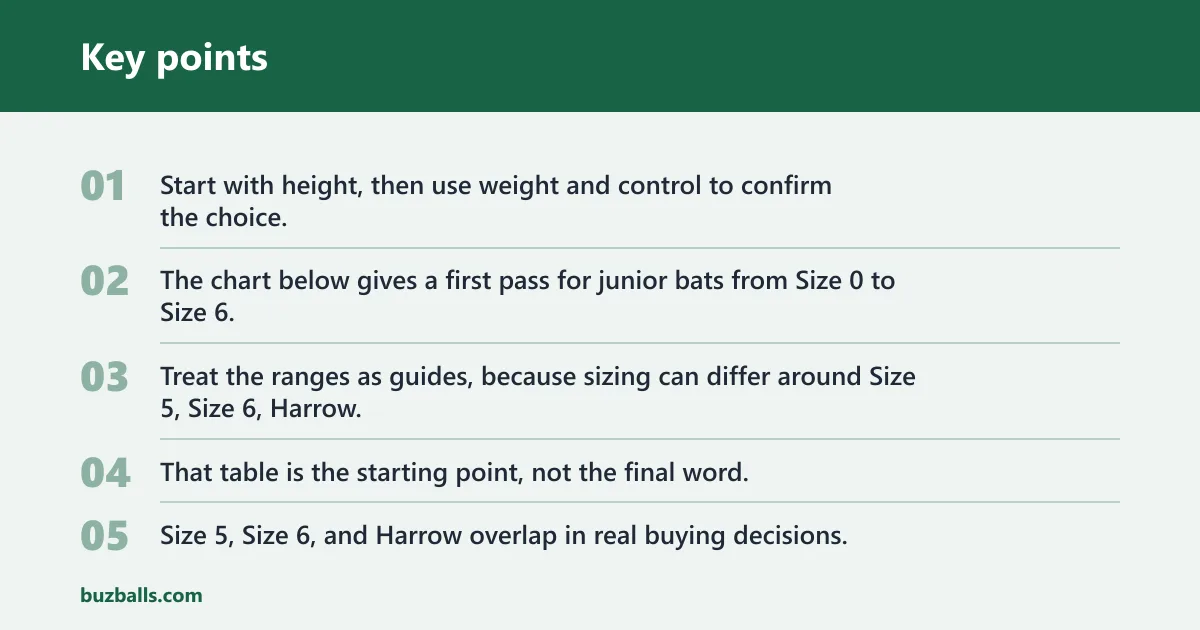
Start with height, then use weight and control to confirm the choice. The chart below gives a first pass for junior bats from Size 0 to Size 6, plus Harrow and adult options. Treat the ranges as guides, because sizing can differ around Size 5, Size 6, Harrow, and adult sizes.
Bat size decision table
| Measured height | Likely bat size | Control test to pass before moving up |
|---|---|---|
| Under 4’0″ / 122 cm | Size 0 | Can lift the bat one-handed by the handle and set the toe down without tipping the shoulder or bending the wrist sharply. |
| 4’0″–4’3″ / 122–130 cm | Size 1 | Can hold the bat at arm’s length, then make a smooth backlift and controlled downswing without dragging the blade. |
| 4’3″–4’6″ / 130–137 cm | Size 2 | Can complete a short defensive block and recover the bat without the hands dropping below the knees. |
| 4’6″–4’9″ / 137–145 cm | Size 3 | Can swing through a straight drive and finish the follow-through without the top hand collapsing or the bat feeling late. |
| 4’9″–5’0″ / 145–152 cm | Size 4 | Can hold the bat one-handed for a brief pause and still keep the blade under control at the end of the downswing. |
| 5’0″–5’3″ / 152–160 cm | Size 5 | Can lift the bat cleanly, keep the backlift upright, and stop the blade on line without shoulder strain. |
| 5’3″–5’5″ / 160–165 cm | Size 6 | Can repeat three controlled swings in a row without the bat pulling the body off balance. |
| 5’5″–5’7″ / 165–170 cm | Harrow | Can handle the longer feel of the bat without losing bat speed or changing the grip to compensate. |
| 5’6″–6’2″+ / 175–183+ cm | Short Handle | Can keep the pickup light enough for clean defensive shots and attacking shots with the same stance. |
| Taller adults who want a longer overall feel | Long Handle | Can still keep the bat balanced in the hands before choosing the longer option. |
That table is the starting point, not the final word. Size 5, Size 6, and Harrow overlap in real buying decisions, so the control test decides whether a player stays put or moves up. A common rule of thumb from another guide places Size 5 at 4’11″–5’2″, which shows why border cases need a hands-on check rather than a number alone.
Read the chart this way: the lower end of a range usually fits better for control, while the upper end can work only if the bat still feels light in action. Bigger is not automatically better. A bat can fit the range and still feel too heavy.
How do you measure height for sizing?
Measure without shoes, with the player standing straight against a wall, because shoe height can move someone across a boundary. Use feet and inches and also note centimeters, since bat charts often list both. Recheck after a growth spurt, especially if the player has moved close to Size 5, Size 6, or Harrow.
Simple at-home steps
- Stand the player flat-footed against a wall with heels down.
- Keep the head level and the shoulders relaxed.
- Mark the top of the head with a straight object or pencil edge.
- Measure from the floor to the mark in feet/inches and centimeters.
- Use that number to find the range in the chart, then check the bat in hand.
If the measurement falls right on a boundary, use the lower size as the default. That avoids the common problem of choosing a bat that is technically within range but awkward in the hands. Height gives the first answer. Control gives the final answer.
What if you’re between two sizes?
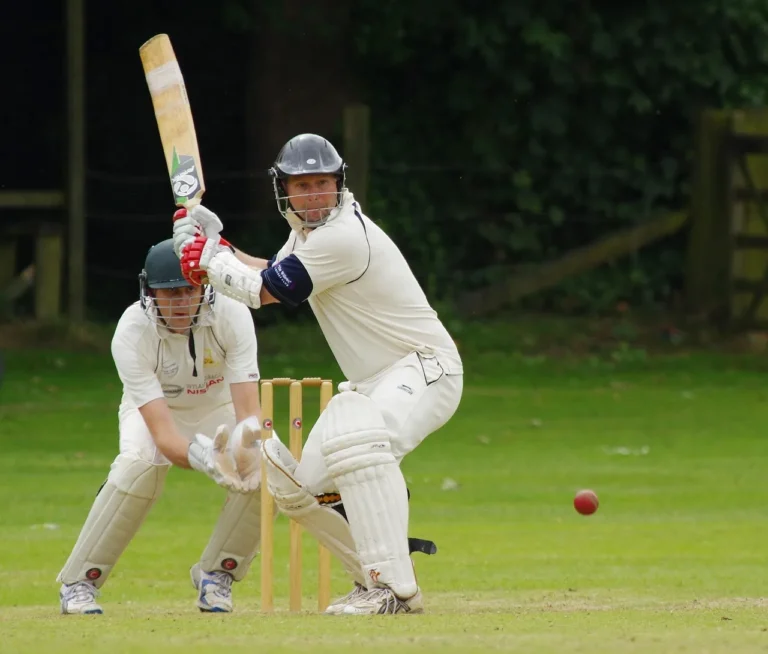
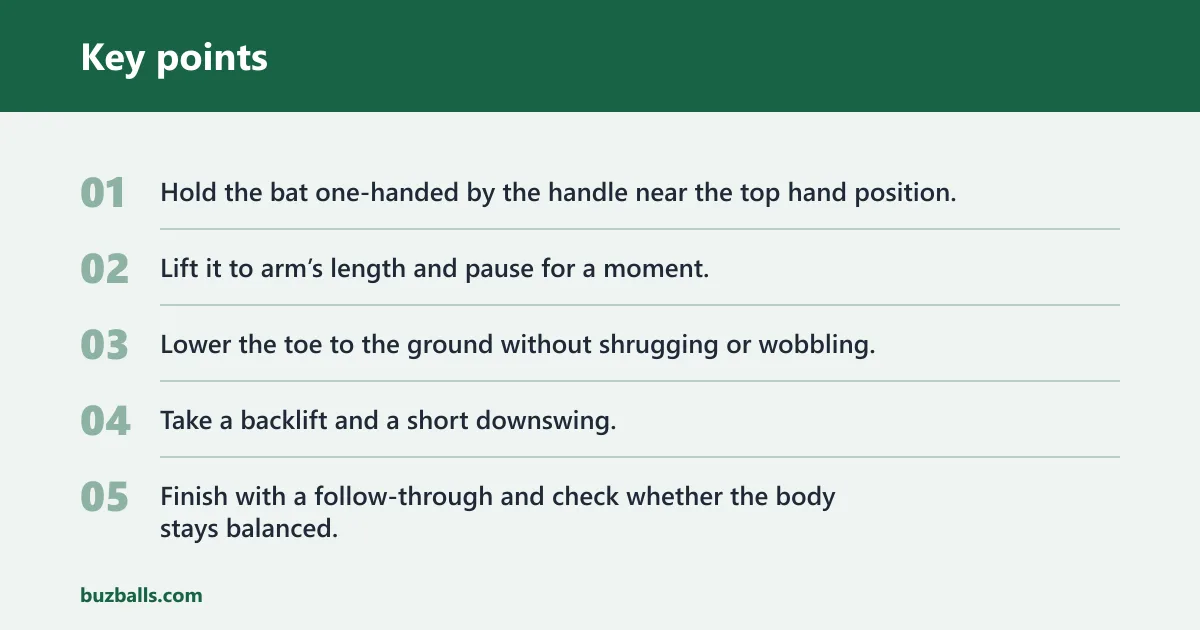
Choose the smaller bat unless the larger one passes a simple control test. The player should be able to hold the bat with a natural stance, then tap the toe to the ground without strain, and still make a smooth backlift, downswing, and follow-through. If any part looks forced, stay with the smaller size. Coaches and many brands focus on overall stance and toe-to-ground fit first, not the arm’s-length test alone.
That rule matters most around Size 4/5, Size 5/6, and Size 6/Harrow. Those are the places where charts overlap and brand charts can drift. The label alone does not settle it. A bat that looks close on paper can still change stance, reach, and timing in practice.
Control test before moving up
- Hold the bat one-handed by the handle near the top hand position.
- Lift it to arm’s length and pause for a moment.
- Lower the toe to the ground without shrugging or wobbling.
- Take a backlift and a short downswing.
- Finish with a follow-through and check whether the body stays balanced.
Judge pickup, not sticker weight. Listed weight and pickup are different things. Pickup is how the bat feels in the hands, and balance matters more than the number printed on a label. A bat with a heavy toe can feel slower than a slightly heavier bat with better mass distribution.
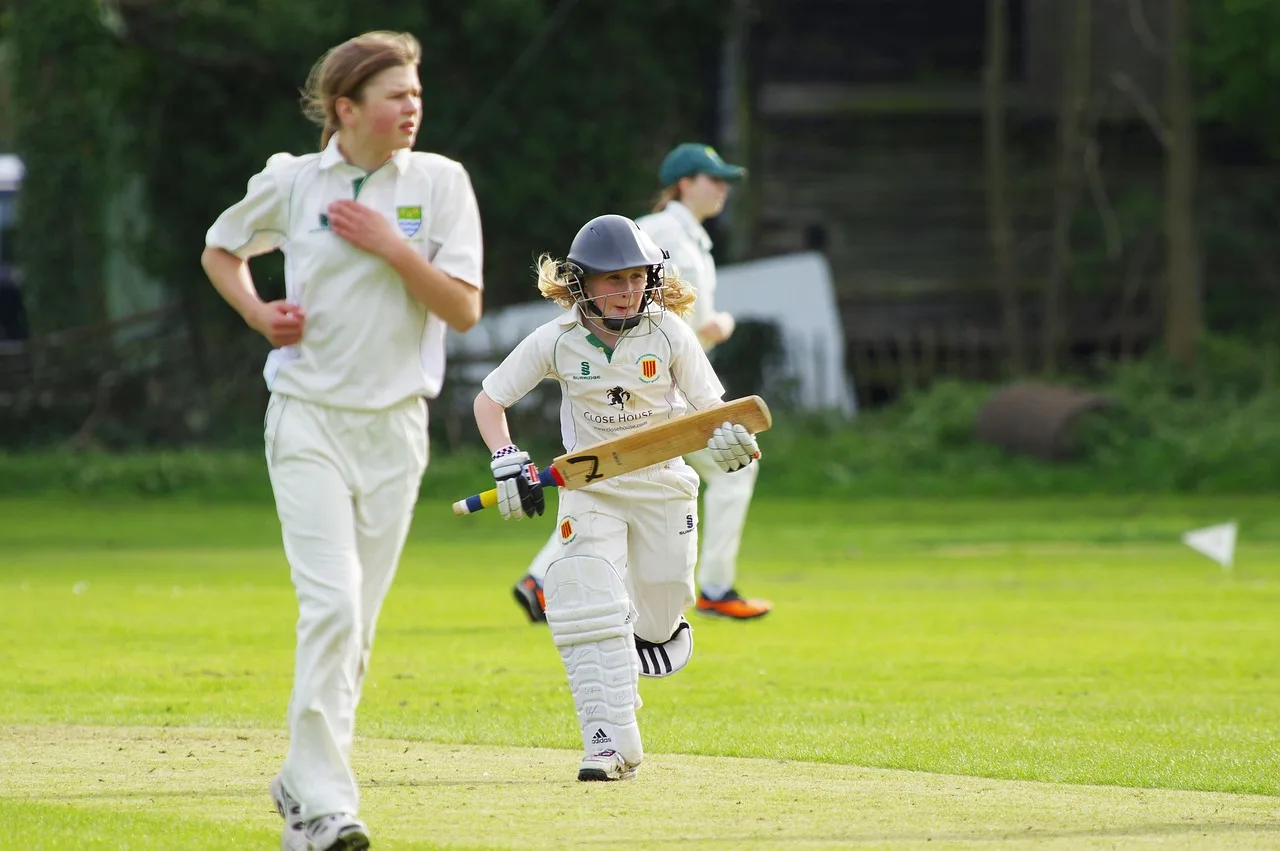
Suppose a child measures 4’11”. Size 5 is the safer first choice. If the Size 6 bat feels fine at rest but the bottom hand tightens, the downswing slows, or the follow-through wobbles, the larger bat is too much. Pick the smaller size and keep the swing clean.
How bat weight affects control
Heavier bats reduce bat speed, which can make timing harder for juniors and smaller adults. That does not mean every light bat is good. The real question is whether the player can move the bat quickly enough to keep the backlift controlled and the blade on line through the shot.
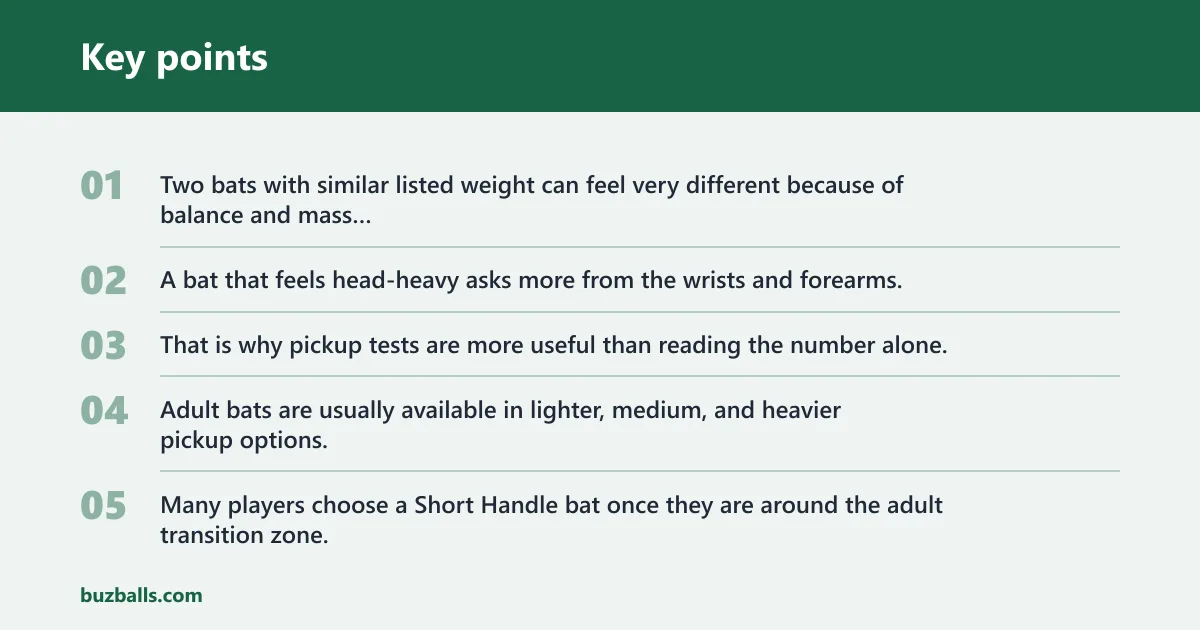
What matters most is pickup. Two bats with similar listed weight can feel very different because of balance and mass distribution. A bat that feels head-heavy asks more from the wrists and forearms, even when the label looks reasonable. That is why pickup tests are more useful than reading the number alone.
Weight bands for adult bats
Adult bats are usually available in lighter, medium, and heavier pickup options, and the best choice is the one the player can swing without losing control. Many players choose a Short Handle bat once they are around the adult transition zone. Taller adults may prefer a Long Handle if the extra length still lets them keep control in defensive and attacking shots.
Do not move up simply because the player is growing fast. A bat chosen for future growth can alter the stance, reach, and swing path right away. That can slow development instead of helping it. Buy for the body the player has now.
Harrow and adult bat sizes
Harrow is the bridge between junior bats and adult bats. It is the next step above Size 6, and Short Handle is the standard adult option after Harrow once the player needs a longer bat but still wants control.
When Short Handle becomes the better option
Short Handle is the standard adult bat option and suits most adult players. It often fits roughly 5’6″ to 6’2″+ depending on brand, but the practical question is still control. If Harrow already feels cramped in the stance or short on reach, Short Handle is the next step.
When Long Handle makes sense
Long Handle is an optional adult alternative for taller players or anyone who wants a longer overall feel. It is not the default choice. Use it only if the player can still keep the bat balanced and avoid changing technique to manage the extra length.
A common first-timer mistake is buying Harrow for a player who has the height for Short Handle but still needs the lighter pickup of a junior-feel bat. That can work for some players, but only if the control test passes cleanly. If not, the shorter, lighter-feeling option is safer.
What cricket bat size should I get for my height?
Use height as the starting point, then confirm with pickup and control. The right bat is the one the player can lift cleanly, set down without strain, and swing without changing technique. If the player sits between ranges, choose the smaller size unless the larger bat passes the arm’s-length and toe-to-ground test.
How do I know if a cricket bat is too big for me?
A bat is too big if the player cannot hold it comfortably at arm’s length, the toe drags awkwardly, or the swing changes because the bat feels late or heavy. Watch for altered stance, shortened backlift, and a weaker follow-through. Those are control problems, not just comfort issues.
Should I choose a cricket bat by height or age?
Choose by height first. Age can help as a rough guide, but it does not fit every child because growth rates vary. A shorter 12-year-old may need a different size from a taller 10-year-old, and the wrong guess can create control problems even when the age looks “right” on paper.
What bat size is right for a child who is between two sizes?
Start with the smaller size, then test the larger one only if the child can lift it cleanly and keep the bat under control through the swing. Between sizes is where weight and pickup matter most. If the larger bat changes the stance or slows the bat speed, stay smaller.
How do I measure my height for a cricket bat size chart
Measure without shoes, standing straight against a wall. Record the height in feet/inches and centimeters, since charts may use either. Recheck after a growth spurt, because even a small change can move a child from Size 4 to Size 5, or from Size 6 into Harrow.
What size cricket bat should a 10-year-old use?
A 10-year-old could fit several sizes, so height should decide the answer. Many players in that age group land around Size 3, Size 4, or Size 5, but the useful rule is the same: measure first, then test pickup. Age alone cannot tell you whether the bat is too long or too heavy.
What size cricket bat should a 12-year-old use?
A 12-year-old often sits near Size 5, Size 6, or Harrow, depending on height and build. The chart should narrow the choice, but the final check is still control. If the larger bat changes backlift, downswing, or follow-through, the smaller size is the better match.
Is Harrow bigger than Size 6?
Yes. Harrow is the next step above Size 6 in the usual junior-to-adult transition. The overlap is small, though, and different charts can vary around that boundary. That is why the hand test matters: if Size 6 still feels secure, stay there; if not, test Harrow next.
Should a taller player always use an adult bat?
No. Height helps, but adult bats are only right when the player can still control the pickup and keep the swing clean. A taller junior may still need Harrow or a lighter-feeling option before moving to Short Handle. The right bat is the one that preserves technique.
What happens if I use the wrong cricket bat size?
The player may lose control, mistime the ball, and compensate with a changed stance or shorter swing. Too much length or weight can also make defensive shots awkward and attacking shots late. The result is usually less confidence and weaker technique, not a simple power gain.
Parent checklist for growth spurts versus immediate fit
- Measure height without shoes before buying.
- Default to the smaller size when the player is between ranges.
- Test pickup with one hand before choosing the larger bat.
- Check backlift, downswing, and follow-through for strain or wobble.
- Do not buy a larger size only for future growth.
- Recheck height after a growth spurt and adjust then, not before.