

What Does Tennis Racket Grip Size Mean and Why Does It Matter?

Tennis racket grip size is the handle circumference, usually measured in inches or millimeters. If you fall between sizes, start with the smaller grip and add an overgrip if the handle feels thin. A grip that is too small can make you squeeze harder and shift under impact. A grip that is too large can limit wrist action and reduce control. This guide explains what the number means, how to measure it accurately, and why handle shape can make two “same-size” grips feel different.
Quick answer
Tennis racket grip size is the circumference of the handle, not the racket’s head size, length, weight, balance, or string pattern. A standard full-size adult racket is 27 inches long, but that length says nothing about how thick the handle feels in your hand.
That distinction matters because the printed size is only a starting point. Two rackets with the same listed grip can feel different once you add a replacement grip or overgrip, or when one brand’s bevels are shaped more sharply than another’s.
What do L0 to L5 mean?
In European sizing, grip labels run from L0 to L5. They map to inch sizes from about 4 inches through 4 5/8 inches, and the common retail range usually stays within that span. Availability can vary by brand and region, so always check the retailer listing for the exact model.
| European label | US size | Approximate circumference |
|---|---|---|
| L0 | 4 inches | about 101.6 mm |
| L1 | 4 1/8 inches | about 104.8 mm |
| L2 | 4 1/4 inches | around 108 mm |
| L3 | 4 3/8 inches | around 111.1 mm |
| L4 | 4 1/2 inches | around 114.3 mm |
| L5 | 4 5/8 inches | about 117.5 mm |
The millimeter numbers help when you compare models from different brands, because the same labeled size may not feel identical after grip wrap, bevel shape, and manufacturing tolerances are factored in. Check the butt cap or throat label, then verify the retailer’s spec sheet before you buy.
How do you measure grip size at home?
Use a rigid ruler or tape measure and take the reading from the lower horizontal palm crease to the tip of the ring finger. Repeat the measurement at least twice, and use the same starting crease each time. Starting from the wrong palm crease can shift the result by a few millimeters.
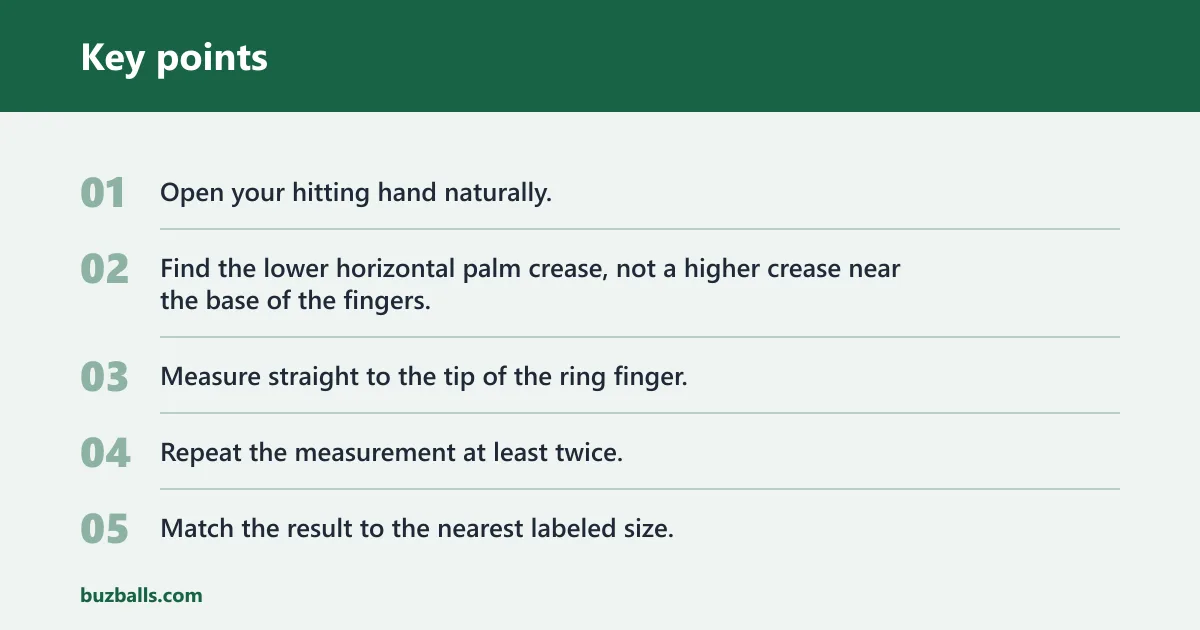
- Open your hitting hand naturally.
- Find the lower horizontal palm crease, not a higher crease near the base of the fingers.
- Measure straight to the tip of the ring finger.
- Repeat the measurement at least twice.
- Match the result to the nearest labeled size, then confirm with an in-person check if needed.
A phone screen ruler can throw off the result if the scale is not calibrated, so avoid it for the main measurement. A rigid ruler or tape gives a cleaner reading, and repeating the process helps catch hand position mistakes.
| Measured hand length from lower palm crease to ring-finger tip | Recommended L size | Adjustment note |
|---|---|---|
| Up to about 102 mm | L0 | Choose smaller if you are on the edge; test in-person if comfort is a concern |
| About 103-105 mm | L1 | Choose smaller if you are between sizes |
| About 106-108 mm | L2 | Good midpoint for many players; add an overgrip if the handle feels slightly thin |
| About 109-111 mm | L3 | Choose smaller if your reading sits between L2 and L3 |
| About 112-114 mm | L4 | Test in-person if you have grip pain or want a precise feel at the bevels |
| About 115 mm and above | L5 | Confirm against the racket listing; availability varies more at the top end |
Picture a player measuring 108 mm one day and 111 mm the next because the ruler started on a different crease. That difference can move the choice from L2 to L3, which is why the starting point matters as much as the number itself.
Common measurement errors
| Error | Typical effect on the result |
|---|---|
| Starting from the wrong palm crease | Several millimeters too high or too low |
| Using a flexible tape loosely or crooked | About 1-3 mm off |
| Using a phone ruler without calibration | Several millimeters off, sometimes more |
| Measuring only once | Harder to spot a small reading error |
| Changing hand posture between readings | Several millimeters of variation |
Why does tennis racket grip size matter?
Grip size affects how securely you can hold the racket and how freely your wrist can move. Too small, and many players squeeze harder than they should. Too large, and the handle can limit comfort and make fine adjustments harder during swings, volleys, and serves.
Handle shape changes the real feel too. Bevels, replacement grip thickness, and any overgrip can make the same labeled size feel flatter, rounder, or fuller in the hand. That is why the number on the butt cap is only part of the fit picture.
Too-small grips can lead to blisters because your hand has to clamp harder to keep the racket from shifting. They can also contribute to tennis elbow by increasing forearm strain. Too-large grips are different: they usually hurt feel first, then control, because the handle can slow wrist action and make the racket less precise at contact.
A common first-timer mistake is choosing by hand size alone and ignoring bevel feel. Two rackets labeled L3 can feel different if one has a thinner base grip and sharper bevels, while the other has a thicker wrap stack that softens the edges.
Can you make a tennis racket grip bigger?
You can make a grip slightly bigger with an overgrip. That is the usual fix when you are between sizes, or when you want a little more padding and a softer feel. An overgrip adds size and comfort, but it cannot truly make a handle smaller.
If you are between two sizes, the smaller grip is usually the safer pick. Then you can add an overgrip if the handle feels too lean. That approach gives you more room to adjust upward than to recover from a handle that starts too large.
Suppose a player is between L2 and L3, wants a firmer feel, and gets slight hand fatigue late in matches. Starting with L2 leaves room to add an overgrip and still stay within a manageable range. Starting with L3 leaves less room to correct a handle that already feels bulky.
Where is grip size marked on a tennis racket?
Grip size is often printed or engraved on the butt cap, and it may also appear on a throat label. Check both places, then compare the marking with the retailer listing, because markings and available sizes can vary by brand and region.
If the racket was strung or regripped before sale, the visible marking may not tell the whole story about how the handle now feels. A labeled L3 can feel closer to a generous L3 or a snug L3 depending on the wrap stack.
Is grip size the same as handle shape or hand size?
No. Grip size is the handle circumference, while handle shape refers to the bevel geometry and how the edges meet your fingers. Hand size helps you estimate a starting point, but it does not guarantee the final feel once grip layers and bevel shape are added.
That is why two players with similar hand measurements can prefer different sizes, and why one brand’s L3 may feel more open or more compact than another’s. The label is the starting specification. The shape and wrap build are what your hand actually meets.
Frequently asked questions
What does tennis racket grip size mean?
It means the circumference of the handle, usually given in inches or millimeters. It is separate from racket length, head size, weight, and string pattern, so you should treat it as a fit measurement rather than a general racket spec.
How do you measure tennis racket grip size at home?
Measure from the lower horizontal palm crease to the tip of the ring finger with a rigid ruler or tape. Repeat the measurement at least twice, use the same crease each time, and then compare the result with the L0-L5 chart.
What happens if my tennis grip size is too small?
You may squeeze harder, which can lead to blisters and more forearm strain. A grip that is too small can also make the racket feel less stable on off-center contact, because your hand is doing more of the work to hold the handle in place.
What happens if my tennis grip size is too big?
A grip that is too big can feel bulky and reduce comfort. It can also make fine wrist movement harder, which matters on quick exchanges, serves, and shots that depend on fast racquet-head adjustment.
Should I choose the smaller grip size if I’m between sizes?
Yes. The smaller size is usually the safer choice, because you can add an overgrip if needed. That gives you a little more size and comfort without locking you into a handle that already feels too large.