
How to Pick a Good Tennis Racket for New Players

Pick a 27-inch adult racket with a head size around 100 square inches, a lighter strung weight of roughly 10.0–10.8 ounces, and a grip size that lets your index finger fit between fingertips and palm. Too much weight, or too small a head, usually leads to mishits, late contact, and sore wrists before a new player builds clean strokes. This guide explains how to choose a good tennis racket for new players by matching swing effort, contact consistency, and arm comfort to exact specs.
What you’ll need before buying
- A ruler or tape measure for grip size.
- Your height and a rough sense of upper-body strength.
- A basic budget range before you browse.
- A short list of rackets with listed head size, strung weight, balance, length, and string pattern.
- If possible, a way to hold or demo the frame before you buy.
How to choose the right racket
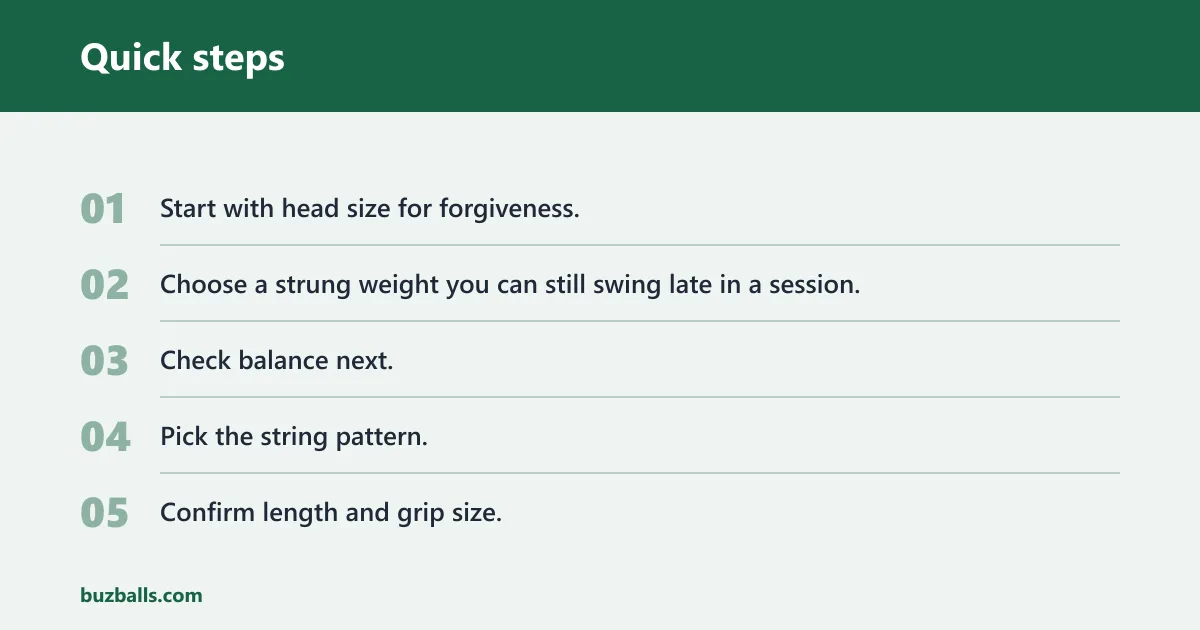
- Start with head size for forgiveness. Beginners usually do best in the 105–110 sq in range, where the hitting area is easier to find.
- Choose a strung weight you can still swing late in a session. Many new players do better with a racket in the roughly 9–10 oz range than with one closer to 11–12 oz.
- Check balance next. Head-light frames are easier to maneuver; head-heavy frames add built-in power; even balance sits between them.
- Pick the string pattern. A 16×19 pattern gives easier spin and more forgiveness, while 18×20 leans toward control.
- Confirm length and grip size. Standard length is 27 inches, and the grip should let you hold without squeezing.
- Choose a comfort-first string. Multifilament or synthetic gut is a better first choice than polyester for most new players.
Set your specs in the right order
Put forgiveness first, then swing effort, then comfort. A beginner frame should help you make contact, keep the racquet moving through the ball, and avoid wrist or forearm fatigue after about 30 minutes. That order matters more than brand names or paint jobs.
Say your contact is late on forehands and your wrist feels tight after a short hit.
What head size is best for a new player?
For most new players, 105–110 sq in is the sweet spot. Bigger heads add forgiveness and easy power, which helps when contact is off-center. Oversize heads are commonly considered to start around 106 sq in, and beginner rackets often have at least about 105 sq in for that reason.
When bigger heads help
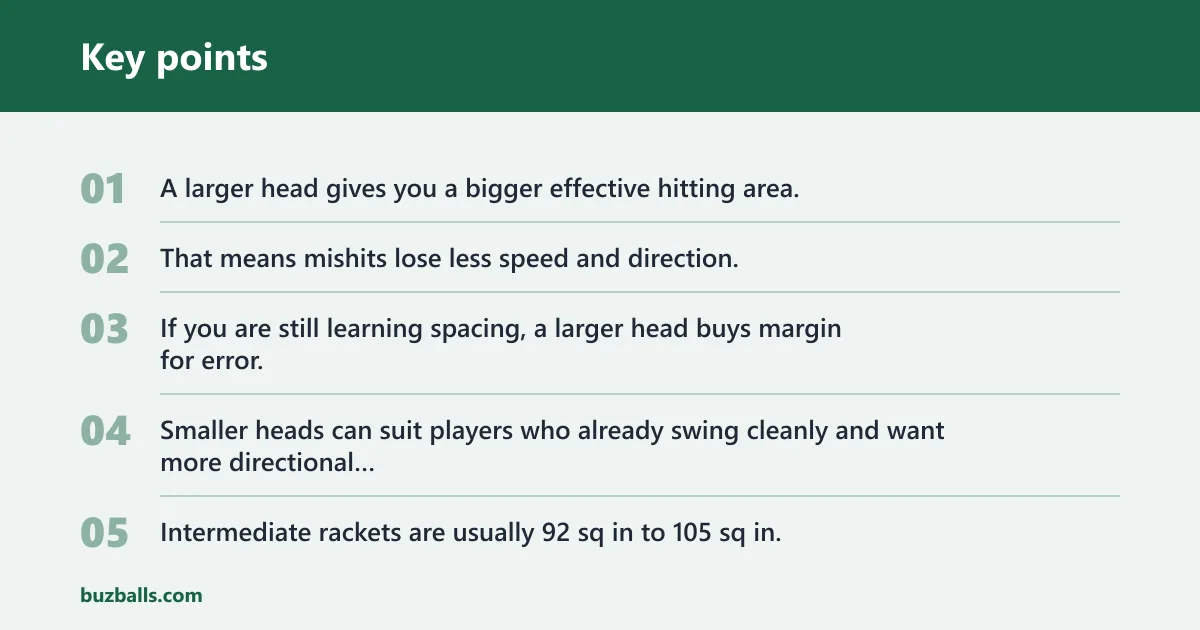
A larger head gives you a bigger effective hitting area. That means mishits lose less speed and direction, so your serve return and rally balls stay in play more often. If you are still learning spacing, a larger head buys margin for error.
When a smaller head can make sense
Smaller heads can suit players who already swing cleanly and want more directional control. Intermediate rackets are usually 92 sq in to 105 sq in, and advanced rackets can begin at 88 square inches. Those sizes make more sense after you can find the ball early and center it often.
How much should a beginner tennis racket weigh?
Most adult beginner rackets sit in the 9–12 ounces strung range. New players often do best around 9–10 oz because the frame accelerates more easily. Heavier frames around 11–12 oz add stability, but they can tire a beginner faster and make late-session strokes break down.
Choose weight for the last 10 minutes
Light rackets feel easy at first, but some become shaky against faster balls. Heavier rackets resist twisting better on contact. Pick the heaviest frame you can still swing with clean mechanics after 30 minutes, not the lightest frame on the shelf.
Picture a beginner who can hit fine for the first half hour, then starts lifting the arm and flinging the racket. That often points to a frame that is too heavy, too head-heavy, or both.
Beginner racket fit matrix
| Player profile | Recommended head size | Strung weight | Balance | String pattern | What mistake to avoid |
|---|---|---|---|---|---|
| Very new | 105–110 sq in | 9.0–9.6 oz | Even-balanced or slight head-light | 16×19 | Buying a dense control frame too early |
| Athletic beginner | 100–105 sq in | 9.6–10.2 oz | Head-light | 16×19 | Choosing a heavy demo that slows your swing |
| Casual adult | 105–110 sq in | 9.2–10.0 oz | Even-balanced | 16×19 | Overspending on an advanced control frame |
| Smaller-framed adult | 105–110 sq in | 9.0–9.6 oz | Head-light | 16×19 | Picking a grip that is too large to hold relaxed |
| Arm-sensitive beginner | 105–110 sq in | 9.0–9.4 oz | Even-balanced | 16×19 with multifilament or synthetic gut | Using polyester strings too soon |
| Returning player | 100–105 sq in | 9.6–10.6 oz | Head-light or even-balanced | 16×19 | Assuming an old frame still fits your current swing |
Common mistakes to avoid
Buying too much control too early is the most common miss. A dense 18×20 frame can feel precise, but it usually asks more of your timing than a true beginner can give. Start with a larger head and easier swing, then move toward control later.
Grip size matters just as much. A grip that is too small can reduce control and increase wrist strain, while one that is too large can limit comfort and wrist freedom. Standard sizing should let you hold the handle without white-knuckling it.
Do not pick polyester strings on day one. A beginner-friendly setup usually starts with multifilament or synthetic gut. Also avoid long or heavy demo frames if they make your contact late, and keep standard adult length in mind at 27 inches. Extended lengths run 27.25–27.5 inches.
Simple yes-or-no checks
If you answered yes to “my arm gets tired fast,” choose the lighter end of the adult range and a softer string. If you answered yes to “I miss the center of the string bed often,” move to a larger head. If you answered yes to “my grip feels cramped,” go up a grip size before you change anything else.
Suppose a new player is athletic, but every forehand floats long. The mistake is often not fitness; it is a frame that is too light, too head-heavy, or strung too loosely for the swing path. Keep one variable the same and change one spec at a time.
Frequently asked questions
What is a good tennis racket for a new player?
That mix gives easy power, more forgiveness on mishits, and less strain while you learn clean contact.
Which tennis racket is best for me as a beginner?
If you are new, start with the frame that helps you swing without forcing it. For most beginners, that means a larger head, lighter strung weight, standard 27-inch length, and a comfort-first string such as multifilament or synthetic gut.
What makes a good tennis racket for beginners?
It makes the ball easier to hit well. The best beginner rackets reduce the penalty for off-center contact, keep fatigue lower, and give enough stability to rally without feeling like the frame is doing all the work.
What tennis racket should I buy first?
Buy the racket that matches your current swing, not your long-term goal.
How does grip size affect racket choice?
Grip size changes control and comfort. Too small can make the handle twist in your hand and irritate the wrist. Too large can block relaxed movement. Choose the size that lets you hold the racket securely without squeezing hard.
Should a new player choose power or control?
Power first, control second. Beginners need help getting the ball over the net and into the court, so a larger head and easier swing matter more than a dense, control-heavy setup. Control can come later as timing improves.