Type 1, Type 2 and Type 3 Tennis Balls: What Is Different?

ITF tennis balls come in three speeds: Type 1 is fast, Type 2 is medium, and Type 3 is slow. Pick them by the pace you want, not by court surface alone. Choose the wrong type and rallies can feel too quick or too flat, which hurts timing, control, and training value. This guide explains what each type is, who should use it, and how to match ball speed to court, player level, and practice goal.
Tennis ball types at a glance
Type 1, Type 2, and Type 3 are ITF speed labels. They are approved ball categories, but they are separate from everyday retail labels such as regular-duty and extra-duty. That split is where many buyers get tripped up.
For practical buying, start with three questions: how fast you want the ball to travel, where you play, and who is hitting it. Then decide whether you need a match-style ball, a practice ball, a junior ball, or a special-case ball for altitude or a machine.
What are Type 1, Type 2, and Type 3 tennis balls?
Type 1 is the fastest approved category, Type 2 is the standard medium-speed category, and Type 3 is the slower approved category. Those labels refer to ball speed, not felt thickness, pressure level, or surface design. That is why they should not be treated as the same thing as retail duty labels.
Type 1: fastest approved category
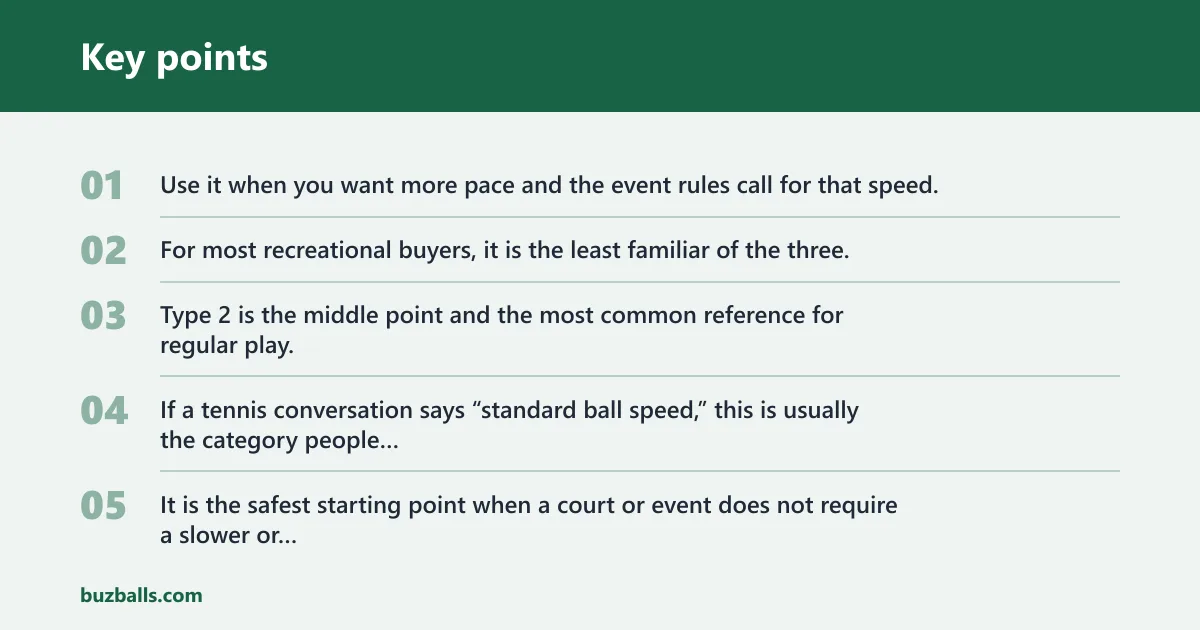
Type 1 is built for faster play. Use it when you want more pace and the event rules call for that speed. For most recreational buyers, it is the least familiar of the three, so it matters most when you are buying to a specific speed spec.
Type 2: standard medium-speed category
Type 2 is the middle point and the most common reference for regular play. If a tennis conversation says “standard ball speed,” this is usually the category people mean. It is the safest starting point when a court or event does not require a slower or faster approved ball.
Type 3: slower approved category
Type 3 is the slower approved category and is designed for slower play. That can help when a court, ball flight, or player group needs less pace. It is still an approved category, but its value is tied to speed control rather than surface branding.
Difference between type 1 matrix
This comparison helps separate speed labels from the retail labels most shoppers see on cans. Use it as a quick filter before you compare pressure, felt, or junior balls.
| Category | Speed | Intended use | Overlap with match play | Common buyer confusion |
|---|---|---|---|---|
| Type 1 | Fastest approved category | Designed for faster play | Used when a faster approved ball is required | People mix it up with extra-duty felt or assume it is a “premium” retail ball |
| Type 2 | Standard medium-speed category | Regular play and the common default | Closest match to everyday match-ball expectations | Buyers assume “Type 2” means regular-duty felt, but it does not |
| Type 3 | Slower approved category | Designed for slower play | Used when slower approved speed is required | Some buyers confuse it with low-compression junior balls, which are different |
A useful shorthand: Type 1 is the pace-up option, Type 2 is the baseline, and Type 3 is the pace-down option. The category tells you speed, not whether the felt is regular-duty, extra-duty, pressureless, or low-compression.
Do these types matter for match play?
Yes, but mainly when an event or governing rule calls for a specific ITF speed category. Type 1, Type 2, and Type 3 are approved ball categories, so they can matter in sanctioned play. For casual buyers, the label often matters less than choosing a ball that fits the court, climate, and training goal.
Suppose a coach wants a faster rally pattern for older juniors on a standard court. Type 1 may fit that goal better than a standard retail can with no speed focus. Now suppose the same group is learning timing and consistency; Type 2 is usually the safer starting point because it behaves like the common match reference.
For recreational players, the type label is often secondary. If the can says regular-duty, extra-duty, pressureless, or low-compression, that retail label usually gives the more useful clue for everyday buying.
How do they relate to pressure and felt?
Type 1, Type 2, and Type 3 are speed categories, while pressure and felt describe construction and feel. Pressurized balls have internal air pressure, give a lively bounce when fresh, and lose bounce as pressure escapes. Pressureless balls get bounce from the rubber shell, last longer, and feel firmer.
Pressurized versus pressureless tennis balls
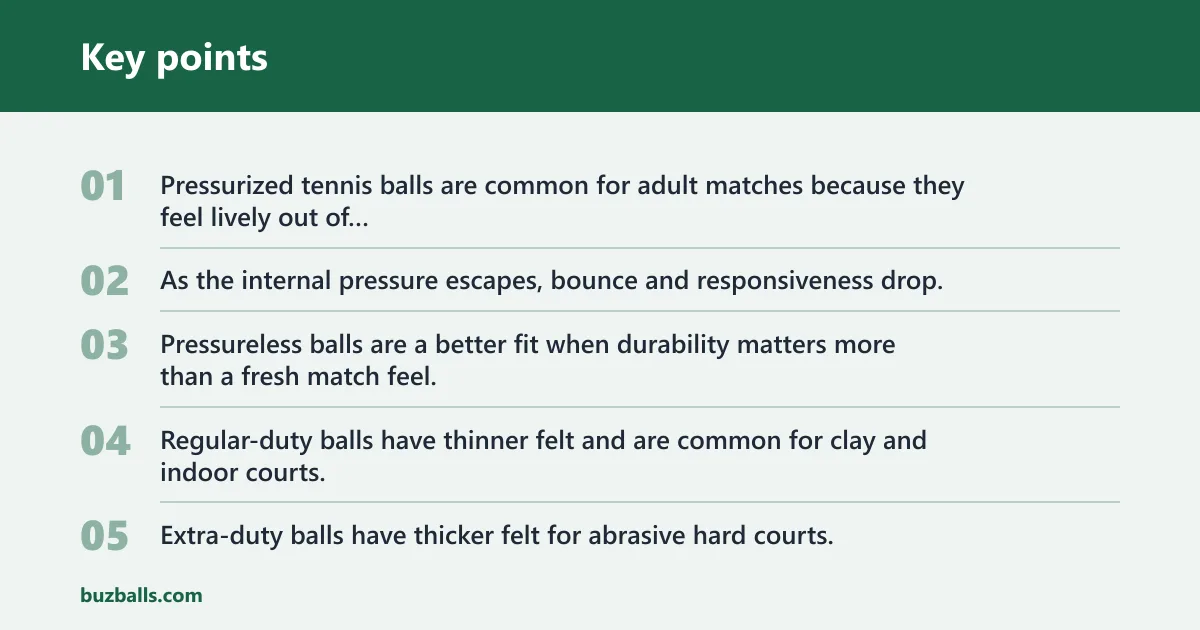
Pressurized tennis balls are common for adult matches because they feel lively out of the can. As the internal pressure escapes, bounce and responsiveness drop. Pressureless balls are a better fit when durability matters more than a fresh match feel, especially for ball machines and frequent practice.
Regular-duty versus extra-duty felt
Regular-duty balls have thinner felt and are common for clay and indoor courts, where they are less likely to collect loose clay. Extra-duty balls have thicker felt for abrasive hard courts, and that thicker covering can fluff up during play. This felt choice is separate from Type 1, Type 2, and Type 3.
Low-compression and altitude balls
Low-compression balls are slower-bouncing balls for children and developing players, with red, orange, and green-dot stages. Red balls are the slowest in the junior progression. Altitude tennis balls are designed for high-altitude locations, where thinner air can make the ball livelier.
A common first-timer mistake is buying a pressureless can for a match where the player expects a lively, fresh bounce. That can feel firm and flat compared with a pressurized match ball. The reverse mistake is using a worn pressurized ball for drill work and blaming the player’s timing when the ball itself has gone dull.
Which tennis ball should you buy?
Choose the ball for the job in front of you. Match the ball to the surface, the player level, and the training goal, and you avoid most bad buys. Type 1, Type 2, and Type 3 matter most when speed is the point; retail labels matter most when the court and use case drive the choice.
Choose this if you play on hard courts
Pick extra-duty felt for most abrasive hard-court use. The thicker felt is built for that surface and is less likely to wear too quickly. If your court is very lively or you are at altitude, check whether an altitude ball is the better match before you default to a standard can.
Choose this if you play on clay or indoors
Pick regular-duty felt for clay and indoor courts. The thinner felt is a better fit when loose clay is part of the equation, and it is also a common everyday choice indoors. If speed is the main concern, then compare the court need against the ITF Type 1, Type 2, or Type 3 label.
Choose this if you use a ball machine or practice often
Pressureless balls are usually the practical choice for ball machines and high-volume practice because they last longer and keep their bounce through extended use. They feel firmer than pressurized balls, so they are not the best stand-in for every match session. For match simulation, a fresh pressurized can is closer to adult match play.
Choose this if you coach juniors or beginners
Low-compression balls are the right starting point for children and developing players. Red, orange, and green-dot stages slow the game down so the player can track the ball and build contact quality. Do not confuse those junior stages with ITF Type 1, Type 2, and Type 3, which are adult speed categories.
Quick decision guide
- Choose Type 1 if you need the fastest approved ITF speed.
- Choose Type 2 if you want the standard medium-speed option for regular play.
- Choose Type 3 if you need a slower approved ITF speed.
- Choose regular-duty if you play mostly on clay or indoors.
- Choose extra-duty if you play mostly on abrasive hard courts.
- Choose pressurized balls for match feel and pressureless balls for machines or heavy practice.
- Choose low-compression balls for children and developing players.
- Choose altitude balls if you play where thinner air makes the ball livelier.
That order matters. Speed label first, then construction, then the surface and player level. If you reverse that order, you can end up with a ball that is technically correct for one category and wrong for the way it is actually being used.
Frequently asked questions
What is the difference between type 1, type 2 and type 3 tennis balls?
Type 1, Type 2, and Type 3 are ITF speed categories. Type 1 is fastest, Type 2 is standard medium speed, and Type 3 is slower. They are approved ball categories, and they are separate from retail labels like regular-duty, extra-duty, pressureless, and low-compression.
Which type of tennis ball is faster: type 1, 2 or 3?
Type 1 is the fastest. Type 2 is the standard medium-speed category, and Type 3 is the slowest of the three. If your goal is more pace through the court, Type 1 is the speed-up option; if your goal is more control, Type 3 is the pace-down option.
Are type 1, type 2 and type 3 tennis balls used in matches?
Yes. They are approved ball categories and can be used when the event or rules call for them. For most recreational buyers, though, the more useful choice is usually the retail label and construction type that fits the court, player level, and practice goal.
Which tennis ball type should beginners use?
Most beginners should start with low-compression balls, not Type 1, Type 2, or Type 3. Red, orange, and green-dot stages slow the game down and make contact easier to manage. Once a player moves into standard adult play, Type 2 is the usual reference point.
Are type 1, type 2 and type 3 different from regular-duty and extra-duty balls?
Yes. Type 1, Type 2, and Type 3 describe speed. Regular-duty and extra-duty describe felt thickness and court fit. Regular-duty has thinner felt, extra-duty has thicker felt for hard courts, and neither label tells you whether the ball is the fastest, standard, or slowest ITF speed.
What is the difference between pressureless and pressurized tennis balls?
Pressurized balls have internal air pressure, so they feel lively when fresh and lose bounce as pressure escapes. Pressureless balls get bounce from the rubber shell, last longer, and feel firmer. That is why pressureless balls suit ball machines and heavy practice, while pressurized balls suit match feel.
What tennis ball should I buy for practice versus match play?
For practice, choose pressureless balls if durability and machine use matter most, or choose pressurized balls if you want match-like response. For match play, start with the ball construction and felt that fit your court, then check whether the event calls for Type 1, Type 2, or Type 3 speed.