
Forgiving Golf Balls for Beginners: What Does It Mean?

A forgiving golf ball is often said to give up less distance and line on mishits, which can help beginners keep more shots in play. Beginners usually start with low-spin, softer-compression, often two-piece golf balls. Pick the wrong ball, and thin shots, heel hits, and slices cost more fairways and more strokes. This guide explains what forgiveness means, what ball features create it, and how to spot it on a box.
How forgiveness works and what it does not do

In golf-ball terms, forgiveness usually means less penalty from off-center contact. A ball is more forgiving when a strike away from center still carries useful distance and a straighter line. That is different from emotional forgiveness, which is about letting go of resentment, anger, or harm.
The idea also differs from perfection. A forgiving ball does not make every swing equal, and it does not erase a slice or hook. It simply makes common beginner mishits less costly by reducing how much speed and direction change after impact.
Center contact and the sweet spot
The sweet spot is the center-contact zone of the ball. When the club meets that area, the ball launches with more efficient speed and more predictable spin. Move away from center, and launch, spin, and ball speed all shift together.
That is why beginners hear so much about the sweet spot. A ball with better mishit tolerance gives you more room before distance falls off sharply. Ball speed retention matters most here, because toe and heel strikes often lose more speed than clean center hits.
What forgiveness does not mean
Forgiveness does not mean forgetting, excusing harm, or making up with the person who caused it. In golf, it also does not mean that a ball can fully hide bad contact or repair a faulty swing path. It means less punishment, not zero penalty.
That distinction matters when you buy your first sleeve or dozen. If your contact is inconsistent, a forgiving ball can keep more shots in play. If your swing is still changing a lot, no ball will turn every miss into a center strike.
What makes a golf ball forgiving?
Three traits do most of the work: ball speed retention on mishits, lower spin that cuts sidespin on stray strikes, and beginner-friendly construction such as a two-piece design. Those traits do not work the same way on every swing, but they explain why some balls feel easier to keep straight.
Ball speed retention on mishits
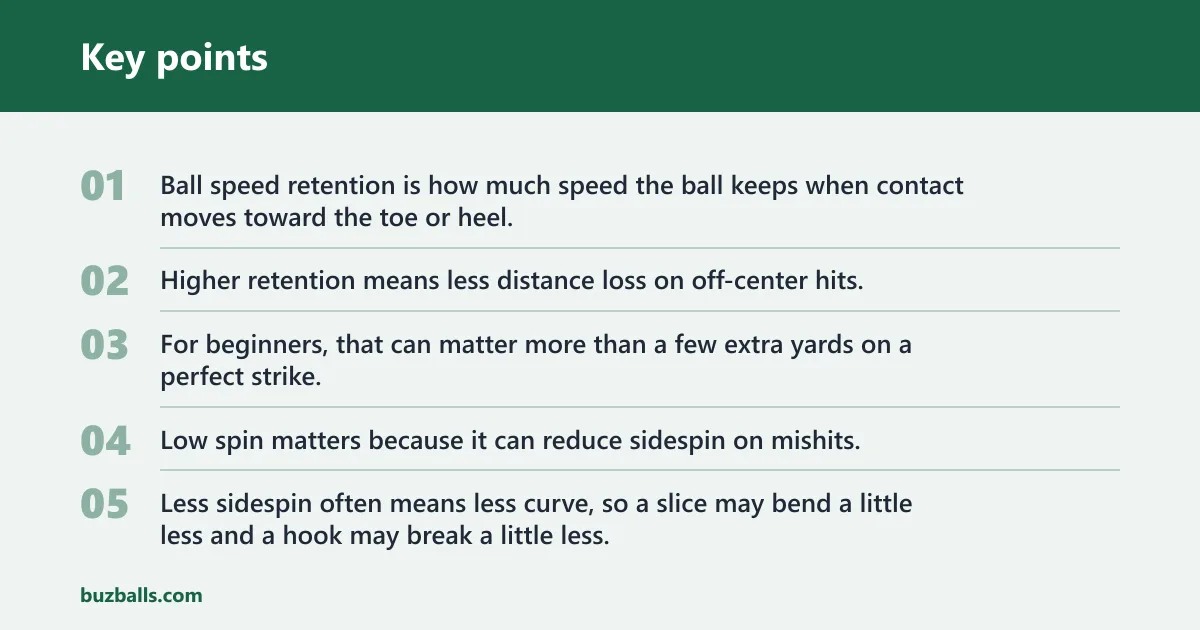
Ball speed retention is how much speed the ball keeps when contact moves toward the toe or heel. Higher retention means less distance loss on off-center hits. For beginners, that can matter more than a few extra yards on a perfect strike.
If two balls launch the same on center contact, the one that holds more speed on mishits is usually the more forgiving choice. That matters on range sessions too, because a beginner often strikes several zones of the face in one bucket.
Low spin and straighter flight
Low spin matters because it can reduce sidespin on mishits. Less sidespin often means less curve, so a slice may bend a little less and a hook may break a little less. It does not remove the swing fault that created the curve.
Suppose a beginner sends a tee shot that starts near target but peels right. A lower-spin ball may still drift right, but the curve can be smaller than with a higher-spin model. The result is often a ball that finishes nearer the fairway instead of sliding into the rough or trees.
Two-piece construction for beginners
Two-piece golf balls are common beginner options because they are usually durable and distance-oriented. They often pair a larger core with a cover designed to keep spin lower on fuller swings. That combination is one reason they are often described as more forgiving than many multi-layer balls.
That does not mean every two-piece ball plays the same. Some are firmer and longer off the tee, while others use softer covers or softer compression to feel easier to compress. The label alone does not tell the whole story, but it gives you a useful first filter.
Are forgiving golf balls better for beginners?
Usually, yes. Beginners often have inconsistent contact, so a ball that loses less distance and direction on mishits can keep more shots in play. The benefit is practical: fewer extreme curves, less distance loss on the face, and fewer balls lost to a small error.
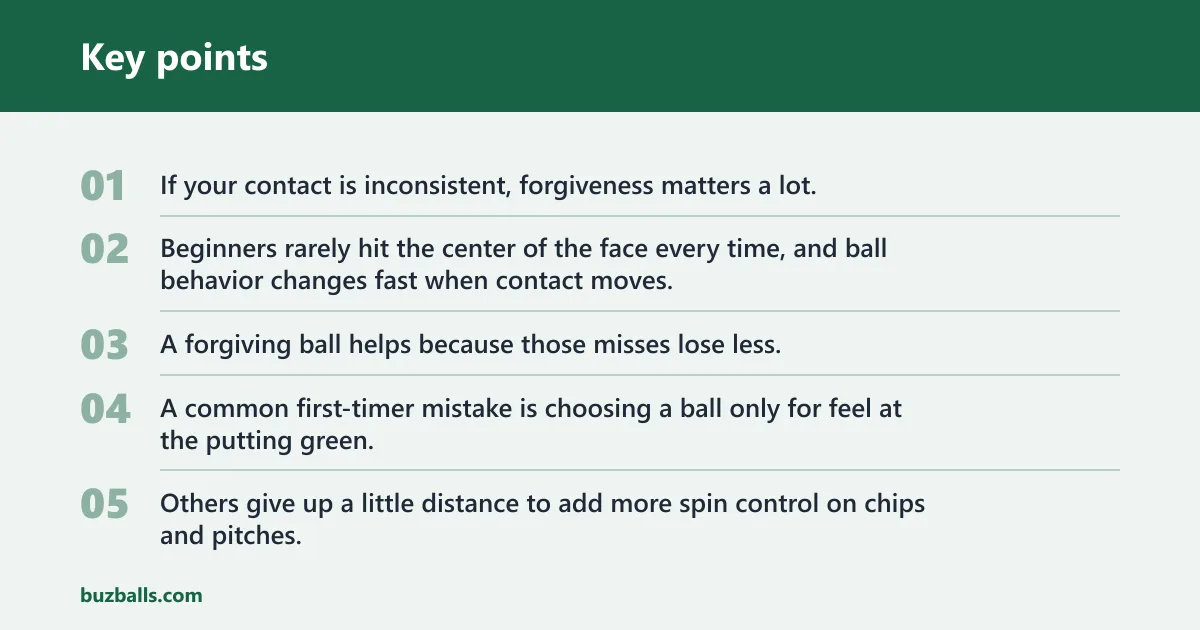
That said, “better” depends on where your game breaks down. If your contact is inconsistent, forgiveness matters a lot. If your strike is fairly solid but your short game needs more control, a very low-spin distance ball may not be the best tradeoff.
Why inconsistent contact changes the answer
Beginners rarely hit the center of the face every time, and ball behavior changes fast when contact moves. A toe strike often loses ball speed; a heel strike can do the same; thin contact can add trouble by changing launch and spin. A forgiving ball helps because those misses lose less.
A common first-timer mistake is choosing a ball only for feel at the putting green. A softer-feeling ball can be pleasant on short putts, but the bigger issue for a new golfer is usually what happens from the tee and with mid-irons. That is where forgiveness pays off most.
When control matters more than raw distance
Forgiveness is not the same as distance. Some balls are long because they spin less and launch efficiently, but that does not guarantee better control around the greens. Others give up a little distance to add more spin control on chips and pitches.
If a beginner is already keeping the ball in play, more control may matter more than another few yards. If misses are still large and frequent, start with forgiveness first. That is the simpler decision rule for most beginners.
Soft compression, distance, and spin tradeoffs
Soft compression means the ball compresses more easily at impact, which is why it is often marketed to slower swing speeds. For many beginners, that can make the ball feel easier to launch and easier to strike cleanly. But softness alone does not equal forgiveness.
The tradeoff is simple: a softer ball may feel better and help some players launch the ball, while a firmer ball may give slightly different distance or spin behavior. The right choice depends on swing speed, strike quality, and how much short-game control you want.
Soft compression for slower swing speeds
Golfers with slower swing speeds often struggle to compress firmer balls efficiently. A softer-compression ball can help the ball rebound more cleanly off the face at those speeds. That is one reason beginner-friendly boxes often mention soft feel or easy compression.
That does not mean every beginner needs the softest ball available. If your swing speed is moderate and your contact is improving, a slightly firmer ball may still offer useful distance and better feel on partial shots. The ball should fit the swing, not the label.
Spin control versus durability
Spin control is the balance of backspin and sidespin. Cover and core design both affect it. Softer covers often help with short-game spin, while firmer covers and simpler constructions often improve durability and keep cost lower.
That is where the beginner tradeoff appears. A durable two-piece ball may give you better value and easier distance off the tee, while a more spin-focused model may help around the green but cost more and react more sharply on mishits. Neither is automatically right.
Forgiving ball decision table
Use this table to match the miss pattern, the ball traits that matter most, and the outcome you are trying to improve. It is a starting point, not a fit check.
| Miss pattern | Ball traits that matter most | What to look for | What it can help |
|---|---|---|---|
| Slice | Low spin, high ball speed retention | Lower-spin, often two-piece balls | Can reduce curve and preserve more fairway line |
| Hook | Low spin, stable flight on mishits | Models that do not add extra side spin | Can soften the curve, though swing path still matters |
| Thin shot | Ball speed retention, playable launch | Ball that keeps distance on poor contact | Can limit the distance drop from low-face contact |
| Toe strike | Ball speed retention, low spin | Forgiving construction across the face | Can keep speed from falling off as sharply |
| Heel strike | Ball speed retention, stable spin | Ball that resists big directional loss | Can keep the ball in play more often |
What the table can tell you is simple: match the ball to the miss that costs you the most strokes. What it cannot tell you is whether your swing path, club choice, or alignment is the deeper issue. A ball can reduce the penalty, but it cannot remove the cause.
-
Identify your usual miss. Track five to ten tee shots and iron shots, then note whether the miss is a slice, hook, thin contact, toe strike, or heel strike. The point is to find the pattern that shows up most often, not the worst shot of the day.
-
Match the trait to the miss. If the ball curves too much, start with low spin. If your problem is distance loss on off-center hits, prioritize ball speed retention. If you struggle to launch the ball, look at softer compression.
-
Choose a beginner-leaning construction. Start with a two-piece model unless you already know you want more short-game spin. Two-piece balls are common because they are durable and usually easier to fit into a distance-first beginner setup.
-
Check your short-game tradeoff. If you need more spin around the green, avoid going too far toward the lowest-spin, firmest ball. A ball that is easy off the tee but too lifeless on pitches can create a different problem.
Picture a beginner who slices driver shots but also hits a few thin irons. A lower-spin, two-piece ball may trim some slice curvature and lose less distance on those thin strikes. That does not fix the swing, but it can keep the round more playable while contact improves.
Can forgiving balls fix slices or bad contact?
No. Forgiving golf balls can reduce the penalty from a slice or bad contact, but they do not repair the swing fault that created the miss. They can make the miss smaller, keep more shots alive, and improve confidence. They cannot turn poor mechanics into good mechanics.
That is why expectations matter. A forgiving ball is a support tool, not a cure. If the swing path, face angle, or strike location stays the same, the ball can only do so much.
Slice versus sidespin
A slice is mostly a sidespin problem, often paired with a face-to-path issue. Lower-spin balls can reduce how much the shot bends, which is helpful. But if the club path keeps producing slice spin, the ball will still curve right for a right-handed golfer.
That distinction matters for beginners because it prevents false hope. If you buy a low-spin ball expecting a straight flight from every swing, you will be disappointed. If you buy it to soften the miss, the result is more realistic.
Toe, heel, and thin strikes
Toe and heel strikes often show up as distance loss first. Thin contact can add low launch and poor carry, which is why it feels so costly. A forgiving ball helps most by reducing the drop-off from those misses, especially on full swings.
That is why ball speed retention belongs near the top of the checklist. If a ball holds speed better on imperfect contact, you keep more usable yards and fewer extreme misses. The shot may still be imperfect, but it becomes easier to recover from.
Frequently asked questions
What does forgiving mean in golf balls?
In golf balls, forgiving means less penalty from mishits. The ball loses less distance and direction when contact is off-center, so beginner golfers stay in play more often. It does not mean perfect shots, and it does not fix the swing fault behind the miss.
Do forgiving golf balls fix slices or bad contact?
No. They can reduce the amount of curve or distance loss, but they do not correct the swing path, face angle, or strike pattern that caused the miss. Think of forgiveness as damage control. It helps the shot survive, not become perfect.
Should a beginner choose a soft or firm golf ball?
A beginner should usually start with a softer-compression ball if swing speed is slow or contact is inconsistent. Softer compression can make the ball easier to compress and can help with launch. If you already swing faster, a slightly firmer ball may still fit better.
Is forgiveness the same as distance in a golf ball?
No. Distance and forgiveness overlap, but they are not the same. A ball can be long on center strikes and still punish mishits. A forgiving ball is the one that keeps more speed and direction when contact moves away from the sweet spot.
What golf ball should I use as a beginner?
Start with a low-spin, usually two-piece ball with softer compression if your swing speed is modest. That combination often gives a good balance of distance, durability, and mishit forgiveness. If your contact improves and you want more greenside control, reassess later.
What is the difference between forgiving and playable golf balls?
Forgiving usually means the ball resists the penalty of mishits. Playable is broader and can include feel, spin, short-game response, and how the ball behaves in different lies or weather. A ball can be playable without being especially forgiving, and forgiving without being ideal around the green.