
How Is Golf Ball Compression Measured and Rated?

Golf ball compression measures how much a ball deflects under a standard load. Lower numbers usually point to a softer ball, higher numbers to a firmer one. Read those numbers wrong, and you can end up with the wrong ball for your swing speed, feel preference, or cold-weather play. This guide explains how compression is measured, why manufacturer claims and lab gauges can differ, and how to compare ratings without treating every exact figure as equal.
What golf ball compression means
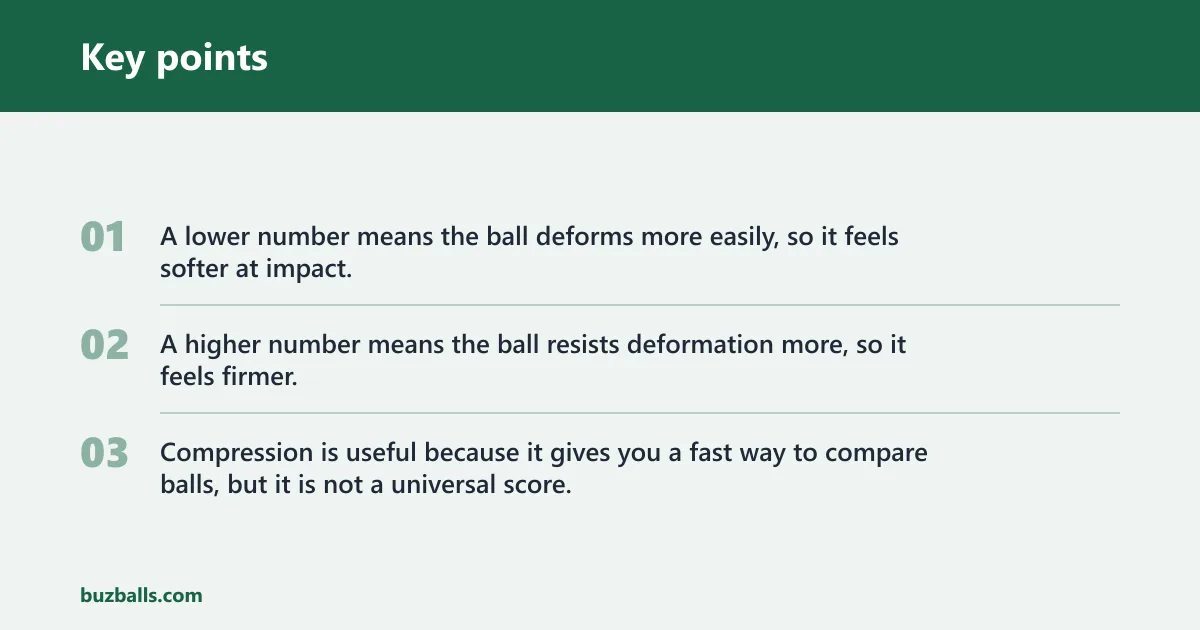
Compression is a firmness rating under load. A lower number means the ball deforms more easily, so it feels softer at impact. A higher number means the ball resists deformation more, so it feels firmer.
Why the number is a fit guide, not a perfect science
Compression is useful because it gives you a fast way to compare balls, but it is not a universal score. Modern charts often place balls in roughly the 30 to 110 range, and some guides use 30 to 120, yet those scales are not interchangeable across brands or sources.
That matters because compression does not stand alone. Cover material, core design, dimple pattern, and player speed all shape how the ball behaves, so a single point difference rarely tells you much by itself.
How compression is measured
In plain terms, compression is measured by pressing a ball with a fixed load and recording how far it deflects. More deflection means lower compression. Less deflection means higher compression.
How the test setup works
-
Apply a fixed load. A gauge or test device presses on the ball with the same force each time. Keeping the load constant is what lets one ball be compared with another.
-
Measure deflection. The device records how much the ball compresses under that load. Greater deflection points to a softer ball; smaller deflection points to a firmer one.
-
Compare the reading. The result is placed on a compression scale or into a chart band. That reading helps with comparison, but only if you know whose scale you are reading.
That method sounds simple, but the result still depends on the test method, the gauge, and the scale being used. A number can be precise without transferring cleanly from one source to another.
Why different sources report different numbers
Different sites can report different compression numbers for the same ball because there is no industry-standard compression test. One source may use a brand claim, while another uses an independent gauge reading. Cubical Golfer notes that two honest sources can disagree by 20 points or more.
Manufacturer-published compression
A manufacturer-published figure is the brand’s own number. It may be listed in a catalog, on a product page, or in a fitting chart. Some brands publish compression for a model, while others leave it out entirely in some charts, including cases where Titleist or Costco may publish nothing for that model.
That absence matters. If a brand does not publish a number, any chart you see elsewhere is likely using an outside measurement or a reviewer’s scale, not the manufacturer’s own figure.
Independent lab measurement
An independent lab measurement comes from a separate test method and can differ from the brand’s published figure by several points or more. MyGolfSpy Ball Lab is often used as an example of this kind of source in comparison charts.
Those lab readings are useful because they give you an outside check, but they still are not interchangeable with manufacturer claims. The important part is knowing which source you are reading before you compare models.
Why the same model can appear to have different ratings
Say your favorite ball lists 38 on one chart and 44 on another. That does not automatically mean one source is wrong. It usually means the chart is using a different method, a different scale, or a different source type.
| Source type | What is measured | Typical scale range | Why numbers differ | How much to trust it |
|---|---|---|---|---|
| Manufacturer-published compression | Brand-stated firmness figure for that model | Often somewhere in about 30 to 110 or 30 to 120 charts | Brands may use their own internal method or omit figures altogether | Trust it for the brand’s own fit language, but not as a universal score |
| Independent lab measurement | Gauge reading from an outside test setup | Often grouped into broad bands instead of a single standard scale | Different gauges, loads, and rounding can shift the number by several points or more | Trust it as a comparison tool, not as the final word |
| Compression chart | Banded grouping by softness or speed fit | Low, mid, and high bands; some charts use 70/80/90 groupings | Charts may prioritize fit, price, or cover type over exact point differences | Trust it most for cross-brand comparison and broad fitting |
| Ball model | Brand-published figure | Lab-measured figure | What the gap means |
|---|---|---|---|
| Callaway Supersoft | 38 | 44 | A modest gap that still shows the source matters |
| TaylorMade Noodle | 34 | 69 | A large split that warns against treating every chart as the same scale |
| Titleist TruFeel | Not published in the cited brand chart | 70 and 68 in two independent sources | Two lab sources can still land close while remaining separate measurements |
Compression bands by swing speed

Compression bands are more useful than exact point chasing. A common guide is that low compression is under about 60, mid compression is around 60 to 85, and high compression is 85 and up. Those bands are guidance, not hard walls.
Low compression: roughly under 60
Low-compression balls are usually the better place to start for slower driver speeds or for players who want a softer feel. They can also help in cold weather, when balls tend to play firmer.
Mid compression: roughly 60-85
Mid-compression balls are the broad middle ground. They often suit a wide range of driver speeds and are a practical starting point if your current ball feels too firm or too soft without fixing anything else.
High compression: roughly 85 and up
Higher-compression balls tend to fit faster swings better. They often feel firmer, especially at impact with the driver, and they can suit players who want a more solid response off the clubface.
Cubical Golfer groups players into under 85 mph, 85 to 100 mph, and over 100 mph bands. BallCaddie uses 70/80/90 groupings in its catalog and ties them to swing speed. Those systems are not identical, but both point to the same method: start with broad bands, then narrow the choice by feel and ball flight.
BallCaddie also says the fastest balls off the driver were firm ones at every swing speed tested. That does not mean firmer is always better for every golfer. It does mean you should not assume softness alone creates more distance.
Driver speed and winter conditions
Driver swing speed is usually the first fitting input because it is the most common place to start. Slower swings generally fit lower compression, while faster swings can use firmer balls.
Cold weather changes the picture. Balls can play firmer in the cold and may lose a little distance, so a softer compression may make more sense in winter than it does in warm air. That is a fit adjustment, not a permanent rule.
How construction and cover change feel
Compression is only one part of the ball. Construction and cover material can change feel, spin, and control enough that two balls with similar compression still play differently.
2-piece, 3-piece, 4-piece, and 5-piece builds
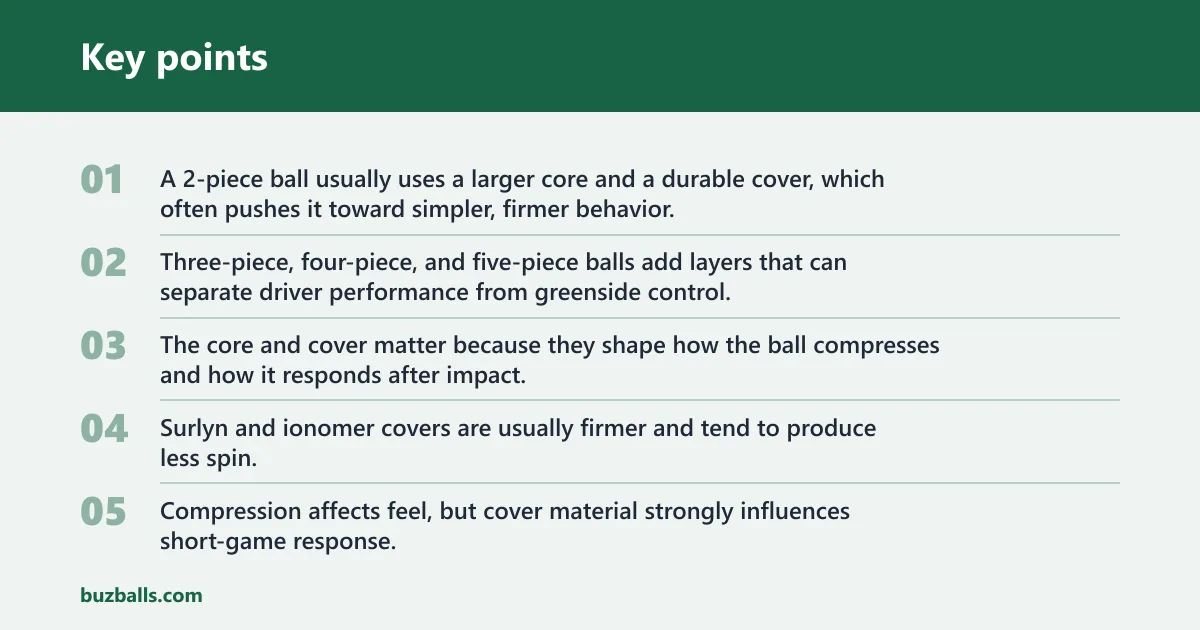
A 2-piece ball usually uses a larger core and a durable cover, which often pushes it toward simpler, firmer behavior. Three-piece, four-piece, and five-piece balls add layers that can separate driver performance from greenside control.
The core and cover matter because they shape how the ball compresses and how it responds after impact. More layers can give designers more control over spin windows and feel, even if the listed compression is close to another model.
Surlyn and ionomer versus urethane
Surlyn and ionomer covers are usually firmer and tend to produce less spin. Urethane covers usually offer more spin and more greenside control, which is why they often appear on higher-end tour-style balls.
That distinction matters because a softer-feeling urethane ball can still behave differently from a softer-feeling surlyn ball. Compression affects feel, but cover material strongly influences short-game response.
What that means on the course
A common first-time mistake is chasing the lowest compression number and ignoring the cover. Suppose a player moves from a firmer ionomer ball to a softer urethane model and sees more wedge spin but no dramatic distance jump. That is normal. The cover changed the short-game behavior more than the compression number changed the driver result.
How to read a compression number
A compression number is easiest to use when you treat it as a sorting tool. Start with the source type, then use broad bands, and only then look at exact figures. That approach keeps you from treating unlike charts as if they came from the same scale.
-
Check the source. Decide whether the number is manufacturer-published, lab-measured, or part of a comparison chart. The source tells you how much weight to give the figure.
-
Use the band first. Group the ball as low, mid, or high compression before you focus on the exact number. Banding is safer because no industry-standard compression test exists.
-
Compare construction and cover. Look at whether the ball is 2-piece, 3-piece, 4-piece, or 5-piece, and whether the cover is surlyn, ionomer, or urethane. These often matter as much as the number itself.
-
Match to your conditions. Think about driver speed, iron speed, and cold weather. Those factors can change which band makes sense more than a couple of compression points do.
Which compression should you play?
Use swing speed as the first filter, then use feel, spin, and course conditions as the second. Slower driver swings usually start lower, faster swings usually start firmer, but those are broad guides rather than fixed rules. If the ball feels too hard in cold weather or too loose around the greens, move one band and retest the fit.
Start with driver speed
Driver speed is the cleanest starting point because it ties most directly to full-swing compression behavior. If your speed is on the slower side, a lower-compression ball is a sensible starting point. If your speed is higher, a firmer ball may be the better fit.
Then adjust for feel and spin
Feel matters because compression is partly about feedback. Spin matters because urethane and multilayer builds can give more control around the green, even when the compression number is similar to a firmer surlyn ball.
Price and cover type should stay in the conversation too. Many compression charts pair softness bands with price tiers and cover materials because those details often help more than a single number does.
Frequently asked questions
How is golf ball compression measured?
Compression is measured by applying a fixed load to the ball and recording how much it deflects. More deflection means lower compression. Less deflection means higher compression. The method is simple in concept, but the result depends on the gauge, the load, and the chart used to present it.
What does golf ball compression rating mean?
A compression rating is a firmness-under-load score that helps compare golf balls by feel and fit. Lower numbers mean a softer ball, while higher numbers mean a firmer one. It is best used as a broad fitting tool, not as a perfect predictor of distance or spin by itself.
Is a lower compression golf ball softer?
Yes. Lower compression means the ball deforms more easily under load, so it generally feels softer at impact. That softer feel can suit slower swings, but it should still be weighed against cover material, construction, and the spin you want around the greens.
Why do different sites show different compression numbers for the same ball?
Because there is no industry-standard compression test. One site may list a brand’s published figure, while another uses an independent lab reading. Even honest sources can differ by 20 points or more, so the source type matters as much as the number itself.
Are compression ratings standardized across brands?
No. Brands do not all use the same test setup or the same published scale, and some do not publish a compression number at all. That is why a compression chart is better for broad comparison than for treating one brand’s 40 as exactly equal to another brand’s 40.
What compression golf ball should I play for my swing speed?
Use your driver swing speed as the first filter. Slower speeds usually start with lower compression, mid-range speeds often fit mid compression, and faster speeds can move toward firmer balls. Then adjust for feel, spin, cover type, and cold-weather conditions before making a final choice.