Golf Ball Compression: What It Means for Your Fit

Golf ball compression describes how much a ball deforms at impact; as a common rule of thumb, under about 80 mph fits roughly 40-60 compression, 80-95 mph about 60-80, and 95+ mph often 80-plus. Miss that fit and the ball can feel harsh, launch on the wrong window, or cost you carry and control. This guide explains what compression numbers mean, how they affect distance, feel, and spin, and why cover material and cold weather can matter as much as the rating.
Use compression as a fitting variable, not a magic number. Driver swing speed is the first input, but cover material, launch, spin, and weather can push the choice a band softer or firmer.
How compression is used in ball fitting
Golf ball compression means how much the ball flattens against the clubface under impact load, and it is commonly presented as a firmness rating. Lower numbers usually mean a softer-feeling ball and higher numbers a firmer-feeling one, but published compression figures do not always compare cleanly across brands or sources.
Compression is a firmness rating, not a quality grade
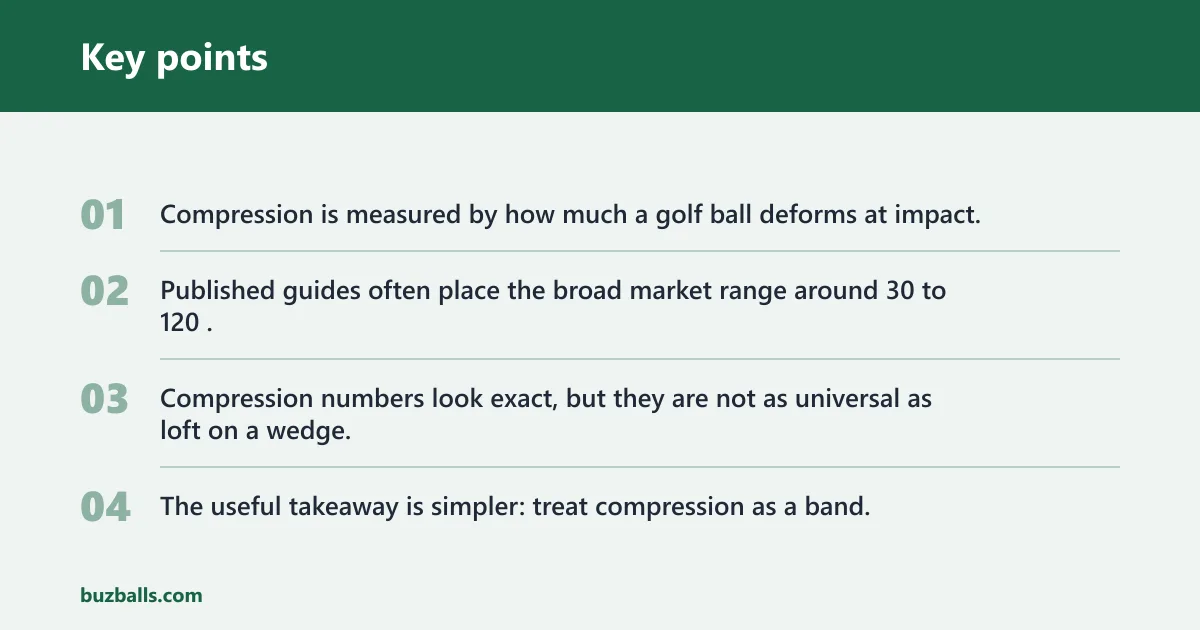
Compression is measured by how much a golf ball deforms at impact. In plain fitting terms, it tells you how soft or firm the ball is built to play, with lower numbers softer and higher numbers firmer.
Published guides often place the broad market range around 30 to 120. Within that spread, one common grouping puts 30-50 in the low-compression bucket and 90-120 in the high-compression bucket.
Why published numbers do not always line up
Compression numbers look exact, but they are not as universal as loft on a wedge. Brands do not always publish them, testing methods can differ, and third-party lists may rely on separate measurements or estimates.
That is why cross-brand comparisons need caution. A ball listed at about 70, such as a published estimate for Titleist TruFeel, is easier to compare inside a general band than against one exact cutoff. The same goes for published estimates of about 49 for Callaway Supersoft, about 92 for Titleist Pro V1, and about 102 for Titleist Pro V1x.
The useful takeaway is simpler: treat compression as a band. Low, mid, and high are more dependable for ball fitting than acting as if every brand’s number sits on one standardized ruler.
Why compression matters less than many golfers think
It is one input in a larger flight equation
Compression affects how a ball reacts at impact, but it does not act alone. Construction, cover material, dimple pattern, spin profile, and launch conditions all shape the flight.
That matters because golfers often expect one number to predict distance. It cannot. A softer ball may feel easier to compress, yet a firmer ball can still be faster off the driver depending on the design and the player’s delivery.
Two balls with similar compression can play very differently
One ball can launch higher, spin less, and feel clickier even if its compression sits near another model’s published number. Core design and mantle layers matter. So does the cover.
Ionomer-cover balls often feel different from urethane-cover balls even when their compression bands overlap. That is one reason golfers sometimes think they are “feeling compression” around the green when they are really noticing the cover and overall construction.
How does golf ball compression affect distance?
Compression affects distance by changing launch, spin, and ball speed relative to your swing speed and strike, but it does not determine distance by itself. Launch, spin, construction, and aerodynamics matter alongside compression, and a mismatch usually costs either carry, peak height, or directional control rather than producing one simple distance penalty.
Slower swings usually gain from softer bands
For slower driver speeds, softer balls often launch more easily and feel less dead at impact. 30-60 compression for players under 85 mph, while another places 50-70 as a fit for 70-85 mph.
That does not mean every soft ball is longest for every slower swinger. A very low-compression ball can add comfort and help launch, but too much spin or too little ball speed can still hold distance back.
Moderate speeds live in the gray area
The biggest fitting mistakes show up around the middle. 60-80 compression for 85-100 mph, which explains why mid-compression balls suit a large share of recreational golfers.
Say your driver speed is 85 mph, your common miss is a low right shot, and you like a soft feel. A very firm ball can feel harsh and launch too flat. A mid band around 60-80 is usually the safer first stop than jumping straight to tour-firm models.
Faster swings can still play softer balls, with tradeoffs
For fast swings, firmer balls are commonly matched to the player because they tend to hold shape better under higher load and often pair with lower driver spin. 100+ mph suits 90+ compression.
There is also a useful reality check: one guide says the fastest balls off the driver were firm ones at every swing speed tested. That does not prove everyone should play the firmest ball available. It means compression alone does not decide driver distance, and firmer construction can still produce speed even for players who prefer a softer feel.
Common mismatch patterns
- A slow swing paired with a very firm ball can feel hard off the face, launch too low, and lose carry.
- A fast swing paired with a very soft ball can feel great but fly too high or spin too much off the driver.
- A golfer chasing distance with compression alone can ignore the bigger problem, which is often launch or strike quality.
Suppose two balls both sit near mid compression, but one is a low-spin urethane model and the other a higher-launch ionomer model. The same golfer can see different driver windows even before wedge performance enters the decision.
What golf ball compression does at impact
Golf ball compression is the ball’s brief deformation against the clubface, and that split-second response helps determine how energy is transferred into speed, launch, spin, and feel. The supporting guide breaks down the sequence from initial contact through rebound, showing why the same ball can behave differently for different swing speeds and why a player can lose efficiency by matching the wrong compression to their game.
If you want the mechanics behind that fit decision, this golf ball compression guide explains how compression changes on impact and what that means for distance, spin, and overall ball selection.
Does golf ball compression affect feel and spin?
Yes, compression affects feel and some spin behavior, but golfers often give it too much credit for both. Compression is usually easiest to notice as firmness on full swings and putts, while cover material and overall construction often matter more for greenside spin and short-game feel.
Driver feel is not wedge feel
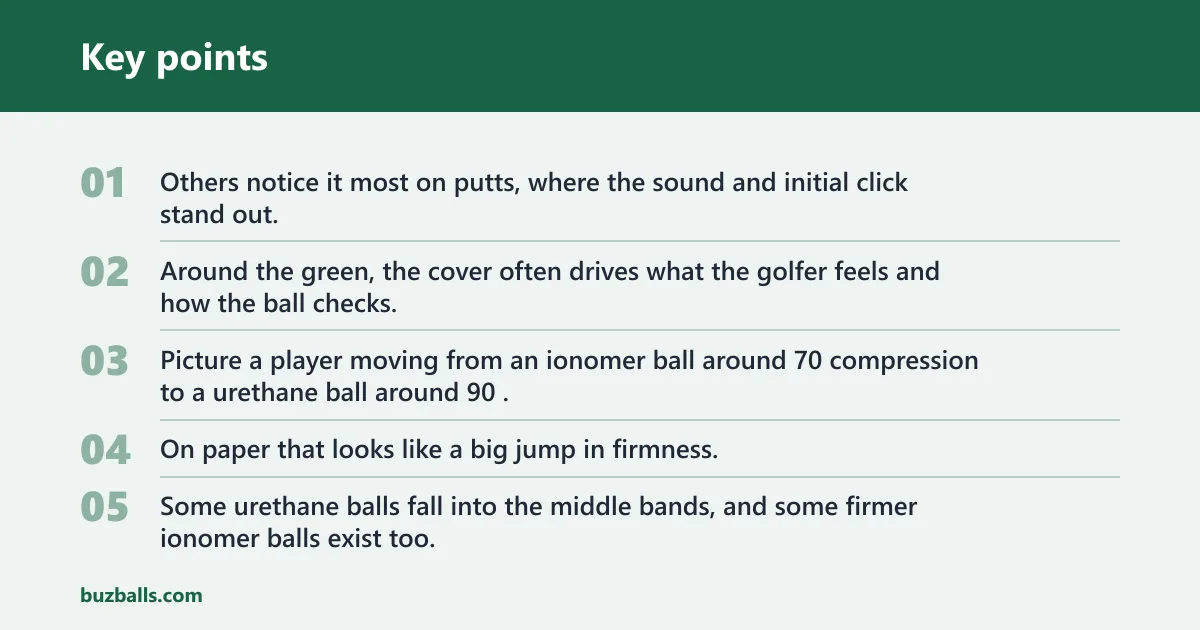
Many golfers judge a ball first with the driver, where compression can change the sense of softness or firmness at impact. Others notice it most on putts, where the sound and initial click stand out.
Wedge shots are different. Around the green, the cover often drives what the golfer feels and how the ball checks. Urethane typically gives the grabbier short-game response golfers associate with tour balls, while ionomer usually feels firmer and spins less on partial shots.
Why cover material can outweigh compression
If two balls share a similar compression band but one uses urethane and the other ionomer, the urethane ball can feel softer on chips and offer more greenside spin. That is why compression is not a complete feel spec.
Picture a player moving from an ionomer ball around 70 compression to a urethane ball around 90. On paper that looks like a big jump in firmness. In the short game, though, the urethane cover may still feel more responsive because cover changes the contact more than the compression label suggests.
Are tour balls always high compression?
Many tour-category balls are firmer, and published estimates for models like Pro V1 at about 92 and Pro V1x at about 102 fit that pattern. But “tour ball” does not mean compression is the only thing that matters, and it does not mean every urethane ball sits at the top of the scale.
Category overlap is real. Some urethane balls fall into the middle bands, and some firmer ionomer balls exist too. The cover, spin profile, and launch shape still need a look.
What compression should you play by swing speed?
Use driver swing speed as the main starting point. Under 70 mph usually fits soft low-compression options, 70-85 mph often fits low to lower-mid, 85-100 mph usually fits mid, and 100+ mph often fits high compression, with feel preference and ball flight deciding the final move.
Under 70 mph
Start in the low-compression range. Another source calls under 50 ultra-low compression, and softer options can help this group with feel and launch.
If impact feels hard and shots fall out of the air early, moving softer usually makes more sense than moving firmer.
70 to 85 mph
This is where many recreational golfers land. Published guidance places 50-70 compression as a fit for 70-85 mph, and this range often balances easier launch with enough structure to avoid a mushy feel.
For players in the upper part of this band, a lower-mid ball can work well if they dislike very soft sound off the putter.
85 to 100 mph
This is the widest decision zone because both speed and preferences pull hard here. 60-80 for 85-100 mph, which is a strong starting point for most players in this bracket.
At exactly 85 mph, begin in the low-mid or mid band rather than assuming you need a tour-firm ball. If feel matters more than a flatter driver flight, staying near the softer end of this zone is usually the better call.
100+ mph
Faster swings often fit high-compression balls better, and one source says 90+ suits 100+ mph. That is where many firm tour-category balls live.
Still, speed alone does not force a single answer. A player with high spin and a steep delivery may still want a softer-feeling ball if the launch window stays under control.
Compression bands by ball type
Low compression balls
Think roughly under 50-60. These are the softer-feeling options and are generally the best fit for slower swings, especially when launch help and comfort matter more than a firm strike sensation.
Mid compression balls
Think roughly 60-85 or 70-90, depending on whose chart is being used. This is the broad middle, and it fits a large share of recreational golfers because it balances feel, driver stability, and short-game usability.
High compression balls
Think roughly 90+. These are firmer-feeling balls built for players who can load the ball harder, and they often sit in tour-ball territory, though not every tour-style model is identical in feel or spin.
What if your feel preference disagrees with your speed?
When speed and feel point in different directions, speed should set the first band and feel should decide whether to shift one band softer or firmer. Most golfers should not jump two full bands away from their speed fit unless weather or ball flight gives a clear reason.
When to stay in the speed-based band
Stay with the speed-first choice if your driver launch and carry look normal and the ball does not feel harsh. That is especially true if the common miss is already too high or too spinny.
When to shift softer
Shift one band softer if impact feels hard, the weather is cold, or putter and iron feel matter more than shaving driver spin. This is often the best adjustment for borderline players around 80-90 mph.
A common first-timer mistake is chasing a tour ball for status at 82 mph when the real complaint is that every full shot feels hard in winter. Moving from a high-compression model to a mid band fixes the feel issue without forcing an ultra-soft ball.
When to shift firmer
Shift one band firmer if the driver flight floats, the strike feels overly muted, or the common miss is a high spinner that stalls. Faster players who like clear feedback often prefer this move.
What matters is restraint. If speed says mid compression and feel says firmer, test high-mid or low-high first, not the hardest ball on the shelf.
How do you know your swing speed for ball fitting?
The simplest way to know swing speed is to hit driver shots on a launch monitor at a store or fitting center. For ball fitting, the number only needs to be close enough to place you in the right speed band, because compression works best as a range choice rather than an exact-code spec.
Use a launch monitor, then fit by band
Launch monitors are the practical tool here because they show driver speed directly. For this decision, a rough average matters more than a single fastest swing.
- Hit ten driver shots. Use the driver and tee height normally played on the course. Ten swings smooth out one-off swings and give a more useful average for ball fitting.
- Ignore the outliers. Toss out the obvious mishits and the one unusually hard lash. The goal is the speed that shows up most often, because that is what the ball sees in real play.
- Find your band. Sort the average into under 70 mph, 70-85 mph, 85-100 mph, or 100+ mph. That band is the starting point for compression, not the final answer.
- Check the flight. If the speed-based band still produces a launch that feels too flat, too floaty, or too harsh, move one band softer or firmer. That final tweak is where feel and ball flight finish the fit.
Store and fitting-center options
Most golfers do not need a full premium fitting session just to narrow compression. A retail launch monitor bay, indoor simulator, or fitting-center basic session can provide enough speed data to avoid buying in the wrong category.
How accurate the number needs
Close is enough. A player who is really 84 mph versus 86 mph does not need a radically different ball; that player needs help choosing between the soft end of mid compression and the firmer end of low compression.
Compression decision checklist
| Driver swing speed | Typical miss | Preferred feel | Weather | Recommended compression band | Secondary band if feel matters more | Do-not-buy warning |
|---|---|---|---|---|---|---|
| Under 70 mph | Low, short, weak fade | Soft | Mild | 40-55 | 55-65 if putter feel is too muted | Avoid 90+; it will usually feel hard and can cost carry |
| Under 70 mph | High, spinny, floating | Neutral | Mild | 50-60 | 60-70 if flight is too soft-feeling | Avoid ultra-low under 50 if shots already balloon |
| 70-85 mph | Low fade or low push | Soft | Mild | 50-70 | 40-55 for maximum softness | Avoid 90+ unless a fitter sees a clear reason |
| 70-85 mph | High draw or spinny straight ball | Firm | Mild | 60-75 | 75-85 if flight is too floaty | Avoid under 50 if driver spin is already excessive |
| 85-100 mph | Flat fade or low-right miss | Soft | Mild | 60-80 | 55-65 if comfort matters more than flight firmness | Avoid 100+ if contact already feels harsh |
| 85-100 mph | High spinner or ballooning flight | Firm | Mild | 75-90 | 90+ if speed is near the top of the band | Avoid very soft 40-55 if driver flight already climbs too much |
| 100+ mph | Controlled launch, wants feedback | Firm | Mild | 90+ | 80-90 if short-game feel matters more | Avoid 40-60 if driver spin and height are already high |
| 100+ mph | Low bullet, harsh feel | Soft | Cold | 80-90 | 70-80 for winter comfort | Avoid jumping straight to the softest ball available |
Does cold weather change which compression you should play?
Yes, cold weather makes golf balls play firmer and can trim distance slightly, so a slightly softer ball can make sense in winter. The key word is slightly: most golfers should adjust by one band at most rather than switching to the softest ball they can find.
Why the cold changes the feel
Lower temperature makes the whole ball play firmer. That can make a normally comfortable ball feel harder at impact and can shave a bit of carry, especially for slower and moderate swing speeds.
How much to adjust
Most golfers should make a moderate move. If the usual ball already sits on the firm edge of the player’s fit, moving one compression band softer for winter is reasonable.
If the normal ball already fits on the soft side, there may be no need to change at all. The cold does not turn every golfer into a low-compression-only player.
Winter choices that make sense
Players under 85 mph often benefit the most from a softer winter option. Players near 85-100 mph may simply want to move from firmer mid to softer mid. Faster players usually need less change unless they strongly dislike the cold-weather feel.
Say your normal fit is around 90+ in summer at 101 mph, but winter rounds are in cold air and the ball feels sharp off the face. Dropping to 80-90 is a measured adjustment. Dropping all the way into a very soft distance ball usually over-corrects.
Frequently asked questions
Is lower compression better for slower swing speeds?
Usually, yes. Slower swings often do better with lower compression because the ball feels softer and tends to launch more easily. The limit is that very soft balls can still be the wrong fit if the player already hits the ball too high or wants more driver stability.
What compression golf ball should I play with an 85 mph swing?
At 85 mph, start around 60-80 compression, then move slightly softer if comfort and putter feel matter more or slightly firmer if the driver floats. That speed sits on the border, so mid compression is usually safer than either extreme.
Can a fast swing use a low compression golf ball?
Yes, but there is a tradeoff. A fast swing can play a low-compression ball if the player likes the feel and the flight stays controlled, yet very soft models may launch too high or spin too much off the driver for some high-speed players.
How do I know my swing speed for ball fitting?
Use a launch monitor and average a group of normal driver swings. A retail simulator bay or fitting center is usually enough. The goal is not a perfect lab number; it is placing the player in the right broad speed band for compression choices.
What is the difference between compression and cover material?
Compression is the ball’s firmness rating and how much it deforms at impact. Cover material is the outer layer, usually ionomer or urethane. Compression often shapes full-swing feel, while the cover often has a larger effect on greenside feel and spin.