
How Does Golf Ball Compression Work on Impact?

Golf ball compression is how much the ball deforms under club impact. Lower-compression balls deform more at slower speeds, while higher-compression balls resist deformation until you load them harder. Pick the wrong one, and you can chase a ball that does not match your speed, which can cost launch, spin, and distance. This guide explains what happens on the face, and how compression affects speed, feel, launch, spin, and fit.
Golf ball compression basics
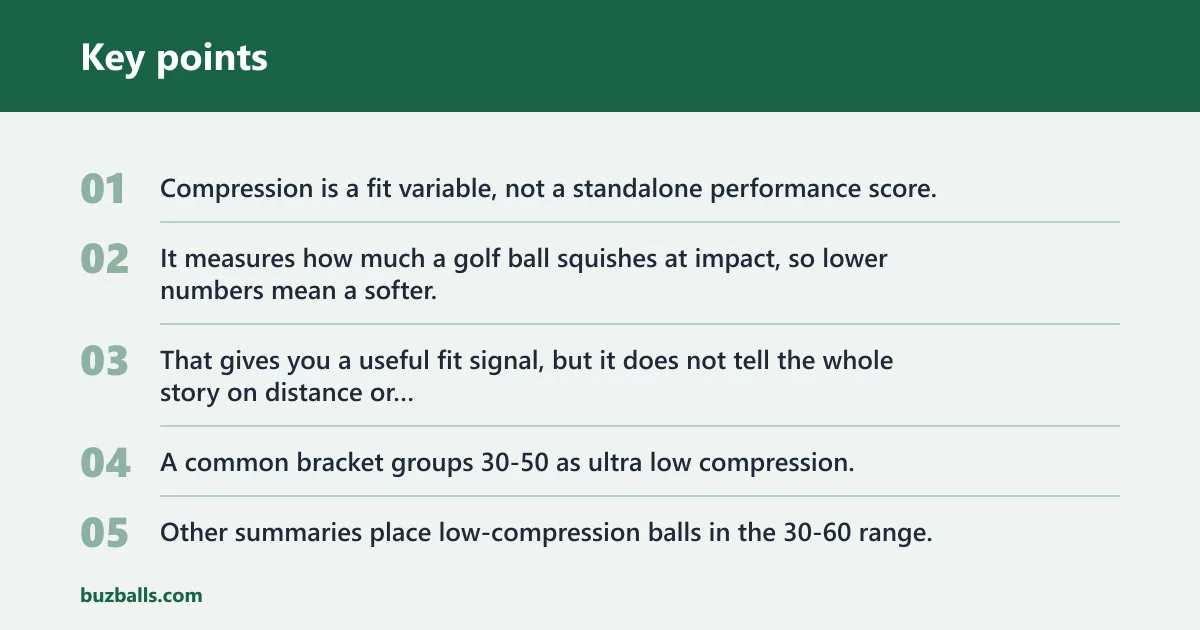
Compression is a fit variable, not a standalone performance score. It measures how much a golf ball squishes at impact, so lower numbers mean a softer, more deformable ball and higher numbers mean a firmer, less deformable ball. That gives you a useful fit signal, but it does not tell the whole story on distance or feel.
Most standard balls sit between 50 and 100. A common bracket groups 30-50 as ultra low compression, while 90-110 is treated as high compression. Other summaries place low-compression balls in the 30-60 range, with higher-compression balls around 80-120. Those ranges are guides, not absolute rules.
What compression measures
Golf ball compression is how much the ball deforms or squishes when struck. The number helps you estimate how easily the core loads under a given swing speed. It does not tell you, by itself, how far the ball will fly, how high it will launch, or how much spin it will produce.
Low compression vs high compression golf ball
Low-compression golf balls, often around 30-60, are commonly aimed at slower swing speeds and are often described as helpful for beginners, high handicappers, or seniors who want more distance. High-compression golf balls, often 80-120, are generally aimed at faster swing speeds. Those are useful starting points, not rigid categories.
Why compression is a fit variable, not a full performance score
Two balls with similar compression can still perform differently because the core, cover, and dimple design are different. A ball can feel soft even if it is high compression, if the cover and construction produce that sensation. Distance and spin still depend on impact quality, loft, speed, and launch conditions.
What happens in the first milliseconds?
At impact, the ball does not stay in one shape. It goes through a short collision sequence: the face meets the cover, the core loads, the ball reaches maximum deformation, then it rebounds and leaves the clubface. After launch, compression is over; flight is then driven by speed, spin, launch angle, and aerodynamics.
Pre-impact and first contact
Before contact, the ball is static and the clubface is moving. The first touch happens in a tiny fraction of a second. At that instant, clubface speed, strike location, face angle, and loft start determining how much energy transfers into the ball and how efficiently the ball can leave the face.
Peak deformation and rebound
At peak deformation, the ball is compressed against the face, and the core stores and returns energy. If the strike is centered and the face is stable, more of that energy becomes ball speed. If the strike is off-center, some energy is lost to gear effect, twisting, and a poorer launch window.
Post-launch and why the ball stops compressing
Once the ball leaves the face, it is no longer compressing. From that point on, dimples and aerodynamics take over. Launch, spin, and trajectory now matter more than compression, because the ball is flying rather than being loaded by the club.
Compression impact sequence
This sequence shows the collision as five stages. It helps separate what the ball is doing on the face from what actually drives distance, feel, and spin.
| Stage | What the ball is doing | What the golfer feels | Variables influenced | Common myths that are wrong |
|---|---|---|---|---|
| Pre-impact | The ball is still round and stationary on the tee or turf. | No impact feel yet. | Alignment, tee height, stance, and setup quality affect strike quality before contact. | Compression has already started before the face arrives. |
| First contact | The cover begins to deform as the face meets the ball. | A sharp or soft strike sensation begins here. | Clubface speed, face angle, strike location, and initial energy transfer shape the result. | The number on the box alone decides ball speed. |
| Peak deformation | The ball reaches maximum squish against the face. | Impact feels firm or muted depending on construction and contact quality. | Core loading, ball speed retention, and spin generation are strongly affected here. | Soft feel always means low compression. |
| Rebound | The ball springs back and leaves the face. | The hit feels more solid if the strike is centered. | Launch speed, launch angle, and spin rate are being set. | Compression keeps changing after the ball leaves the face. |
| Post-launch | The ball is flying; deformation is over. | No more contact feel. | Dimples, spin, and launch conditions control carry and total flight. | Compression is what makes the ball climb and curve in the air. |
Does swing speed change compression?

Yes. Driver swing speed is the main reference for ball fitting because it gives a practical estimate of how much the ball will load at impact. A launch monitor or swing-speed radar, often available in stores and fittings, can verify that speed instead of guessing from feel alone.
That said, swing speed is only part of the story. Strike quality, centered contact, and face conditions can matter more than compression itself. A well-struck ball with a slightly mismatched compression often performs better than a poorly struck ball that is technically “correct.”
Why driver swing speed is the main reference
Driver speed is useful because it is the club most people use when fitting ball compression. One source ties under 70 mph to compression under 50, and 100+ mph to compression 90+. Professional golfers usually swing between 110 and 130 mph. Those numbers are reference points, not hard limits.
What faster and slower speeds do to deformation
Slower speeds may not load a very firm ball enough to get the response the player wants. Faster speeds can load a softer ball easily, but that does not automatically mean it is the wrong choice. The result still depends on launch, spin, and how the strike lands on the face.
When strike quality matters more than compression
If contact moves toward the heel or toe, or the face is delivered with excess loft or an open face, the compression match matters less than the strike mistake. Centered contact is the first filter. Compression comes after that. A ball that is “wrong” on paper can still work if the strike is clean and the launch window is right.
Picture a player with an 86 mph driver swing choosing a very firm tour-style ball because it sounds controlled. If the strike is centered and launch is stable, that ball may still perform well. If the same player hits low on the face with too much spin, the problem is more likely strike quality than compression.
What really changes distance and spin?
Compression contributes to the impact response, but it is not the whole distance story. Clubface speed, energy transfer, strike location, face angle, loft at impact, and the ball’s cover and dimple design all shape the result. That is why two balls with similar compression can fly very differently.
Clubface speed and energy transfer
Clubface speed is the engine of ball speed. The face delivers energy at contact, and the quality of that transfer depends on how centered the strike is and how stable the face is through impact. Compression helps explain the ball’s loading response, but it does not replace speed.
Strike location and face angle
A centered strike usually gives better energy transfer than a strike toward the toe or heel. Face angle also matters because it influences direction and sometimes spin axis. Loft at impact changes launch and spin too, which means the same ball can fly differently from one strike to the next.
Launch, spin, and loft after impact
After the collision, launch conditions take over. Higher launch with too much spin can balloon. Lower spin with a poor strike can fall out of the air. Compression affects the contact phase, but launch and spin determine what the ball does once it is flying.
Why two balls can feel different

Feel is not the same as compression. A ball can feel soft because of its cover, sound, or overall construction, even if its compression is not especially low. Core firmness, core gradient, and cover material all shape what you feel at impact and what the ball does off the face.
Core firmness and core gradient
The core is the main driver of compression response. In multi-layer designs, the core gradient can vary from center to edge, which changes how the ball loads and rebounds. That is why two balls with similar listed compression can still feel and perform differently.
Urethane vs ionomer cover material
Urethane and ionomer covers can produce different feel and spin, even at similar compression levels. Urethane is commonly associated with more short-game spin and a softer feel. Ionomer often feels firmer and can reduce short-game spin. Neither cover material is the same thing as compression.
How dimples affect flight after launch
Dimples and other aerodynamic features do not change the compression event itself. They matter after launch, when the ball is already in the air. Their job is to shape lift and drag, which affects carry, height, and total flight. Compression and aerodynamics work at different moments.
Say your driver speed is 68 mph and you move from a 90-plus compression tour-style ball to a low-compression model in the 30-60 range. If contact stays poor and the strike drifts low on the face, the new ball will not fix the main issue. If contact is centered, the lower-compression ball may better match the speed.
Frequently asked questions
What is golf ball compression?
Golf ball compression is the amount a ball deforms when struck. Lower numbers mean a softer, more deformable ball; higher numbers mean a firmer, less deformable ball. It is a fitting clue, not a full performance rating, because strike quality, loft, cover material, and launch conditions still shape the result.
What is golf ball compression means?
If you are asking what the phrase means in plain terms, it points to how much the ball squishes at impact. That squish happens only during contact. It does not tell you everything about distance or spin, because the face, the strike, and the ball’s construction all affect performance.
Does a golf ball really compress at impact?
Yes. The ball deforms during the collision with the clubface, reaches peak deformation, then rebounds. That short sequence is real, but it is brief. Once the ball leaves the face, compression is no longer part of the flight. What matters then is launch, spin, and aerodynamics.
Is compression the same as feel?
No. Feel comes from compression response plus cover material, core design, and sound at impact. Two balls can both be low compression and still feel different. Urethane, ionomer, and different core gradients can change sensation even when the listed compression number is close.
What compression should I use for my swing speed?
Use your driver swing speed as the starting point, then confirm it with a launch monitor or swing-speed radar. Under 70 mph often fits under 50 compression, while 100+ mph often fits 90+ compression. Treat those as guides. Centered strike quality and launch conditions can move the answer one way or the other.
What happens if I use the wrong compression golf ball?
You may get a ball that feels too firm or too soft for your speed, and that can affect launch, spin, and distance. But “wrong” is not always disastrous. A well-struck ball that is slightly mismatched can still perform well, while poor contact can make any compression choice look bad.