How to Choose the Right Pickleball Paddle Weight for Your Style

Start with a paddle that is about 7.8 to 8.2 ounces if you want a balanced baseline; go lighter for faster hands or arm comfort, and heavier only if you can keep compact swings. Pick the wrong weight and you can lose control, add wrist strain, or slow your net reactions. This guide shows how to match weight to shot pattern, injury risk, and a simple on-court test.
What you’ll need
- A short list of paddles in different weight bands
- Your usual playing notes: dink-heavy, drive-heavy, or transition-heavy
- A simple note sheet for comfort, miss pattern, and hand speed
- A tape measure or grip-size chart from the retailer
- Access to a court for at least three sessions
- If possible, two paddles with different core thickness or face material
Step 1: Match weight to your shot pattern
- Start with the way you win points, not the label on the paddle.
- Choose lighter heads for fast resets, blocks, and quick kitchen exchanges.
- Choose midweight if you mix control with drives and want one paddle for most shots.
- Choose heavier only if your drive, counter, and putaway game stays compact through full matches.
Weight changes how a paddle moves through the air. That affects reaction speed, net play speed, perceived heaviness, and how easy it is to hold the face steady on soft shots.
Say your game is dink-heavy doubles, with long kitchen exchanges and few full-speed drives. A midweight paddle with a thicker core often gives steadier touch and easier resets than a very light, poppy setup.
Suppose you play aggressive baseline singles and win with drives, passing shots, and overheads. A heavier frame can add stability and power, but only if your shoulder and wrist stay fresh enough to keep the same swing path late in a set.
How shot pattern changes the choice
Control and touch players usually want lower perceived heaviness and quicker hands. Balanced all-court players usually fit the middle band. Power and baseline players can handle more mass if the paddle still turns fast enough at the net.
What paddle weight fits your style?
The best weight is the one that fits your shot mix and stays comfortable after repeated volleys. Lightweight paddles are often under 7.3 oz, midweight paddles are 7.3 to 8.4 oz, and heavy paddles are 8.5 oz and over. Typical competitive paddles are commonly in the 7 to 8.5 oz range.
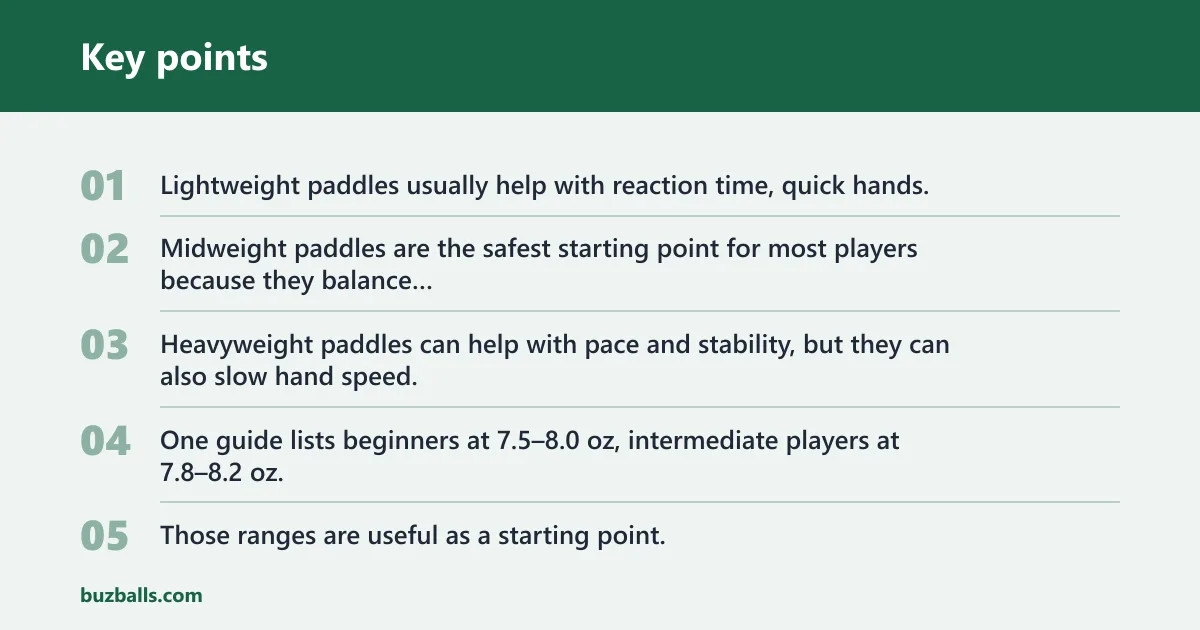
Lightweight, midweight, and heavyweight ranges
Lightweight paddles usually help with reaction time, quick hands, and longer sessions if your arm is sensitive. Midweight paddles are the safest starting point for most players because they balance control, stability, and power. Heavyweight paddles can help with pace and stability, but they can also slow hand speed.
One guide lists beginners at 7.5–8.0 oz, intermediate players at 7.8–8.2 oz, and advanced players at 8.2–8.5 oz. Those ranges are useful as a starting point, but your shot pattern should still decide the final pick.
What most beginners should try first
New players usually do best in the middle range, especially while learning dink control and block timing. A midweight paddle is easier to adapt after matches because it does not demand as much force as a heavy model or as much precision as a very light one.
How doubles and singles change the choice
Doubles rewards quicker hands, softer touch, and faster resets near the kitchen, so many doubles players lean lighter or midweight. Singles asks for more baseline pace and reaching stability, so a slightly heavier paddle can make sense if it does not slow recovery steps.
Step 2: Check swing weight and balance
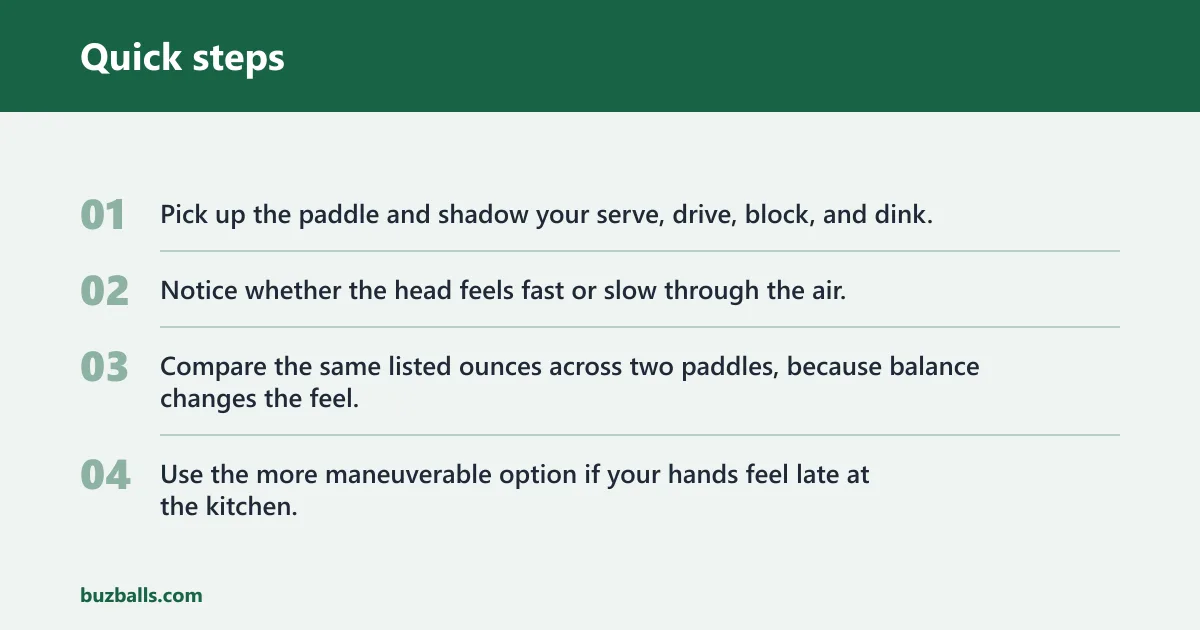
- Pick up the paddle and shadow your serve, drive, block, and dink.
- Notice whether the head feels fast or slow through the air.
- Compare the same listed ounces across two paddles, because balance changes the feel.
- Use the more maneuverable option if your hands feel late at the kitchen.
Swing weight matters as much as static weight. A paddle that sits more in the head can feel heavier than its listed ounces suggest, while a more handle-forward design can feel easier to move even when the scale reads the same.
How balance changes control and power
More head weight usually adds stability and power on contact. More handle balance usually improves control, touch, and reaction speed. The same 8.0 oz paddle can feel very different depending on where that mass sits.
Core thickness and face material also change the feel. Pickleball Central notes paddle thicknesses from 8-20mm, thinner paddles often have more pop or rebound, and thicker paddles help control the ball more easily. Fiberglass faces often feel livelier, while carbon fiber or raw carbon tends to feel more muted and precise. A polypropylene core is common because it helps keep the paddle consistent and stable.
What size pickleball paddle should I get?
Choose grip size before you settle on weight, because the wrong handle can make a good paddle feel unstable. Small grips are commonly about 4 to 4.125 inches, medium grips are about 4.25 to 4.375 inches, and large grips are about 4.5 inches and up. A grip that is too large can reduce wrist action; one that is too small can feel loose on contact.
How do you know if a paddle feels wrong?
A paddle is too heavy if your hand slows late in games, your resets arrive late, or your shoulder and forearm feel loaded after repeated blocks. A paddle is too light if off-center contact twists the face, drives float more than expected, or the paddle feels unstable against hard shots.
Signs it is too heavy
Watch for slower reaction speed at the net, a late start on counters, and rising elbow, wrist, or shoulder fatigue. If you keep shortening your swing just to survive, the paddle is probably asking too much.
Signs it is too light
Look for face flutter on blocks, weak returns against pace, and a need to over-swing for depth. If you keep losing stability on drives or volleys, you may need more mass or a more head-friendly balance.
When comfort changes the choice
Wrist sensitivity usually points toward lighter or midweight paddles with easier handling. Elbow sensitivity often rewards a more stable paddle that does not force abrupt deceleration. Shoulder fatigue is a warning sign that the paddle may be too heavy for long sessions, especially in singles.
Step 3: Fit grip, materials, and standards
- Choose the grip size that lets you hold the paddle without squeezing hard.
- Match the face and core to the feel you want: softer control or livelier pop.
- Check that the paddle meets USA Pickleball equipment standards before sanctioned play.
- Test the same paddle after matches, not only on fresh hands.
USA Pickleball standards matter for sanctioned play, equipment rules, and approved materials. If you plan to enter organized events, confirm that the paddle is legal before you buy or modify it.
How materials change handling
Fiberglass faces often produce more pop, which can help power but may make soft control harder. Carbon fiber and raw carbon usually feel more muted and predictable, which helps touch players. A thicker core tends to quiet the paddle; a thinner core tends to feel quicker and livelier.
Shape also matters. Standard shapes are often easier for beginners to handle, while elongated paddles maximize reach and power potential. That extra reach can come with more swing weight, so the shape can change the feel as much as the listed ounces.
Paddle weight decision matrix
| Playing style | Common shot patterns | Arm comfort | Recommended weight band | What to test in your next 3 sessions |
|---|---|---|---|---|
| Control and touch | Dinks, resets, blocks, short volleys | Wrist or elbow sensitivity | Under 7.3 oz to 7.8 oz | Kitchen speed, third-shot drop control, late-game hand speed |
| Balanced all-court | Mix of dinks, drives, counters, rolls | Neutral, no strong pain points | 7.8 oz to 8.2 oz | Reset quality, drive depth, transition blocks |
| Power and baseline | Drives, passing shots, overheads | Shoulder fatigue or late-match heaviness | 8.2 oz to 8.5 oz, then only heavier if still quick | Serve pace, counter stability, recovery speed after big swings |
| Soft game first | Dinks, drops, roll volleys | Any arm soreness after long play | Midweight with lower perceived swing weight | Touch on drops, kitchen blocks, face stability |
| Aggressive game first | Hard volleys, counters, speedups | No joint pain, but fatigue matters | Midweight to heavy, depending on hand speed | Reaction time, net exchanges, stability on hard contact |
Failure-case checklist
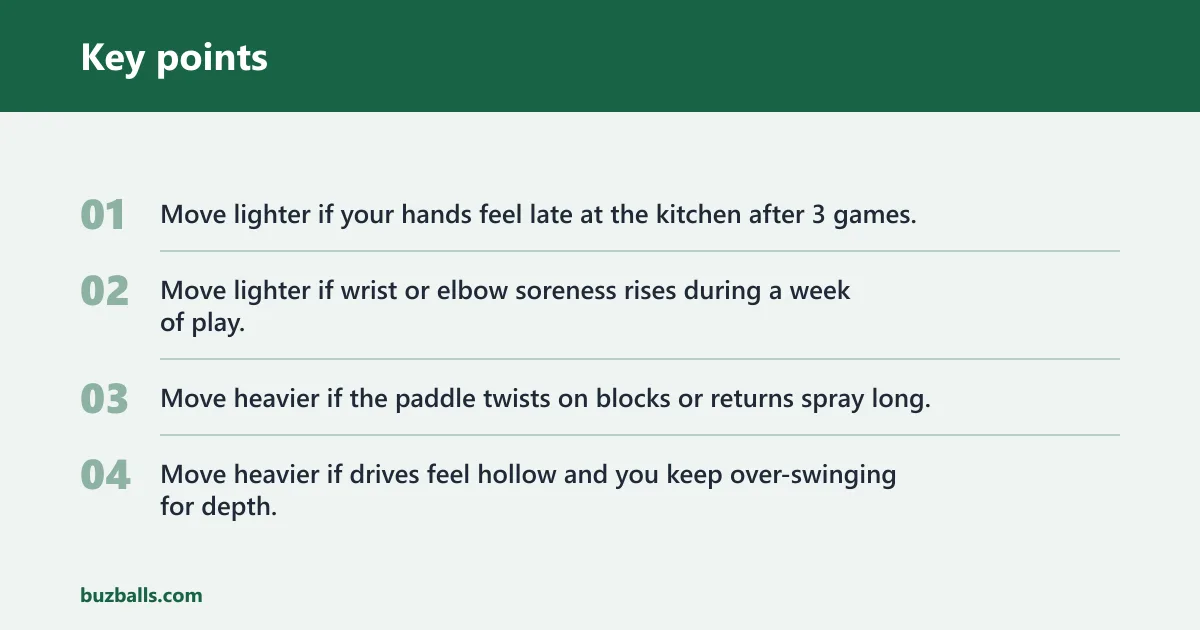
- Move lighter if your hands feel late at the kitchen after 3 games.
- Move lighter if wrist or elbow soreness rises during a week of play.
- Move heavier if the paddle twists on blocks or returns spray long.
- Move heavier if drives feel hollow and you keep over-swinging for depth.
Tryout protocol
Test one paddle for 3 games, then compare it to your baseline. After 10 games, note whether your misses shift toward the net or long. After a full week, keep only the weight that still feels quick when you are tired.
How to add weight to a pickleball paddle: start with 1 to 2 grams of lead or tungsten tape per side near the perimeter, then recheck balance after each addition. Adding tape near the head raises stability and power more than handle tape, which mainly changes balance and feel. Stop as soon as hand speed starts to drop.
Common mistakes include choosing by ounces alone, ignoring grip size, and judging a paddle after one fresh set. A lighter paddle is not automatically better for control, and a heavier paddle is not automatically better for power if it slows your reaction speed.
Picture a smaller-framed intermediate player who wins points with soft hands in doubles. A 7.9 oz midweight paddle with a medium grip may feel easier to manage than a 8.6 oz power model, even if both are legal and both are marketed for all-court play.
Frequently asked questions
What weight is best for my playing style?
Start with midweight if your game mixes soft shots and drives. If you win mostly at the kitchen with touch, go lighter. If you win from the baseline with pace and want more stability, move heavier only as long as your swing stays compact and quick.
Should I choose a lightweight, midweight, or heavyweight pickleball paddle?
Choose lightweight if arm comfort and reaction speed matter most. Choose midweight if you want the safest all-around starting point. Choose heavyweight only if you can still react quickly in hands battles and your joints stay comfortable through longer play.
Is a lighter pickleball paddle better for control or power?
A lighter paddle usually helps control, touch, and fast hand exchanges more than raw power. It can also reduce fatigue. It gives up some putaway pace and stability, so hard hitters often need more compact swings or a slightly heavier setup.
What weight do most pro pickleball players use?
Pro preferences vary by role, court position, and format, so there is no single pro number. Many competitive paddles sit in the 7 to 8.5 oz range, with some players choosing heavier setups for stability and others staying lighter for speed at the net.
How do I know if my paddle is too heavy or too light?
Too heavy shows up as slower hand speed, late counters, and arm fatigue. Too light shows up as unstable blocks and weak contact on pace. If you are unsure, test the same shot pattern for 3 games with each paddle and compare late-match control.
What is the best paddle weight for beginners?
New players usually do well in the middle range, with many starting near 7.8 to 8.2 oz. That range is easier to learn with because it gives enough stability for contact while still moving fast enough for kitchen exchanges and resets.