Pickleball Paddle Weight Guide: How Weight Affects Your Game

Many players tend to do well with a pickleball paddle in about the 7.8–8.3 oz range: choose the lower end for quicker hand speed and lower arm load, choose the higher end for more ball-drive momentum and steadier contact, and adjust in 0.1–0.2 oz steps. Miss the weight, and you can give up put-away power, soft-game control, hand speed, or your shoulder by the third game. This guide maps common on-court symptoms to paddle weight, swing feel, and simple fixes such as lead tape or a lighter frame.
What does pickleball paddle weight actually mean?
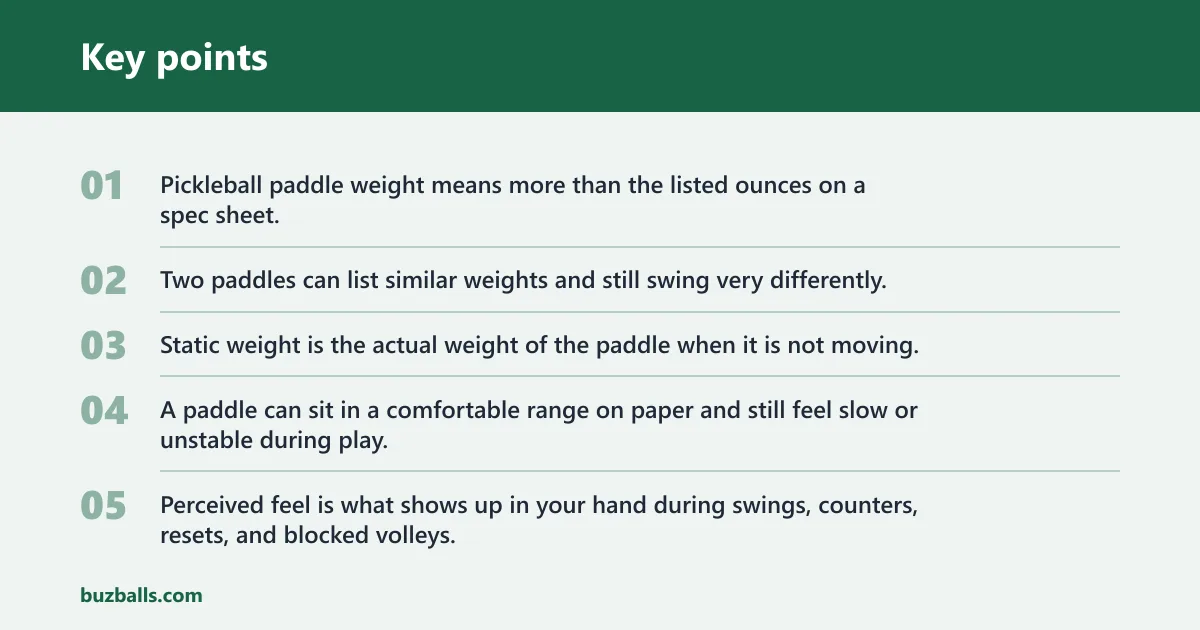
Pickleball paddle weight means more than the listed ounces on a spec sheet. The key split is between static weight, which is the paddle’s actual weight at rest, and perceived feel, which shifts with balance, shape, and where the mass sits. Two paddles can list similar weights and still swing very differently.
Static weight is the number at rest
Static weight is the actual weight of the paddle when it is not moving. Most manufacturers list it in ounces, and the common categories are lightweight under 7.5 ounces, midweight from 7.6 to 8.4 ounces, and heavyweight over 8.4 ounces.
That number matters, but it does not tell the whole story. A paddle can sit in a comfortable range on paper and still feel slow or unstable during play.
Perceived feel comes from balance and shape
Perceived feel is what shows up in your hand during swings, counters, resets, and blocked volleys. Head-heavy paddles usually feel slower to start and stop. Handle-heavy paddles often feel quicker, even if the total weight is close.
Paddle shape changes this too. A longer, stretched paddle can carry more mass away from the hand, which often makes it feel heavier in motion than a shorter, wider paddle at a similar static weight.
Why similar listed weights can play differently
Two paddles can both weigh 8.0 ounces and still produce opposite reactions at the kitchen. One may feel crisp and fast because more weight sits near the handle. The other may feel late on hand battles because more of its mass sits toward the tip.
Weight also interacts with thickness and balance. Thicker, more stable builds can calm mishits, while thinner or more head-heavy setups may feel livelier but harder to control under pressure.
Why do static weight, swing weight, and twist weight matter?
These three measurements explain different problems. Static weight tells you the paddle’s total mass, swing weight tells you how heavy it feels in motion, and twist weight tells you how well it resists wobbling on off-center contact. If a paddle feels wrong, the fix depends on which one is causing the issue.
Static weight: the listed total
Static weight is still useful because it sets the overall starting point for fatigue, power potential, and how much mass is available to absorb impact. More total mass usually helps the paddle carry through contact, while lighter models usually lower strain and speed up hand exchanges.
Swing weight: how heavy the paddle feels in motion
A higher swing weight feels heavier and harder to maneuver. A lower swing weight feels lighter and easier to swing quickly. That is why two paddles with close static weights can feel completely different when you speed up a volley exchange.
Koala lists low swing weight as less than 110 kg*cm2, mid-range swing weight as 110-120 kg*cm2, and high swing weight as over 120 kg*cm2. Those ranges are useful because they point to reaction-speed tradeoffs that a plain ounce number cannot show.
Twist weight: stability on mishits
Twist weight is about resistance to turning when the ball catches the edge or lands away from the center. Higher twist weight usually helps on blocked volleys, stretched counters, and defensive saves. Lower twist weight can make mishits flutter, open the face, or die short.
This is separate from swing weight. A paddle can feel quick through the air yet still twist too much on off-center contact.
How to tell which one is the problem
- Static weight issue: your arm feels loaded even before fast exchanges begin, especially late in longer matches.
- Swing weight issue: your hands are late at the net, speed-ups beat your paddle to the spot, and counters arrive a fraction slow.
- Twist weight issue: centered shots feel fine, but edge contact or hurried blocks wobble and spray.
How does paddle weight affect your game?
Paddle weight changes four things most: put-away power, soft-game control, hand speed, and fatigue. More mass can improve plow-through and stability, but it can also slow reactions. Less mass can speed up the hands and reduce strain, but it may give up stability or depth unless the balance is right.
Power, plow-through, and put-away pace
More total mass often helps the paddle keep moving through contact, which is why heavier setups can feel better on drives and overhead put-aways. Selkirk describes midweight models as allowing more power, and heavyweight paddles can push that further for players who can still swing them cleanly.
That does not mean every heavier paddle hits harder for every player. If the swing weight gets too high, swing speed can drop enough to cancel the extra mass.
Control on drops, dinks, and resets
Control depends on more than softness. The same source says lighter paddles help maintain more control, which often shows up in quicker face adjustments and easier touch on short swings. But stable weight distribution matters too, especially when a reset contacts outside the center.
If your resets float high, the cause can go either direction. Too much swing weight may make the face late and open. Too little stability may let the paddle twist on contact and send the ball up.
Hand speed in fast exchanges
The same source says lightweight models help players react faster at the net. That matches what swing weight predicts: lower swing weight gives faster reactions, easier counters, and less effort when changing paddle direction in a firefight.
Say your doubles game revolves around compact backhand counters and quick middle poaches. A lighter or more handle-biased setup often helps more than adding raw mass.
Fatigue over long matches
Heavier setups can add strain over repeated games, especially in the shoulder and forearm. The problem often shows up late. A paddle may feel fine in warmup and game one, then start dragging on overheads and backhand blocks by game three.
Match length matters here. If you play one short rec game, a high swing weight may be manageable. If you stack several games or long tournament days, the same setup can turn into slower hands and sore mechanics.
How to narrow paddle weight by style and feel
If you want the quickest path to a better paddle match, start by pairing weight with how you actually play: lighter setups help speed at the kitchen line and can feel easier on the arm, while heavier paddles can add stability if you can still keep your swings compact. The supporting guide on pickleball paddle weight explains how to use your shot pattern, injury risk, and a simple on-court check to avoid a paddle that feels sluggish, harsh, or hard to control.
That matters because the wrong weight can show up as late hands, extra wrist strain, or inconsistent touch, even if the paddle looks right on paper.
What weight category should you start with?
The best starting category depends on what you need most from the paddle. Lightweight paddles under 7.5 ounces favor speed and easier handling, midweight paddles from 7.6 to 8.4 ounces balance traits, and heavyweight paddles over 8.4 ounces favor mass and stability if fatigue stays manageable.
Lightweight: under 7.5 ounces
Lightweight paddles are typically under 7.5 ounces. This range suits players who want quicker hand speed, easier maneuverability, and less arm load over long sessions. It often fits doubles-first players, some seniors, and anyone who feels late in hand battles.
The tradeoff is that very light setups can feel less stable on blocks and off-center contact unless the twist weight is still strong.
Midweight: 7.6 to 8.4 ounces
Midweight paddles usually range from 7.6 to 8.4 ounces. This is the broad middle because it can cover many styles once balance is factored in. It is a sound starting point for many new players, but only after narrowing by symptoms and playing style.
A common first-timer mistake is buying the middle of the range and assuming the problem is solved. An 8.0-ounce paddle can still feel sluggish if it is head-heavy, or unstable if its twist weight is low.
Heavyweight: over 8.4 ounces
Heavyweight paddles exceed 8.4 ounces. This range can help players who want more plow-through, more blocking stability, and easier depth on drives. It often suits strong players, former tennis hitters, or singles players who attack more from the baseline.
The risk is faster fatigue. If the shoulder starts to dip or the paddle face trails behind on fast balls, the setup may be too heavy for the length of play.
Choose a target range, not a single number
Use your style and match load to pick a range. For quicker hands and lower fatigue, stay near the lower part of midweight or lighter. For more stability and drive depth, stay in the upper midweight to heavyweight area, then tune the feel in 0.1–0.2 oz steps.
Which weight fits your player type?
Your background changes what “right weight” feels like. Beginners often need a forgiving middle ground, doubles specialists usually value speed first, tennis converts often tolerate more mass, and players managing elbow or shoulder discomfort usually benefit from lower strain and better balance rather than chasing the heaviest setup.
Beginners and improving rec players
Beginners are often steered toward midweight, and that can be a reasonable choice when strength, stroke shape, and preferences are still forming. But split this group up. A stronger beginner coming from tennis may be comfortable near the upper midweight area, while a true first-timer focused on kitchen play may do better lighter.
If contact quality is inconsistent, avoid assuming “heavier equals more control.” Stability helps, but so does being able to set the face quickly.
Doubles specialists and quick-hands players
If most points are won at the kitchen, reaction time is usually the first filter. Lower swing weight matters here. A paddle that feels fast on resets, counters, and hand battles often beats a more powerful option that arrives late to the ball.
Players in this segment often land in lightweight or lower-midweight static weight, with balance adjusted for enough stability on blocks.
Tennis converts and power-first hitters
Former tennis players often prefer more mass because they are used to driving through the ball and finishing points with pace. That can work, especially in singles or aggressive transition play, but pickleball punishes slow hands more often than tennis does.
Suppose a tennis convert picks an 8.6-ounce paddle and loves the depth on drives, then struggles on chest-high speed-ups. The issue may be swing weight, not total power. A slightly lighter or less head-heavy setup can keep the drive without giving away every firefight.
Seniors and players managing elbow or shoulder discomfort
Less strain usually matters more than maximum plow-through. A lighter static weight or a lower swing weight can reduce the effort needed to start, stop, and redirect the paddle through repeated exchanges. For these players, long-session comfort is often a better guide than a single hard-hit drive.
That is not medical advice. It is equipment logic: when a setup asks for less effort per swing, fatigue usually arrives later.
How can you diagnose a bad weight fit from your on-court symptoms?
Start with what the ball and your body are telling you. Late hands, high resets, shoulder drag, weak put-aways, unstable blocks, and frequent mishits point to different causes. Some mean the paddle is too heavy, some mean too light, and some point to balance or twist weight instead of total ounces.
Signs your setup may be too light
A too-light setup often shows up as unstable blocks, short drives, and off-center shots that wobble or spray. You may also feel that the paddle gets pushed around by pace. That points to a need for more total mass, more twist weight, or both.
Signs your setup may be too heavy
If your hands are slow at the net, your backhand counter arrives late, or your shoulder tires before the session ends, the setup may be too heavy overall or too high in swing weight. Head-heavy balance makes this show up faster.
When the real issue is balance, not total weight
Some paddles miss the target because of distribution, not ounces. A head-heavy 8.0-ounce paddle can sometimes feel slower than a handle-heavy 8.2-ounce paddle. If the listed weight seems reasonable but the paddle still drags in fast exchanges, suspect swing weight first.
Picture an 8.1-ounce paddle that feels fine on serves yet clumsy on kitchen counters. That is a classic balance clue. The paddle may not be too heavy at rest, it may simply carry too much mass far from the hand.
How match length changes the diagnosis
If the problem appears only late, fatigue is part of the answer. A setup that works for ten minutes can still be the wrong match fit for ninety. Judge the paddle after short games and again after a longer run, because weight problems often hide early.
Weight fit checklist
| Player symptom | Likely weight issue | Adjustment to test |
|---|---|---|
| Slow hands at the net | Swing weight too high, or head-heavy balance | Test a lower swing weight paddle or remove head bias; if customizing, reduce tip weight before changing total ounces |
| Missed resets | Either too much swing weight causing late face control, or too little twist weight causing flutter on off-center contact | Compare a quicker paddle first, then test small side weight for more stability if mishits are the trigger |
| Arm fatigue | Static weight too high, swing weight too high, or both for the length of play | Drop into a lighter setup or a more handle-biased balance and recheck after multiple games |
| Lack of put-away power | Static weight too low, swing weight too low, or contact quality reduced by instability | Test 0.1–0.2 oz added mass, starting with upper hoop for plow-through if hand speed is still acceptable |
| Unstable blocks | Twist weight too low | Test small weight additions on both sides of the paddle to improve resistance to twisting |
| Mishits | Often twist weight or balance mismatch rather than total static weight alone | Keep the same total weight if needed, but test a more stable shape or side weighting before going much heavier |
How do balance and lead tape change paddle feel?
Balance changes where the paddle feels heavy, and lead tape changes that balance. Weight at the top usually raises plow-through and swing weight, weight on the sides usually improves stability, and weight near the handle usually shifts feel toward quicker handling without the same jump in head-heaviness.
Head-heavy vs handle-heavy feel
Head-heavy paddles usually offer more momentum through contact, but they can feel slower in hand battles. Handle-heavy paddles often feel quicker to position and easier to recover after contact. Neither is always better. The right choice depends on whether your bigger problem is speed, stability, or depth.
What lead tape changes by placement
Pickleballsinfo says lead tape is one of the best ways to add weight to a paddle, and it says using lead tape can improve stability and control. Pickleballsinfo also says the USAPA rule book allows lead tape on paddles.
- Top of the paddle: raises swing weight fastest, often adding more plow-through and put-away punch, but also making the paddle feel slower.
- Sides of the paddle: tends to improve twist resistance, helping blocks and mishit consistency more than raw pace.
- Handle area: adds static weight while changing balance less aggressively, which can make the paddle feel less head-heavy.
How much weight to add before re-testing
Use small changes. The practical move is 0.1–0.2 oz at a time, then re-test before adding more. Large jumps make it hard to tell whether the improvement came from more mass, more stability, or simply from changing too many variables at once.
Mistakes to avoid when customizing
- Do not add weight in multiple locations on the first round if you want a clear read on the result.
- Do not assume top weight fixes every weak shot; it can also slow hands and raise fatigue.
- Do not chase power if the real issue is face stability on mishits.
How should you test paddle weight in one session?
Test paddle weight by holding the drill set constant and changing only one variable at a time. Compare two paddles with similar shapes, or one paddle before and after a small weight change, then judge hand speed, reset height, block stability, and fatigue in the same session.
Before you start: set a fair comparison
- Match the baseline. Use the same balls, court, partner, and drill order for both setups. Keep grip size and overgrip the same if possible, because grip changes can alter perceived handling.
- Change one variable. Compare two paddles close in shape and face style, or add only 0.1–0.2 oz of weight in one location. That isolates whether the result came from static weight, swing feel, or stability.
- Pick a target symptom. Decide what you are trying to fix before the first rally: slow hands, floating resets, weak put-aways, unstable blocks, or fatigue. One clear symptom gives the session a useful pass-fail test.
The shot groups that reveal problems fastest
- Start with hand battles. Hit short kitchen exchanges and fast counters for a few minutes. This exposes swing weight quickly because a sluggish paddle shows up here before it shows up on serves.
- Move to resets and blocks. Feed pace from the transition zone and defend with compact resets and blocks. Watch whether misses are late-face pop-ups or twisting mishits, because those point to different fixes.
- Finish with drives and put-aways. Hit a small set of third-shot drives, overheads, and shoulder-high put-aways. This tells you whether extra mass is helping depth and plow-through enough to justify any loss in hand speed.
What to track in short games and longer runs
- Track early reaction speed. In the first game, note whether your paddle gets to speed-ups on time. Early lag usually points to swing weight more than fatigue.
- Track mishit behavior. Note what happens when contact drifts from center. If the face twists and the ball sprays, the setup likely needs more stability, not simply more ounces everywhere.
- Track late-session strain. After several games, check forearm and shoulder effort on counters, serves, and overheads. If performance falls off late, the setup may be fine in bursts but wrong for real match length.
How to decide what to change next
If speed improves but stability gets worse, add a little side weight instead of jumping to a much heavier paddle. If power improves but hand speed drops too much, reduce head bias before cutting total weight. If fatigue is the main issue, lower total load or move the balance closer to the hand.
Frequently asked questions
What pickleball paddle weight should I use?
Most players should start in the 7.8–8.3 oz area, then adjust based on symptoms. Go lighter if your hands are late or your arm tires early. Go heavier if blocks feel unstable or put-aways lack depth. Use on-court feel and small changes, not ounce range alone.
How does paddle weight affect power and control?
More weight can add plow-through and depth, especially on drives and put-aways, but too much can slow your face control. Less weight can help touch and reaction speed, yet very light setups may lose stability. Control depends on balance and twist resistance as much as total mass.
What is the difference between static weight and swing weight?
Static weight is the paddle’s actual weight at rest. Swing weight is how heavy it feels when you move it. Two paddles can have similar static weight and very different swing weight if one carries more mass toward the tip, making it feel slower and harder to maneuver.
How does paddle weight affect arm fatigue?
Heavier setups, especially head-heavy ones, usually demand more effort over repeated swings and longer sessions. That can show up as slower hands, shoulder drag, or forearm fatigue later in play. A lower static weight or lower swing weight often helps more than focusing on raw ounces alone.
Should beginners use a lightweight or midweight pickleball paddle?
Many beginners do well with midweight paddles from 7.6 to 8.4 ounces, but that is only a starting point. A stronger tennis convert may prefer the upper end, while a doubles-first beginner may benefit from something lighter and quicker. Style and symptoms matter more than skill label alone.
How much weight can I add with lead tape?
Use small, measured changes and re-test after each one. A practical adjustment is 0.1–0.2 oz at a time, because that is enough to feel without muddying the diagnosis. Add weight at the top for more plow-through, at the sides for stability, or near the handle for less head-heavy feel.