Pickleball Paddle Weights Explained: What Do the Numbers Mean?

Pickleball paddle weight specs usually include total weight, often about 6.5 to 8.5 ounces, plus balance-related numbers like swing weight and twist weight. Read them together, because the same total weight can feel fast, stable, or sluggish. Misreading those numbers can leave you with arm strain, weak reset control, or a paddle that fights your style. This guide explains every weight-related spec on a paddle sheet and how to compare them correctly.
What do paddle weight numbers mean?
The number printed most often is static weight: the paddle’s total mass on a scale, usually measured in ounces. That number does not tell you how the paddle moves through the air, how stable it is on off-center contact, or how the handle and head are balanced. You need the other weight specs to get the full picture.
Weight changes hand speed, stability, comfort, and fatigue. A lighter paddle is easier to swing quickly and recover with, but the same “light” label can hide very different swing feel if the weight sits more in the head. That is why two paddles with nearly identical ounces can play very differently.
Static weight versus swing weight
Static weight is the plain number a manufacturer lists after weighing the paddle on a digital scale. Swing weight increases when more mass sits farther from your hand. It describes how heavy the paddle feels when you swing it, and it rises when more mass sits farther from your hand. A paddle can be modest on the scale and still feel slow through the air.
That difference matters most at the kitchen line and on quick exchanges. If you need fast reactions, the better question is not “How many ounces?” but “How much of that weight sits out in front of me?”
Twist weight and off-center hits
Twist weight measures resistance to twisting when contact lands away from the center. Higher twist weight usually means the face holds steadier on mishits, so blocks, counters, and resets lose less shape. Lower twist weight can feel quicker, but it is less forgiving.
That is why a paddle can feel light in hand yet still punish mishits. Static weight is one number. Twist weight is another. Together they tell you whether a paddle is merely light or also stable.
Which specs you should read together?
Read static weight, swing weight, twist weight, and balance point as a set. Static weight tells you total mass. Swing weight tells you how fast it moves. Twist weight tells you how well it resists turning on contact. Balance point tells you where that mass sits.
Suppose two paddles both list 7.8 ounces. One places more mass in the head and has a higher swing feel. The other sits closer to the hand and feels quicker on resets. Same ounce number. Different play.
Static weight, swing weight, and twist weight
Static weight is what most buyers see first, but it is only the starting point. Swing weight and twist weight explain what the paddle does once you start hitting. If you only compare ounces, you can miss the real reason one paddle feels lively and another feels clumsy.
How static weight is measured
Static weight is measured on a digital scale and listed in ounces. Manufacturers often publish it as the main weight spec because it is easy to compare. That number, however, can shift slightly from one paddle to the next because of build variation.
That is why two paddles from the same line can feel a little different even when the listed weight matches. The printed figure is a reference point, not a promise of identical on-court feel.
What swing weight changes on court
Swing weight changes how fast the paddle accelerates, how quickly it stops, and how tiring it feels during repeated swings. More mass farther from the hand raises swing weight, which can help drive through the ball but can slow reaction time on fast exchanges.
If you have slower swing speed, a high swing-weight paddle may feel heavier than the scale suggests. If you rely on quick blocks and counters, you will usually notice swing weight before you notice static weight.
Why twist weight matters on mishits
Twist weight matters when the ball lands toward the edge of the face. Higher twist weight reduces flutter and keeps the face from opening or closing too much on contact. That often means better forgiveness and cleaner direction on defensive shots.
Players who miss the center often, or who want more stability on blocks, should pay attention here. The number helps explain why some paddles feel calm on contact while others twist in the hand.
Balance point and paddle feel
Balance point tells you whether the paddle feels head-heavy or head-light. It is usually measured from the butt cap. Read it with static weight and swing weight, because balance can make the same ounce number feel very different in play.
Head-heavy versus head-light
A head-heavy paddle places more mass toward the face, which can add plow-through and stability but can also slow hands. A head-light paddle shifts more mass toward the handle, which usually helps quick reaction and faster hand speed.
The published weight number alone will not reveal that balance. Two paddles can both be midweight, yet one feels nimble and the other feels like the head keeps leading the swing.
How balance point affects maneuverability
Balance point is one of the best clues for maneuverability. When the weight sits closer to the handle, the paddle often feels easier to reload between shots. When the balance shifts toward the head, you may feel more punch, but you may also need more effort to reset the paddle after contact.
That is why balance point belongs beside swing weight, not beside static weight alone. One number tells you how much mass exists. The other tells you where it sits.
Paddle weight decoder
This table turns the weight-related specs into on-court meaning. Use it to compare paddles as a whole, not as isolated figures.
| Spec | What the number means | What it changes in play |
|---|---|---|
| Static weight | Total paddle mass listed in ounces after scale measurement | Baseline heft, overall comfort, and how heavy the paddle feels before you swing |
| Swing weight | How heavy the paddle feels in motion, based on mass placement farther from the hand | Maneuverability, hand speed, and how quickly you can react at the kitchen line |
| Twist weight | Resistance to twisting on off-center contact | Stability, forgiveness, and how steady the face stays on mishits |
| Balance point | Where the paddle’s mass sits from the butt cap | Head-heavy or head-light feel, plus how quick the paddle recovers between shots |
| Core thickness | How thick the internal core is, commonly linked to response | Thinner builds often feel more direct and explosive; thicker builds often feel calmer and more stable |
| Face material | Surface material that affects total mass and feel | Fiberglass tends to add weight; carbon fiber can reduce it |
| Edge guard | Protective rim around the head that adds material near the perimeter | Can raise final weight and often shifts balance slightly toward the head |
| Grip tape | Added material on the handle | Can change final weight and handle feel, with small but real effects on balance |
Edge guard and grip tape can contribute up to 0.2 oz to the final result, which is enough to change how a paddle feels if you are sensitive to balance. That is why published weight and final setup are not always identical. Small additions matter most on lighter builds.
Core thickness also has a major effect on paddle response. A 13mm core can be lighter and often feels more direct and explosive. A 16mm core often offers more control and a calmer response, which many players prefer for resets and blocks.
Face material matters too. FYFUL says fiberglass can add weight, while carbon fiber can reduce it. That does not mean every fiberglass paddle is heavy or every carbon fiber paddle is light, but the material choice can move the final number in either direction.
How to use the decoder before you buy
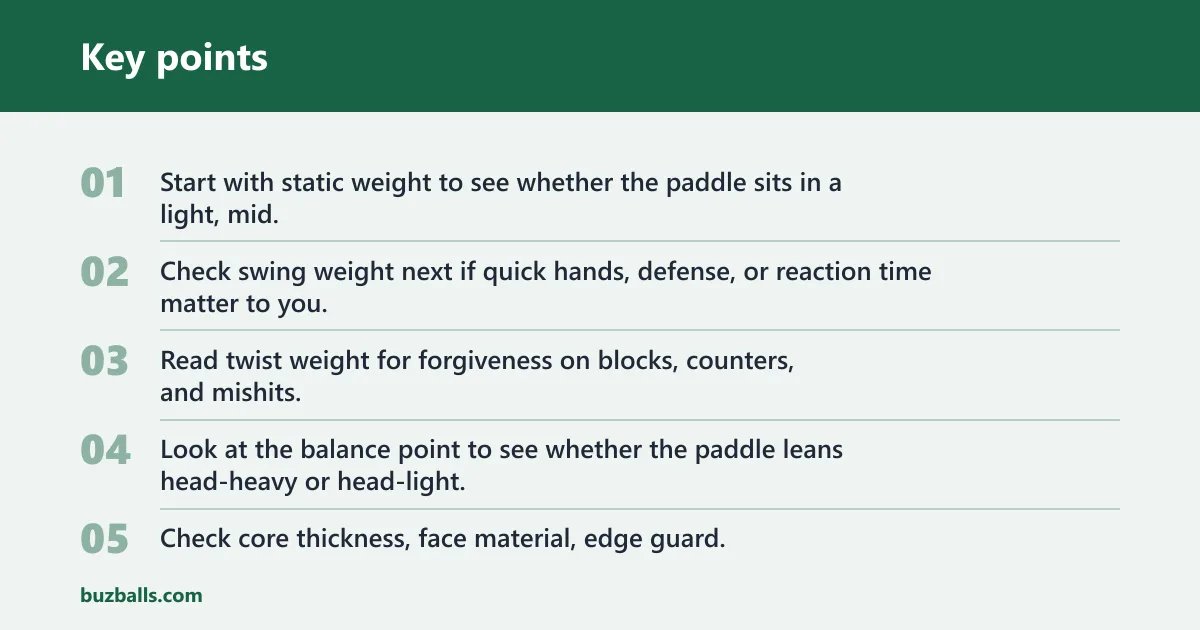
- Start with static weight to see whether the paddle sits in a light, mid, or heavy category.
- Check swing weight next if quick hands, defense, or reaction time matter to you.
- Read twist weight for forgiveness on blocks, counters, and mishits.
- Look at the balance point to see whether the paddle leans head-heavy or head-light.
- Check core thickness, face material, edge guard, and grip tape to judge why the listed number may shift in real use.
What is a lightweight paddle?
Lightweight paddles are listed under 7.3 ounces. Some guides use under 7.5 ounces, which is why brand charts can look inconsistent. The practical idea is the same: lighter paddles usually let you swing faster and react sooner, and they are often chosen for defensive or finesse play.
Who benefits most from lighter paddles
Players who want fast hands, quick blocks, and easier reaction time often gravitate to this category. It can also suit smaller hands, slower swing speed, or anyone trying to reduce arm strain. A lighter paddle can feel easier to place on the ball in tight exchanges.
A common first-timer mistake is choosing the lightest paddle available and assuming it will solve every problem. If the paddle is too light for your swing, it can feel hollow on drives and unstable on off-center contact.
Trade-offs in power and stability
Lighter paddles usually give up some power and stability. That trade-off shows up most on put-aways, blocks against pace, and shots hit away from the center of the face. You gain quicker hands, but you may need cleaner technique to keep depth and control.
What is the difference between midweight and heavy?
Midweight paddles sit at 7.3 to 8.4 ounces, while heavyweight paddles are listed at over 8.5 ounces. The middle range is the common all-around choice because it balances power and control. Heavier paddles push farther toward stability and power, but they can increase fatigue.
Typical midweight ranges
Midweight paddles are the broad middle ground. They often fit players who want one paddle to handle drives, resets, counters, and serves without feeling extreme in either direction. The category is broad because makers and guides do not always use the same cutoff.
Typical heavyweight ranges
Heavyweight paddles emphasize power and stability. The trade-off is that the extra mass can slow hand speed and tire the arm over long sessions. If a paddle feels too heavy even when the listed weight looks normal, the balance point or swing weight may be the real issue.
How fatigue, power, and control change
Heavier paddles can help on drives and blocks because the extra mass resists being pushed around by the ball. They can also feel more planted on contact. But if your technique is late or if you play long doubles sessions, fatigue can creep in and reduce control late in play.
Picture a player with elbow pain choosing a heavy, head-loaded paddle because the ounces look manageable. The paddle may still feel demanding on repeated volleys because the swing weight and balance point load the arm more than the scale number suggests.
Weight choices by player type
There is no single best weight for everyone. Match the paddle to your style, arm comfort, and how quickly you need to get the face into position. Beginners, defensive doubles players, and singles power players often benefit from different weight profiles.
Beginners and all-court players
Beginners usually do best with a midweight paddle unless they have a clear reason to go lighter or heavier. Midweight gives enough stability to learn clean contact while still leaving room for quick reaction. All-court players often land here too because the category covers the widest range of shots.
Defensive doubles and quick hands
Players who live at the kitchen line often want a lighter or balanced midweight setup with lower swing feel. Quick hands matter more than raw power in many doubles rallies. If your main mistake is late reaction, a lighter and more head-light paddle can help.
Singles, power players, and arm-comfort priorities
Singles players and power-first hitters often prefer more mass because it helps drive the ball and stabilize contact. Players with elbow pain may need to stay away from heavy, head-loaded builds even if the total weight appears reasonable. Comfort depends on the full setup, not the ounce number alone.
Frequently asked questions
What do pickleball paddle weight numbers actually mean?
The main number is static weight, which is the paddle’s total mass listed in ounces. That figure does not explain how fast the paddle moves, how stable it feels on mishits, or where the weight sits. Swing weight, twist weight, and balance point fill in those gaps.
What is considered a lightweight pickleball paddle?
Lightweight paddles are generally listed under 7.3 ounces, though some guides use under 7.5 ounces. The range is meant to signal easier maneuvering and quicker reaction, which is why defensive and finesse players often like it. The exact cutoff varies by source.
What is the difference between midweight and heavyweight paddles?
Midweight paddles are listed at 7.3 to 8.4 ounces, while heavyweight paddles are listed at over 8.5 ounces. Midweight is the common all-around choice because it balances power and control. Heavyweight models usually add stability and power, but they can also increase fatigue.
How does paddle weight affect power and control?
More weight can help drive the ball and steady the face, especially on blocks and counters. Less weight usually makes the paddle easier to swing and place quickly. Control depends on more than ounces, though, because swing weight, twist weight, core thickness, and balance also shape the result.
What weight paddle is best for beginners?
Most beginners should start by looking at midweight paddles, because the category gives a workable balance of power, control, and forgiveness. If you want quicker hands or have arm discomfort, lighter can make sense. If you want more planted contact, a slightly heavier midweight may fit better.
What affects the final weight of a pickleball paddle?
Core thickness, face material, edge guard, and grip tape all affect the final result. A 13mm core can be lighter, while a 16mm core often feels more controlled. The same source says fiberglass can add weight and carbon fiber can reduce it, and edge guard plus grip tape may change the final number by up to 0.2 oz.
Can you change pickleball paddle weight with tape?
Yes. Tape can add weight and shift balance, usually toward the area where you place it. Small changes can help tune stability or swing feel, but they can also make a paddle feel slower if you add too much. Start with small amounts and test the result on court.