
What Size Basketball Hoop Is Best for a Driveway?

For many driveways, a 54- to 60-inch basketball hoop is a common size; about 48 inches can suit narrower spaces or younger kids, and 72 inches is generally only a fit if the driveway is wide and parking stays clear. Match the backboard width to the space you can spare, then pick the most stable hoop type that still leaves room to park and turn.
How driveway width affects board size
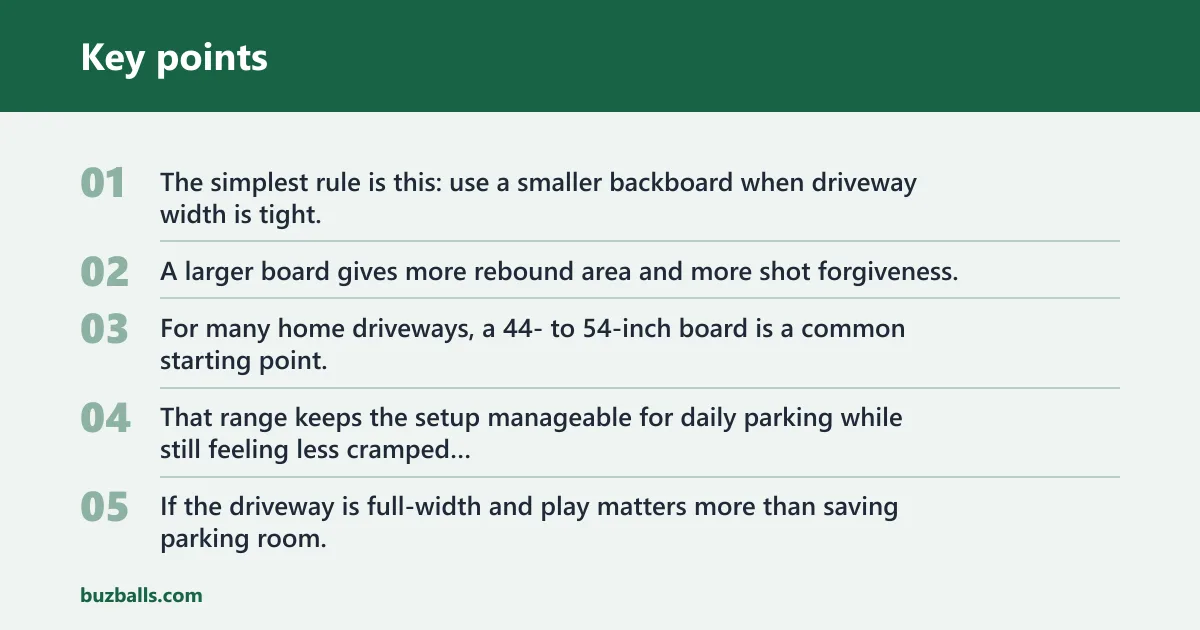
The simplest rule is this: use a smaller backboard when driveway width is tight, and move up in size only when parking clearance still feels comfortable. A larger board gives more rebound area and more shot forgiveness, but it also takes more visual and physical space near cars, garage doors, and turning paths.
For many home driveways, a 44- to 54-inch board is a common starting point. That range keeps the setup manageable for daily parking while still feeling less cramped than a very small board. If the driveway is full-width and play matters more than saving parking room, 60 inches is often the better fit.
The simple size rule
Backboard width should track both player level and the driveway’s usable width. Smaller boards suit compact driveways because they cut overhang and make it easier to keep a car lane open. Larger boards suit wider driveways because they give a bigger target and more surface for bank shots and misses near the rim.
What changes with driveway width
A one-car driveway leaves less room for both the pole and the car’s turning line, so a compact board usually makes sense. A two-car driveway gives you more flexibility, especially if one side stays open for play. If parking must happen in the same spot where the hoop sits, stability and clearance matter as much as board size.
When to choose a smaller board
Choose a smaller board if the driveway is narrow, if the hoop sits near a garage door swing, or if the family needs to park there every day. A smaller backboard also makes more sense when younger kids are the main users, because the setup is easier to place without crowding the driveway.
What size basketball hoop is best for a driveway?
For a one-car driveway, a compact portable hoop with about a 40- to 44-inch backboard is a practical starting point. For a two-car driveway, about 50 to 54 inches is often a good balance of rebound area and clearance. Renters usually need a portable or wall-mounted setup, with size limited by what the parking area can safely spare.
One-car driveway recommendation
A one-car driveway can suit a compact portable hoop. That is the best fit when you still need a clear path for a vehicle and want to avoid a backboard that dominates the space. A 40-inch or 44-inch board keeps the setup contained while still giving kids and casual players a usable target.
Two-car driveway recommendation
A two-car driveway can support a larger board, especially if the hoop sits to one side and does not block turning. A 54-inch backboard is often the strongest middle ground here. It gives a larger shooting window without pushing too far into parking space, and it feels closer to a full residential court setup.
Renter and shared-driveway recommendation
Renters should usually start with a portable hoop unless wall mounting is allowed and the structure can support it. Shared driveways need extra caution because parking and moving cars matter as much as shooting space. In those cases, a smaller portable system with a controlled footprint is usually the least disruptive option.
Say your driveway is one car wide and your family parks there every night. A 44-inch portable hoop leaves a better chance of keeping the car lane open than a larger board, and it is easier to place without forcing awkward turns near the rim.
Backboard size and rebound feel
Backboard width changes both rebound area and shot tolerance. Common residential sizes include about 40, 44, 50, 54, and 60 inches. Larger boards feel closer to regulation play because they give more room around the rim, while smaller boards demand cleaner aim and leave less margin on bank shots.
40-inch and 44-inch boards
A 40-inch or 44-inch board suits tighter driveways, lighter play, and homes where parking space matters most. Walmart listings show portable hoops with 44-inch backboards, and a portable hoop listing includes a 40-inch shatterproof backboard. Those sizes are common because they fit better in compact spaces and keep the footprint under control.
50-inch and 54-inch boards
A 50-inch or 54-inch board is usually the sweet spot for many driveway hoops. It gives more shot margin than a 40-inch or 44-inch board, but it does not crowd the driveway as heavily as a larger system. Walmart listings also show 54-inch portable basketball hoop systems, which fits the common need for a bigger target without full-court scale.
When 60 inches makes sense
Choose 60 inches when the driveway is wide enough that the board will not interfere with parking or walking paths. This size makes sense for families that play often or for players who want a larger practice target. It is less forgiving of space limits, so the extra width should be reserved for driveways that can spare it.
Driveway hoop types compared
Portable hoops use a weighted base and wheels, in-ground hoops are anchored for permanence, and wall-mounted hoops save floor space. The right type depends on parking, rental rules, and how often the hoop will be used. For a driveway, the size and the mounting method should be chosen together, not separately.
Portable hoops
Portable hoops move out of the way more easily, which helps when the driveway has to double as parking. Their base usually needs water or sand fill, and more fill generally means more stability. A 34-gallon base is one example of the kind of capacity buyers may see, but larger fill and stronger framing usually help more in wind and on hard cuts.
In-ground hoops
In-ground hoops stay steadier because they are anchored into a footing. That makes them better for frequent play, stronger rebound feel, and less wobble. They need suitable soil and a proper concrete footing, so they make the most sense when the hoop will stay in one place and the driveway layout allows a permanent install.
Wall-mounted hoops
Wall-mounted hoops save driveway floor space, which can be useful in tight or shared areas. They can be a smart choice when the wall position is suitable and parking needs must stay open. The tradeoff is placement flexibility: the mounting point controls the play area, and the wall must be able to handle the load safely.
Suppose a renter wants a hoop but must move out later without leaving hardware behind. A portable 44-inch system is the safer choice than a permanent in-ground install, because it can be repositioned or taken with the household.
Can an adjustable hoop work for kids and adults?
Yes. Adjustable hoops can work well for kids and adults because the rim height can be lowered for younger players and raised to regulation height for older players. Regulation basketball hoop height is 10 feet, and some adjustable driveway hoops lower to 7.5 feet, which gives a useful range for mixed-age family play.
Height settings for younger players
Younger players usually benefit from lower settings because the rim becomes easier to reach and shots are less discouraging. A setting around 6 to 7.5 feet is common for youth-friendly play, depending on the system. That range helps keep the hoop useful as skills develop instead of forcing a single height for everyone.
Why adults still need stability
Adults usually need more stability than younger players because harder drives, stronger shots, and more forceful rebounds can expose wobble. A portable system can work, but only if the base is filled well and the pole structure is stiff enough. Thicker steel poles, often around 3.5 to 6 inches on residential systems, generally move less than lighter builds.
When fixed height is the better pick
Fixed-height systems make sense when the hoop will be used mostly by teens or adults and the main goal is steadiness. They remove the moving parts that come with frequent height changes. If the driveway is wide enough and the hoop will stay in place, a fixed-height in-ground setup is often the steadier choice.
Driveway hoop sizing matrix
This matrix gives a practical starting point. It matches driveway type to backboard size, hoop type, and the main reason the setup fits. Use it to narrow the field before you compare materials or exact models.
| Driveway type | Recommended backboard size | Ideal hoop type | Why it fits |
|---|---|---|---|
| One-car driveway | 40 to 44 inches | Portable | Compact board leaves more room for parking and turning. |
| Two-car driveway | 50 to 54 inches | Portable or in-ground | More width allows a larger target without crowding the lane. |
| Renter | 40 to 44 inches | Portable or wall-mounted | Limits permanent changes and keeps the setup flexible. |
| Serious-player setup | 54 to 60 inches | In-ground | Larger board and stronger anchoring give a steadier feel. |
Space, stability, and installation checks
The right hoop still needs enough room around it. Parking clearance, turning radius, and the path to the garage should stay open. Stability depends on base fill, pole stiffness, surface quality, and whether the install method matches the ground below it.
Clearance and turning room
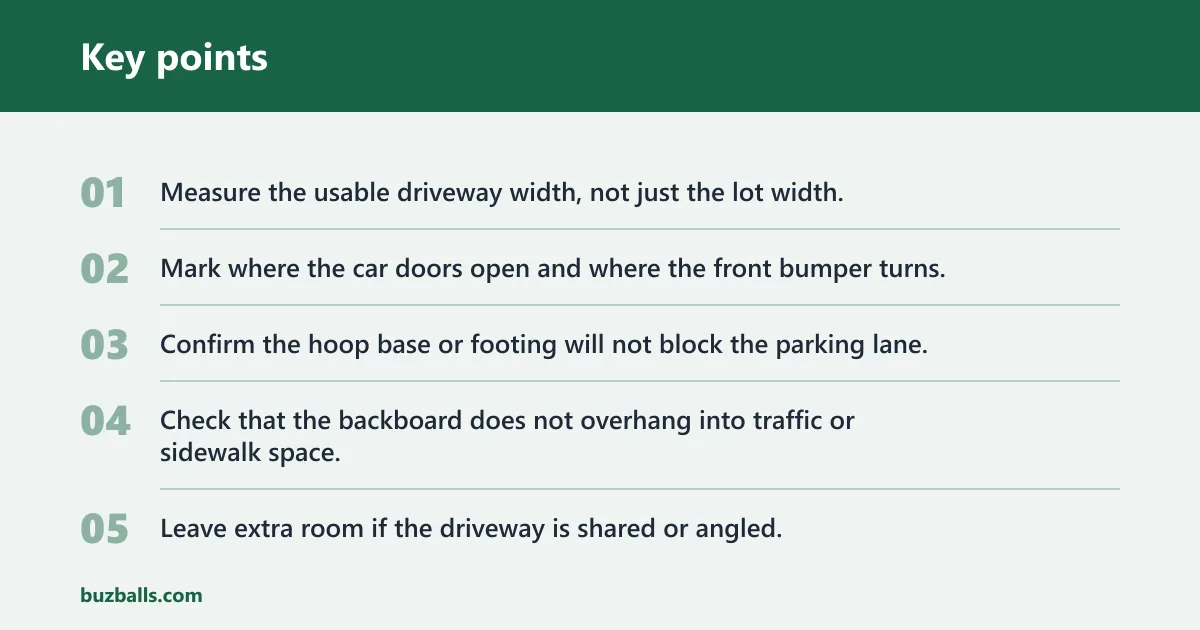
Before choosing size, check where the car actually swings while entering or leaving the driveway. A backboard that fits on paper can still create a problem if it sits too close to the parking line. The goal is to leave room for the hoop, the vehicle, and a clear walking path.
- Measure the usable driveway width, not just the lot width.
- Mark where the car doors open and where the front bumper turns.
- Confirm the hoop base or footing will not block the parking lane.
- Check that the backboard does not overhang into traffic or sidewalk space.
- Leave extra room if the driveway is shared or angled.
Base fill and wind resistance
Portable hoops depend on base fill. Water or sand adds weight, and more fill generally improves stability. That matters on windy days and during hard cuts to the basket. A larger base can help, but the real goal is enough mass to keep the pole from rocking when the rim is hit.
Surface, footing, and wobble risks
Flat asphalt or concrete is preferred for portable hoops because it helps the base sit evenly. Uneven ground increases wobble and can make the hoop settle over time. In-ground systems need proper soil conditions and a correct footing, because a poor base below the surface will show up later as leaning or movement.
A common first-timer mistake is choosing a large board first and the driveway second. A 54-inch hoop can work well on a broad driveway, but the same system may crowd a narrow lane and make everyday parking annoying.
Frequently asked questions
Is a 44-inch or 54-inch basketball hoop better for a driveway?
A 44-inch hoop is better for narrow driveways, renters, or younger kids because it takes up less space. A 54-inch hoop is better when you want a larger target and still have room to park. If the driveway is wide enough, 54 inches is usually the better all-around pick.
Should I get a portable or in-ground basketball hoop for my driveway?
Choose portable if parking space, rental status, or flexibility matters most. Choose in-ground if the hoop will stay put and you want the steadiest setup. Portable hoops are easier to reposition, while in-ground systems are more stable and usually feel firmer on rebounds and contact.
How much space do I need for a basketball hoop in a driveway?
You need enough room for the hoop, the car lane, and the turning path. A one-car driveway usually calls for a compact setup, while a two-car driveway can handle a larger board. The safest answer is to measure the actual usable width where the hoop base and car will overlap.
Can an adjustable basketball hoop work for adults and kids?
Yes. Adjustable hoops are a practical choice for mixed-age households because the rim can be lowered for kids and raised to 10 feet for older players. For adults, the key is height range and stability, especially base fill and pole stiffness.
What size basketball hoop feels most like a real court?
A 54- to 60-inch backboard usually feels closest to a real court in a driveway setting. Larger boards offer more rebound area and more room around the rim, which helps the setup feel less cramped. If the driveway is narrow, though, a smaller board may be the smarter tradeoff.