What Size Pickleball Paddle Do Beginners Need?

Beginners should start with a standard or widebody pickleball paddle around 7.5 to 8.0 inches wide, with a grip that fits hand size and a weight you can swing cleanly. Choose the wrong size and you can lose control, miss sweet-spot contact, or tire your wrist and forearm fast. This guide covers beginner paddle size, shape, grip, and weight, plus when a smaller or elongated model makes sense.
How to choose a beginner paddle
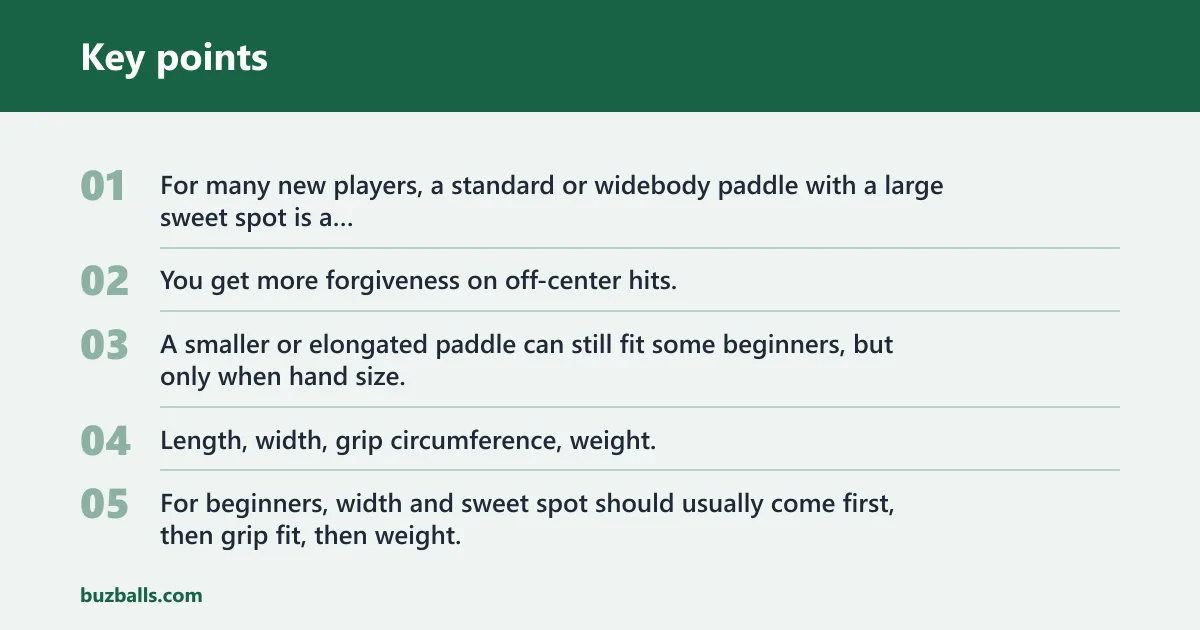
For many new players, a standard or widebody paddle with a large sweet spot is a practical first choice. You get more forgiveness on off-center hits, and that matters more than extra reach or extra power early on. A smaller or elongated paddle can still fit some beginners, but only when hand size, reach, or racket-sport habits point that way.
Think of paddle size in separate parts. Length, width, grip circumference, weight, and core thickness all affect how the paddle feels and performs. For beginners, width and sweet spot should usually come first, then grip fit, then weight.
Beginner paddle decision table
| Player type | Recommended shape | Typical dimensions | Grip size range | Why it fits |
|---|---|---|---|---|
| Players who want the most forgiveness | Widebody or square shape | About 15.5 to 16.0 inches long; about 8.0 to 8.25 inches wide | About 4 to 4.5 inches circumference | Large sweet spot, easier contact, less punishing on mishits |
| Average hands, first-time recreational players | Standard shape | About 16 inches long; about 7.5 to 8 inches wide | Medium grip, about 4-1/4 to 4-3/8 inches | Balanced size for control, comfort, and general use |
| Small hands | Standard or slightly narrower standard | About 15.5 to 16 inches long; width near 7 to 7.5 inches | Small grip, around 4 inches | Lets the hand close naturally without overgripping |
| Tennis-background players | Standard or elongated | About 16 to 16.5 inches long; width near 7 to 8 inches | Medium to large grip, about 4-3/8 to 4-1/2 inches | Longer reach and familiar hand position can feel more natural |
A common first-timer mistake is choosing an elongated paddle because it looks more advanced. Suppose a new player with average hands picks a long, narrow paddle for extra reach, then starts missing soft dinks near the kitchen line. The issue is often shape, not skill. A wider face would usually give better contact and more room for error.
When a smaller or elongated paddle can still fit
A smaller or elongated paddle can be correct if your hand size or playing background changes the fit. Tennis and other racket-sport players sometimes prefer a longer handle or a narrower face because the grip feels familiar. Players with smaller hands may also do better with a lighter, easier-to-close handle rather than a thick, bulky one.
That said, the beginner rule still holds: start with forgiveness unless you have a clear reason not to. For most new players, the best paddle is the one that helps the ball meet the face cleanly and often.
What paddle dimensions should you know?
Pickleball paddle size is not one number. You need to look at length, width, and the combined total. Standard paddles are often around 16 inches long and 8 inches wide. Paddles usually range from 15.5 to 16.5 inches long, and typical width is between 7 and 8.25 inches.
USA Pickleball says the combined length and width must not exceed 24 inches. That rule matters because a paddle can look normal in the hand and still fail the legal limit if the shape is too extreme. Tournament-legal paddles must also be USA Pickleball approved.
Standard, widebody, and elongated shapes
Standard and traditional paddles keep a balanced surface area horizontally and vertically. Traditional paddles are good for beginners to pros, which makes sense because they sit in the middle. Widebody and square shapes put more face area into the hitting zone, while elongated paddles stretch the paddle length for reach.
Elongated paddles are about 16.5 to 17 inches long and are often described as better for more experienced players. They can help reach wide balls and can add extra power, but they usually shrink the sweet spot relative to a widebody shape. Beginners usually benefit more from forgiveness than from extra reach.
For a first paddle, the practical order is simple: widebody first, standard next, elongated only if your hand size, reach needs, or prior racket-sport habits clearly point there.
What grip size should a beginner paddle have?
A beginner-friendly grip size usually falls around 4 to 4.5 inches in circumference. Small grips are around 4 inches, medium grips are about 4-1/4 to 4-3/8 inches, and large grips are about 4-1/2 inches. If the grip is wrong, the paddle can feel unstable, hard to maneuver, or tiring in the forearm.
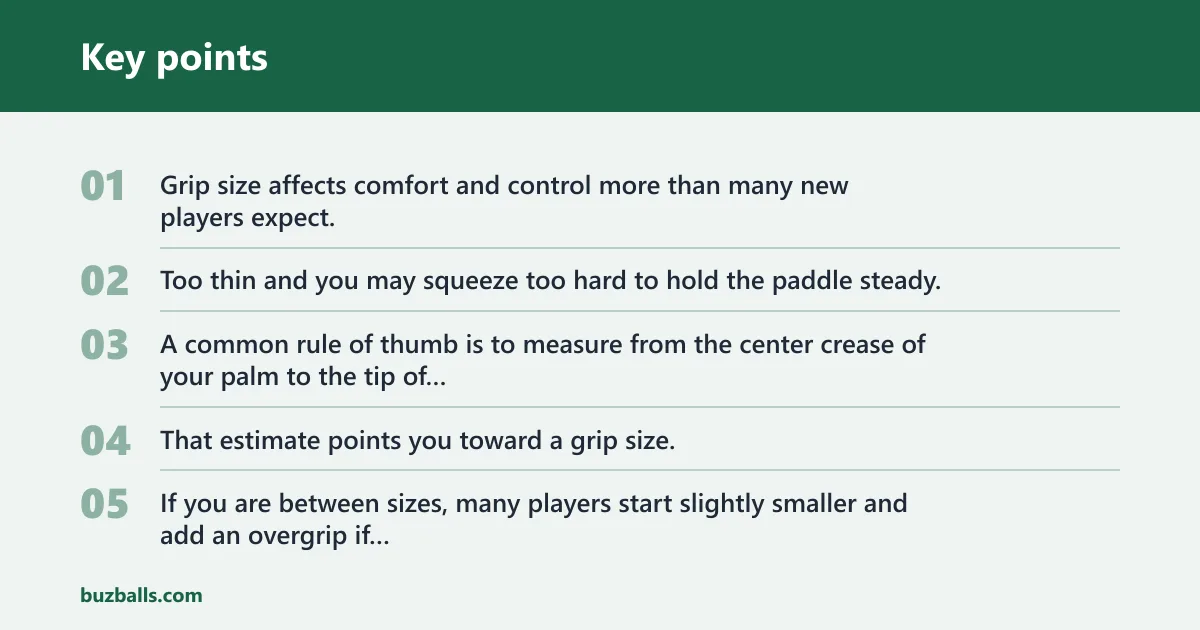
Grip size affects comfort and control more than many new players expect. Too thick and the hand struggles to close. Too thin and you may squeeze too hard to hold the paddle steady.
How to measure the right grip size for your hand
A common rule of thumb is to measure from the center crease of your palm to the tip of your ring finger. That estimate points you toward a grip size, then you confirm it by how the handle feels in your hand. If you are between sizes, many players start slightly smaller and add an overgrip if needed.
An overgrip can increase handle thickness, so it is a useful adjustment when the base grip feels a little slim. It is easier to build up a small handle than to shrink one that is too thick.
Grip fit in real use
Picture a beginner with medium hands holding a 4-1/2-inch grip. The paddle may feel secure at first, but wrist rotation can get sluggish and resets at the kitchen line may feel awkward. A medium grip closer to 4-1/4 inches often feels easier to close and faster to move.
By contrast, a 4-inch grip can work well for smaller hands. The key is that your fingers should wrap naturally without a death grip.
How much should a beginner pickleball paddle weigh?
Weight matters because it changes swing speed, control, and fatigue. Lightweight paddles are under about 7.3 oz, midweight paddles run about 7.3 to 8.4 oz, and heavy paddles are about 8.5 oz and over. For many beginners, the sweet spot is often around 7.8 to 8.2 oz or 7.7 to 8.1 oz.
Lightweight paddles are easier to swing quickly, but they can reduce power and may feel less stable on hard contact. Heavy paddles can add plow-through and pace, but they can also tire the arm faster. Midweight usually gives the best balance for new players who want a paddle that feels manageable on day one.
Why most beginners fit the midweight range
Midweight paddles help you block, dink, and drive without forcing you to swing a heavy frame. That matters in doubles, where quick reaction time and repeated soft shots are common. If you are newer to the sport, a paddle that is too heavy can make long sessions feel clumsy fast.
Weight also changes how a paddle feels at the net. A lighter paddle can be fast but less stable. A slightly heavier midweight option often feels steadier without becoming tiring.
Is a thicker core better for beginners?
Usually, yes. A thicker core often gives more control and forgiveness, especially for beginners who want a calmer response on contact. A 16mm core is a common beginner-friendly choice, and a 17mm core is another option for players who want even more dampening and stability.
Thickness matters because it changes how much the paddle absorbs impact. Thicker cores tend to reduce harsh feedback and can help on off-center hits. That said, core thickness is usually less important than choosing the right shape and grip fit first.
Where thickness matters most
If you are choosing between two similar paddles, a thicker core can be the safer call for a beginner. It tends to support control-first play, softer hands at the kitchen line, and a more forgiving response when the ball does not hit the center every time.
The main exception is a player who already knows they want a faster, more attack-oriented setup. Even then, a first paddle usually should not sacrifice too much forgiveness.
Do beginners need carbon fiber?
No. Beginners do not need carbon fiber, and fiberglass is fine for many first paddles. Carbon fiber, Kevlar, fiberglass, and composite faces all have a place, but face material should come after shape, grip, weight, and core thickness. Fit matters more than hype at this stage.
Carbon fiber faces are often chosen for control and a more consistent feel. Fiberglass faces are commonly associated with livelier pop. Kevlar and composite options sit elsewhere on the feel spectrum. Those differences can matter, but they do not fix a paddle that is too long, too heavy, or the wrong grip size.
What material changes and what it does not
Material can change touch, pop, and how lively the face feels at contact. It does not change the basic beginner rule: a widebody shape with a usable grip and a sensible weight is still the first priority.
If you are unsure, choose the paddle that matches your size and comfort first, then use face material as the final tie-breaker.
Too big or too small?
Use symptoms, not marketing labels, to check fit. A paddle that feels too big or too small usually gives clues in your hand, your forearm, or your contact point. If you notice those clues early, you can avoid buying the wrong setup twice.
Too big versus too small symptoms
| Fit problem | Common symptoms | Quick fix |
|---|---|---|
| Grip too large | Hard to close the hand, slower wrist action, awkward resets, less touch near the net | Try a smaller base grip or remove added overgrip thickness |
| Grip too small | Need to squeeze hard, handle twists more easily, forearm feels busy, hand slides during play | Add an overgrip or move up one grip size |
| Paddle too long or too narrow for the player | Misses on soft shots, less forgiveness on off-center hits, harder to control at the kitchen line | Move to a standard or widebody shape with a larger face |
| Paddle too short or too wide for the player’s needs | Reach feels limited, timing feels cramped, contact point feels too close to the body | Consider a standard shape or a modestly longer handle before going elongated |
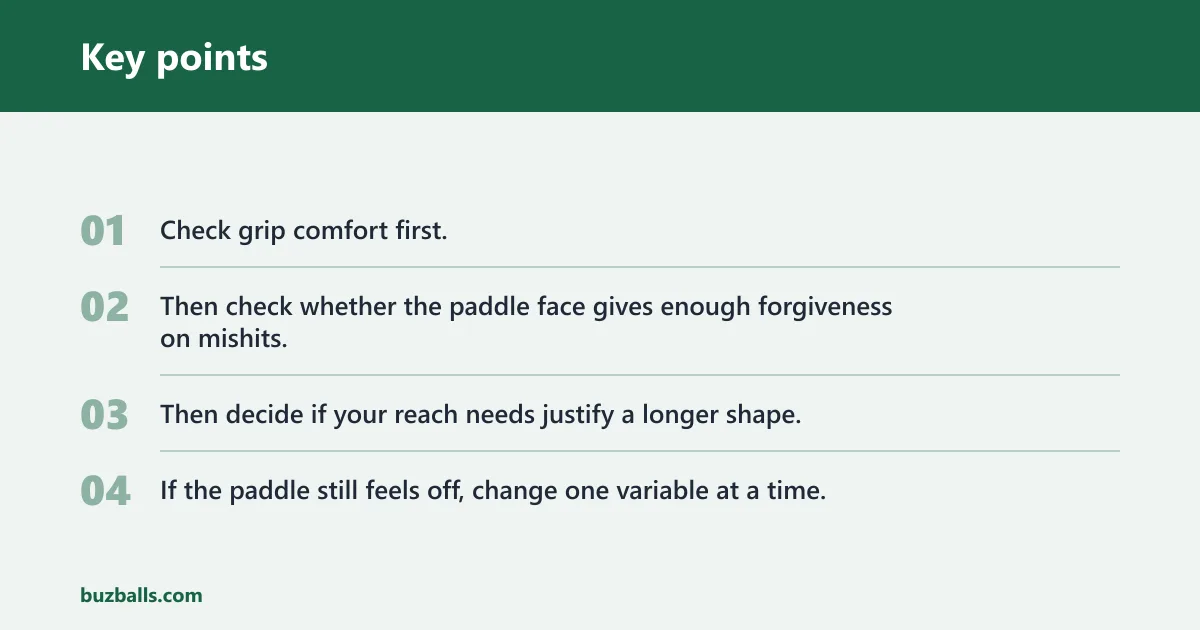
- Check grip comfort first.
- Then check whether the paddle face gives enough forgiveness on mishits.
- Then decide if your reach needs justify a longer shape.
- If the paddle still feels off, change one variable at a time.
Say your paddle feels steady, but you keep missing soft dinks off the upper edge. If the grip size is fine and the paddle is under control, the next fix is usually a wider face, not a different face material. That is the sort of problem a widebody paddle is meant to solve.
Frequently asked questions
What size pickleball paddle is best for beginners?
Most beginners should start with a standard or widebody paddle around 15.5 to 16.5 inches long and about 7.5 to 8.25 inches wide, with a grip that matches hand size. The widebody option is usually the safest first choice because it gives a larger sweet spot and more forgiveness on off-center hits.
Should beginners use a widebody or elongated paddle?
Widebody is usually better for beginners. It gives more face area, a larger sweet spot, and easier contact on mishits. Elongated paddles can help with reach and power, but they usually suit more experienced players or beginners with a clear reason to want extra length, such as a strong racket background.
What grip size should a beginner pickleball paddle have?
A beginner-friendly grip usually falls around 4 to 4.5 inches in circumference. Small grips are around 4 inches, medium grips are about 4-1/4 to 4-3/8 inches, and large grips are about 4-1/2 inches. If you are between sizes, a slightly smaller grip plus an overgrip is often easier to fine-tune.
What is the standard pickleball paddle size limit?
The same source says the combined length and width must not exceed 24 inches. That is the legal sizing rule to keep in mind when comparing standard, widebody, and elongated paddles. A paddle can still be legal in one shape and illegal in another if the total size goes over that limit.