What Is Pickleball Paddle Swing Weight and Why Does It Matter?

Pickleball paddle swing weight is how heavy a paddle feels when you move it through the air. A higher swing weight usually means slower hands and more plow-through on blocks and drives. Ignore it, and you may buy a paddle that looks fine on paper but feels late at the kitchen or tiring in long rallies. This guide explains swing weight, how it differs from static weight, and how to match it to your speed, control, and fatigue tolerance.
What is pickleball paddle swing weight?
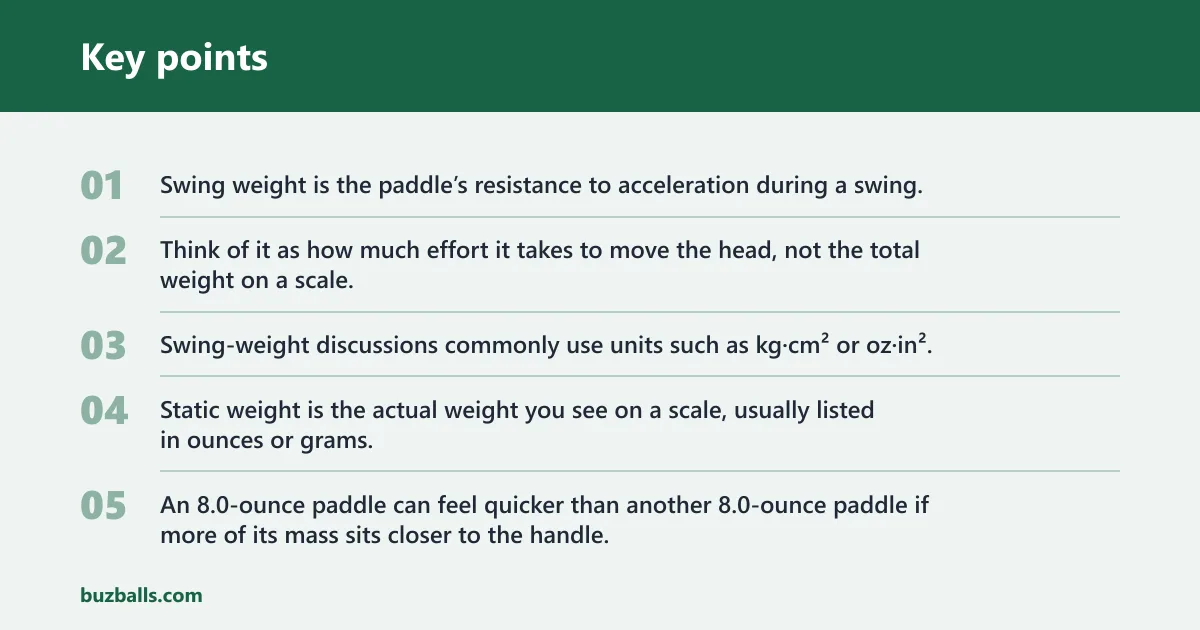
Swing weight is the paddle’s resistance to acceleration during a swing. It depends on how mass is spread along the frame, so two paddles with the same listed ounces can feel very different in motion. Think of it as how much effort it takes to move the head, not the total weight on a scale.
Swing-weight discussions commonly use units such as kg·cm² or oz·in². Balance-point measurements in cm also matter, because a paddle with more mass toward the head usually feels heavier to swing than a head-light paddle of the same static weight.
How swing weight differs from static weight
Static weight is the actual weight you see on a scale, usually listed in ounces or grams. Swing weight is the moving feel. An 8.0-ounce paddle can feel quicker than another 8.0-ounce paddle if more of its mass sits closer to the handle.
That difference matters because static weight alone does not predict hand speed, block stability, or fatigue. The same model can feel different if the balance point shifts, if the shape changes, or if manufacturing tolerances move a little more mass toward the tip.
What the common units mean
kg·cm² and oz·in² are ways to express rotational resistance. Larger numbers mean the paddle takes more effort to start and stop during a swing. Balance point, measured from the butt cap in cm, helps you compare whether a paddle is more head-light or head-heavy.
For practical buying, the exact unit matters less than the comparison. A paddle with a higher balance point usually feels slower in fast exchanges, while a lower balance point usually feels easier to whip through resets and counters.
Why swing weight matters on court
Lower swing weight helps you react faster at the kitchen line, especially on blocks, counters, and quick resets. Higher swing weight can add stability on contact, more plow-through against pace, and a heavier sense of drive on serves and groundstrokes. The tradeoff is simple: speed versus mass behind the ball.
That tradeoff shows up in the two-bounce rule, where the first few exchanges often decide who controls the rally. Pickleball is played on a court that is about badminton-sized, commonly described as 20 feet wide by 44 feet long, with a non-volley zone about 7 feet on each side of the net. Those dimensions keep hand speed at a premium near the line.
Quick hands at the kitchen
At the kitchen line, a lower swing weight usually helps you catch up to fast hands battles and recover between blocks. If your paddle feels late on counters or forces you to open the face early, swing weight may be too high for your reaction speed.
That does not mean lighter always wins. A very low swing weight can feel twitchy, especially when you are trying to absorb pace and keep the ball low. The goal is quick enough for the exchange, but not so light that the paddle twists on contact.
Blocks, resets, and stability
Higher swing weight can help the paddle resist twisting when a hard ball meets the face. That extra mass in motion can make blocks feel calmer and drives feel heavier. The downside appears when you need to change direction fast or defend repeated volleys in a long rally.
Suppose a paddle feels fine on soft third balls but starts fluttering on hard middle attacks. That often points to too little swing weight or too little effective mass near the head, not necessarily a static-weight problem.
Perceived power and fatigue
More swing weight can increase perceived power because the paddle carries more momentum through contact. But the same trait can tire the forearm and shoulder, especially in singles or in long hand-speed sequences. If your strokes slow down late in a match, swing weight may be part of the reason.
A common first-timer mistake is chasing power by moving to a longer, heavier-feeling paddle without checking whether the extra mass matches the player’s pace and recovery speed. The result can be stronger drives with less control late in rallies.
Which swing weight suits your style?
The right swing weight depends on where you create points. Beginners and all-court players usually do better with easier handling and fewer mishits. Counter-punchers and net players often want quicker hands. Singles players and two-handed players may tolerate or prefer more swing weight if they value stability and driving contact over pure hand speed.
Beginners and all-court players
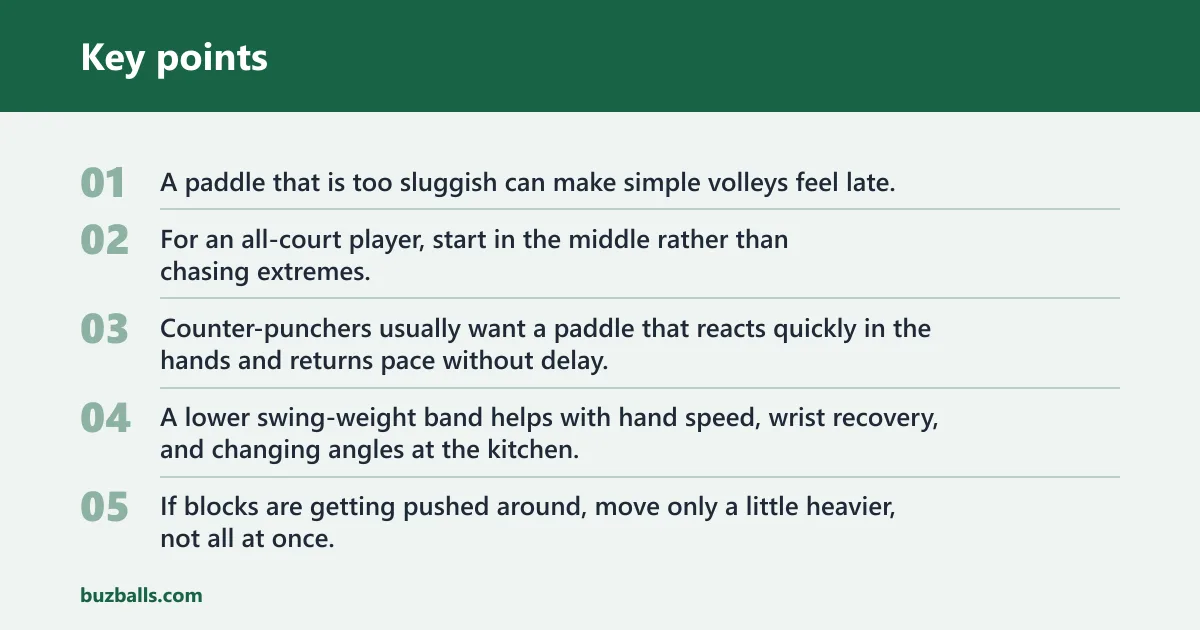
Beginners usually benefit from a lower to moderate swing weight because it is easier to maneuver, reset, and recover from off-center contact. That can reduce mishits while you are still learning spacing, face control, and timing. A paddle that is too sluggish can make simple volleys feel late.
For an all-court player, start in the middle rather than chasing extremes. You want enough stability for returns and blocks, but not so much head weight that soft game touch and quick corrections become work.
Counter-punchers and net players
Counter-punchers usually want a paddle that reacts quickly in the hands and returns pace without delay. A lower swing-weight band helps with hand speed, wrist recovery, and changing angles at the kitchen. If blocks are getting pushed around, move only a little heavier, not all at once.
For these players, the symptom matters more than the spec. “Too slow” usually means the paddle is late to the ball. “Too unstable” usually means the face twists or wobbles on impact. Those are different problems.
Singles players and two-handed players
Singles players often value more plow-through on drives, serves, and passing shots, so a moderate-to-higher swing weight can make sense if the player can still defend quickly. Two-handed players may also handle more swing weight better because the second hand helps accelerate and stabilize the paddle.
Even here, higher is not automatically better. If the paddle tires your shoulder before the second game ends, the extra mass is costing more than it gives back.
How paddle shape changes swing weight
Paddle length and shape change how the paddle moves through the air. Standard shapes usually feel easier to move, while elongated paddles usually feel slower because more mass sits farther from the hand. A longer paddle also changes reach, which can be useful, but the extra length often raises swing weight.
Shape affects more than reach. It changes how quickly the face comes around on forehands and how easy it is to defend the body. A longer paddle can help on wide balls, then feel sluggish on fast exchanges at the kitchen.
Standard versus elongated paddles
Standard paddles usually keep more mass closer to the hand, which tends to lower swing weight. Elongated paddles stretch the head farther from the handle, so the same static weight often feels slower in motion. That is why two paddles with similar ounces can feel different on court.
If you like quick resets and compact volleys, standard shapes usually fit better. If you value reach, two-handed backhands, or added driving force, an elongated shape may be worth the slower hands.
Why balance point changes feel
Balance point is the distance from the butt cap to the point where the paddle balances. A higher balance point usually means a more head-heavy feel and a higher swing weight. A lower balance point usually means easier maneuverability.
This is why two paddles with the same weight can disagree with your hand. One may place more mass in the head, another may keep it closer to the handle. The scale says equal; the swing says otherwise.
How construction changes swing weight
Core thickness and face material both move weight around the frame and can change how the paddle feels in motion. Common comparisons are 14 mm versus 16 mm cores, and fiberglass versus carbon fiber faces. Those build choices can shift balance, stability, and perceived speed even when the listed static weight is similar.
Do not assume the thickest or stiffest option is always best. Construction changes interact with shape and balance, so the same nominal weight can feel quick in one build and slow in another.
Core thickness: 14 mm versus 16 mm
A 16 mm paddle often feels more stable and damped, while a 14 mm build often feels quicker and firmer. Those are broad tendencies, not guarantees. Core thickness can shift how mass is distributed and how the paddle loads the ball, which changes both speed and control.
If you want faster hands and a more direct feel, a thinner core may help. If you want steadier blocks and a calmer response on hard contact, a thicker core may fit better.
Face material and weight distribution
Fiberglass and carbon fiber do not behave the same, and their fabric weights can shift swing weight by a few kg·cm². The important point is not that one material is always faster or always stiffer, but that face construction changes how mass sits across the paddle.
That means a paddle with the same advertised weight can still feel head-heavy or head-light depending on the face layup and the rest of the build. If you compare models, compare the feel in motion, not just the listed ounces.
Swing-weight decision matrix
Use this matrix to match the symptom to the likely swing-weight band and the direction of adjustment. It is a feel guide, not a lab rating. Brands and measurement methods vary, so use it to narrow the search, then test the paddle in hand before you buy if you can.
| Player type | Common shot preference | Symptom | Likely swing-weight band | Adjustment direction |
|---|---|---|---|---|
| Beginner / all-court | Safer resets, easier volleys | Too slow | Lower-to-mid | Move lighter or shorter in shape |
| Beginner / all-court | Safer resets, easier volleys | Too unstable | Mid | Add a small amount of head weight |
| Counter-puncher / net player | Quick blocks, counters | Too slow | Lower | Reduce head-heavy feel |
| Counter-puncher / net player | Quick blocks, counters | Too tiring | Lower-to-mid | Trim added mass, especially near the tip |
| Singles player | Drives, passing shots | Too unstable | Mid-to-higher | Add stability in small steps |
| Two-handed player | Backhand drives, reach | Too slow | Mid | Keep reach, but avoid extra head weight |
| Two-handed player | Backhand drives, reach | Too unstable | Mid-to-higher | Test slight head weighting and recheck hand speed |
How to measure and tune feel
You do not need lab gear to get useful information. A tape measure, a scale, and a careful comparison can tell you a lot about balance point and likely swing feel. If the paddle already feels wrong in hand, do not rely on weight alone.
-
Measure the balance point. Balance the paddle on a narrow edge or round object and note the distance from the butt cap to that point in cm. A higher number usually means a more head-heavy feel, which tends to raise swing weight.
-
Check static weight separately. Put the paddle on a scale and record the ounces or grams. This tells you total mass, but it does not tell you how that mass is distributed, so compare it with the balance-point number.
-
Compare two paddles in motion. Hold each paddle the same way and make a few short shadow swings, then a few quick hand changes. If one feels late or harder to start, the swing weight is likely higher even if the scale reading matches.
-
Add tape in small increments. If you want more stability, use weight tape or lead tape in small amounts near the head, then retest. Small changes can shift swing weight and balance more than expected, so add only a little at a time.
-
Retest the symptom. After each change, check the exact issue: too slow, too unstable, or too tiring. The point is not to make the paddle heavier in general; it is to fix one feel problem without creating another.
Say your paddle feels stable on returns but late on kitchen counters. That points toward too much swing weight for fast hands, so reduce head mass or move to a shape with a lower balance point. If the paddle feels lively but gets knocked around on hard blocks, a small amount of added head weighting may help, but only if the extra swing effort stays manageable.
Frequently asked questions
How is swing weight different from static weight?
Static weight is the actual weight on a scale, usually in ounces or grams. Swing weight is the moving feel. Two paddles can match on the scale and still feel very different if one has a more head-heavy balance point or a longer shape.
What swing weight is best for quick hands at the kitchen?
Lower to moderate swing weight usually works best for quick hands because it is easier to change direction fast. If your blocks and counters feel late, the paddle may be too head-heavy. If it feels too twitchy, add only a small amount of stability, then retest.
Does higher swing weight mean more power?
Not always. Higher swing weight can add plow-through and create a heavier feel on drives and blocks, but it can also slow your hands and increase fatigue. Power only helps if you can still swing fast enough to use it well through the whole match.
How do I measure a paddle’s balance point?
Find the point where the paddle balances and measure from the butt cap to that point in cm. A higher number usually means a more head-heavy feel and a higher swing weight. Use that number with static weight, not instead of it, because both affect feel differently.
Can lead tape or weight tape change swing weight?
Yes. Tape near the head usually raises swing weight and can increase stability, while smaller changes elsewhere can shift balance without changing the feel as much. Add it in small increments and test after each change, because a little extra mass can alter hand speed quickly.