Pickleball Paddle Weight vs Tennis Racket: Key Differences

A pickleball paddle often feels lighter than a tennis racket, so a tennis player may want to start at about 7.8–8.3 oz and pay more attention to swing weight than static weight; if quicker hands matter more, go lighter, and if more plow-through matters more, go heavier. Choose wrong and you get late volleys, shaky resets, or an arm that works harder than your timing allows. This guide compares paddle weight, swing weight, and balance against tennis racket feel, then maps that feel to real pickleball shots.
| Factor | Pickleball paddle weight | Tennis racket | Winner |
|---|---|---|---|
| Contact feel | Solid face, no strings, firmer and more direct response | String bed adds pocketing and trampoline effect | tennis racket |
| Static weight | Commonly lighter; many paddles land around 7.8–8.3 oz for tennis converts | Usually heavier overall, with more frame mass and string bed mass | Pickleball paddle weight |
| Maintenance | No restringing | Restringing needed as tension drops | Pickleball paddle weight |
| Maneuverability at net | Shorter grip and lower mass make quick hands easier | Longer, more top-heavy swings can slow reaction speed | Pickleball paddle weight |
| Power ceiling | Depends more on mass distribution and face response than string rebound | String bed can create easier free power | tennis racket |
How paddle and racket construction affects feel
Pickleball uses a paddle, not a racket, and the paddle has no strings. That simple change alters everything that follows: the hit feels firmer, the sweet spot behaves differently, and weight shifts from “frame plus string bed” to a solid face with a core behind it.
USA Pickleball allows a combined length plus width up to 24 inches, with length capped at 17 inches and no weight limit. Tennis rackets live in a different design space: strung frames, string tension, and more obvious maintenance as the string bed ages.
Solid paddle face versus strung frame
A pickleball paddle has a solid hitting surface, usually built around a polymer honeycomb core with graphite or fiberglass faces. A tennis racket uses a network of tensioned strings, which changes launch, spin, and feel at impact.
That difference matters more than labels. The paddle sends a more direct feedback signal into the hand, while the racket adds the string bed’s spring and dwell time.
Typical weight ranges and what they mean
Pickleball paddles are often discussed in the low-to-mid ounce range, and many tennis players land in the 7.8–8.3 oz band when they first convert. Tennis rackets vary widely, but the practical difference is that the racket’s total mass and balance were designed around a longer lever and a strung face.
Static weight is only the starting point. Two paddles can weigh the same and feel very different if one carries more mass toward the head.
Why the contact feel changes immediately
The paddle feels firmer because there is no string bed to stretch and rebound. With a tennis racket, the strings add a trampoline effect that cushions the ball and can add easy pace.
That is why a former tennis player often says a paddle feels “harder.” The ball leaves sooner, with less pocketing and less built-in help from the surface.
Paddle weight conversion table
This table translates common tennis racket feel into a starting band for pickleball paddle weight. The goal is to preserve your timing, then adjust for a shorter lever and a solid face.
| Tennis racket feel | Common on-court feel | Recommended pickleball paddle weight band | Winner |
|---|---|---|---|
| Light, quick frame | Fast at net, easier to whip through contact, less plow-through | 7.3–7.8 oz | Pickleball paddle weight |
| Balanced or moderate frame | Easy enough to handle, stable enough for fuller swings | 7.8–8.3 oz | Pickleball paddle weight |
| Heavy or head-heavy frame | More mass through contact, slower hand speed, steadier block | 8.3–8.8 oz | Pickleball paddle weight |
Light tennis racket feel to paddle weight band
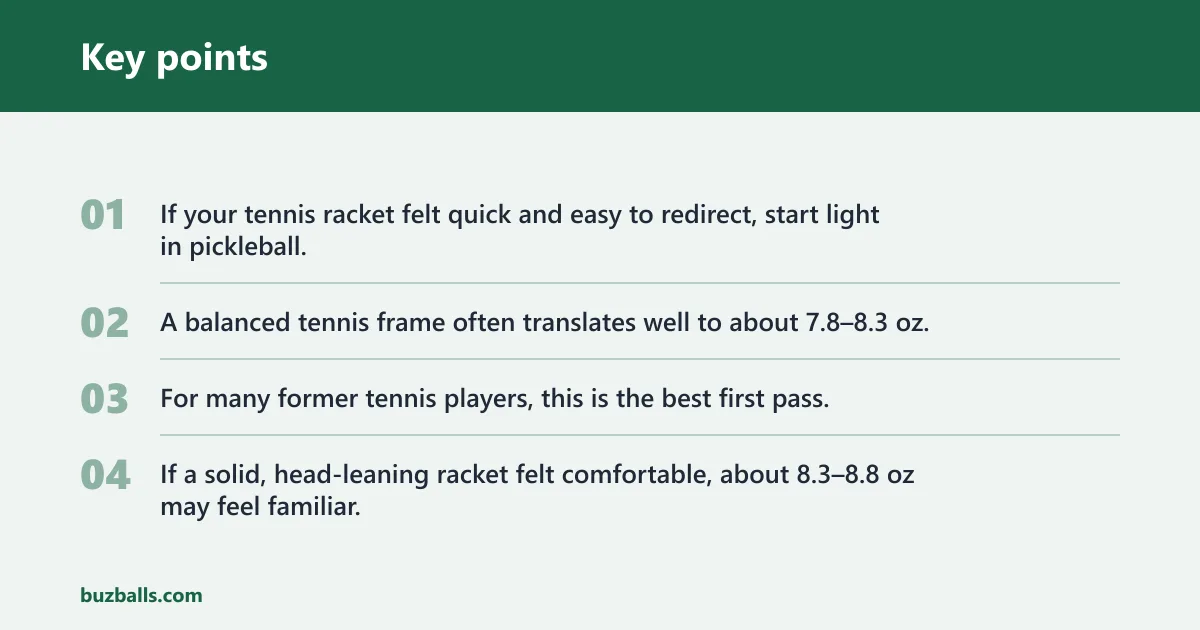
If your tennis racket felt quick and easy to redirect, start light in pickleball. A 7.3–7.8 oz paddle often helps preserve hand speed for dinks, resets, and fast exchanges, which are usually more important in kitchen play than in a baseline rally.
This is the band for players who value reaction speed over blunt stability. It is also the safer starting point if wrist load or elbow fatigue has been an issue.
Midweight tennis racket feel to paddle weight band
A balanced tennis frame often translates well to about 7.8–8.3 oz. That range gives enough mass for control on block volleys while staying light enough for quick hand battles and third-shot transitions.
For many former tennis players, this is the best first pass. It keeps the paddle from feeling toy-like without making the arm fight every reset.
Heavy or head-heavy tennis racket feel to paddle weight band
If a solid, head-leaning racket felt comfortable, about 8.3–8.8 oz may feel familiar. The tradeoff is real: more stability and plow-through, but slower reactions and more fatigue during long hands exchanges.
That band can work for strong net players who want a calmer paddle face on blocks and counters. It is a poor match if you are already late on speed-up exchanges.
Is a pickleball paddle lighter than a tennis racket?
Yes, in practical play a pickleball paddle is usually lighter in feel than a tennis racket, and it also carries its weight differently. Static weight matters, but swing weight matters more because the paddle is shorter and the mass distribution changes how fast the head moves through contact.
Static weight in ounces and grams
Static weight is the number you see on a scale. It tells you how much the paddle weighs at rest, not how heavy it feels when you accelerate it.
A paddle can be light on paper and still feel slow if the mass sits farther toward the tip. That is why ounces alone do not solve the conversion problem.
No weight limit in pickleball versus racket weight ranges
USA Pickleball does not set a paddle weight limit, so makers have room to tune mass for control, stability, or speed. The governing rules focus on dimensions and surface requirements instead, including the 24-inch combined length-plus-width cap and the 17-inch length cap.
Tennis racket weight is part of the sport’s long-standing frame design, but the bigger issue for a convert is how that weight interacts with strings and length. A racket’s total setup is built around a different hitting system.
What lighter actually changes on court
Lighter usually means quicker hands, easier resets, and less fatigue in long hand battles. It also means less free stability on blocks against hard drives, so timing has to be cleaner.
Picture a former tennis doubles player facing a fast kitchen exchange. A paddle that is a touch too heavy can make the first volley late by a fraction, and that fraction is enough to turn a routine block into a pop-up.
Why does a pickleball paddle feel harder?
A pickleball paddle feels harder because it lacks the string bed that makes a tennis racket pocket the ball. The response is more direct, the sound is sharper, and the ball comes off with less built-in rebound from the hitting surface.
No string bed and no trampoline effect
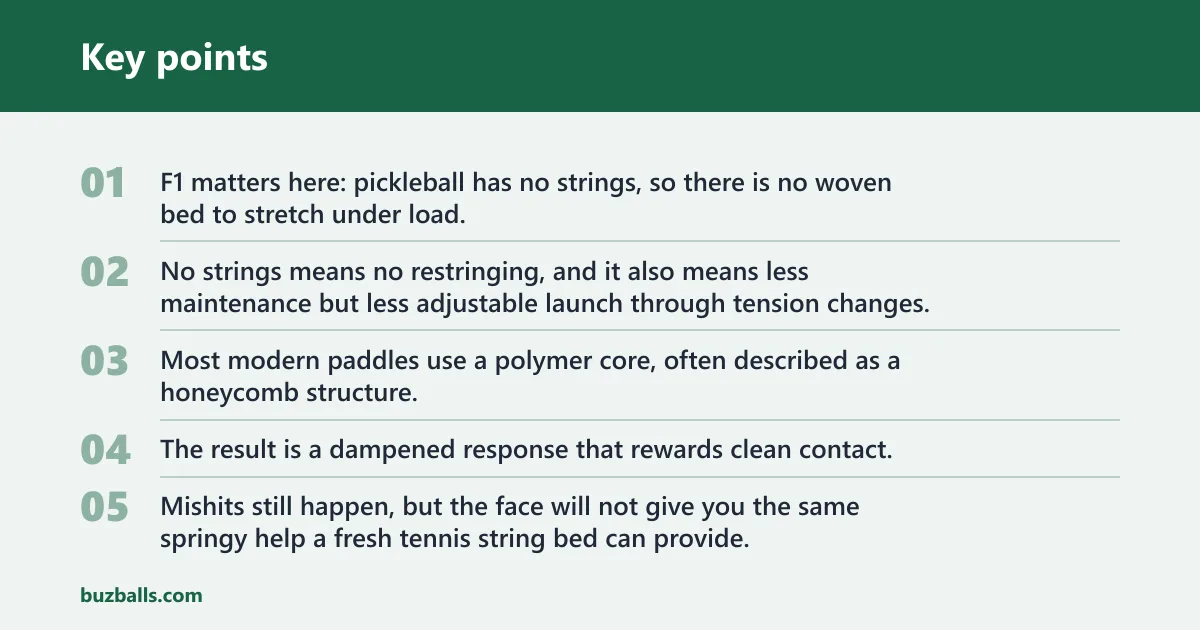
F1 matters here: pickleball has no strings, so there is no woven bed to stretch under load. By contrast, a tennis or badminton racket uses a network of tensioned strings, and that string bed is where much of the trampoline effect comes from.
F3 follows from that construction. No strings means no restringing, and it also means less maintenance but less adjustable launch through tension changes.
Polymer honeycomb cores and dampened response
Most modern paddles use a polymer core, often described as a honeycomb structure. That core is built to control rebound and soften vibration more than to launch the ball like strings do.
The result is a dampened response that rewards clean contact. Mishits still happen, but the face will not give you the same springy help a fresh tennis string bed can provide.
Face materials, edge guards, and ball feedback
Graphite or carbon fiber faces tend to give a crisp, controlled feel with good spin potential and durability. Fiberglass faces often feel a bit livelier, but the basic sensation is still firmer than a strung racket.
An edge guard can add durability and protect the perimeter, though it may also shift a little mass toward the edge. That affects swing weight more than static weight alone and can subtly slow hands.
How do static weight and swing weight change play?
Static weight tells you how much mass the paddle has. Swing weight tells you how much that mass resists movement as you start, stop, and redirect the head, and that is the number that usually matters most for former tennis players.
Mass distribution and maneuverability
Two paddles can share the same static weight and still feel different if one is more head-heavy. More mass in the tip increases swing weight and makes the paddle slower to accelerate, especially on quick volleys.
Head-light balance does the opposite. It makes the paddle feel more maneuverable and helps with fast defensive reactions near the kitchen line.
Head-heavy versus head-light feel
A head-heavy paddle feels steadier on contact, which some players like for counters and drives. A head-light paddle moves faster in the hand, which helps in blocks, resets, and touch shots.
Former tennis players often overvalue the steadiness of a head-heavy feel because it resembles a solid racket. That resemblance can hide a problem: pickleball points often demand faster redirection than tennis rallies do.
Fatigue, wrist loading, and volley speed
More swing weight usually means more fatigue over time. The wrist and forearm work harder to start and stop the paddle, which can slow reaction speed late in a session.
Suppose a player chooses a paddle that feels like a favorite heavy tennis frame. The first few drives may feel stable, but repeated hands exchanges can expose the cost: slower volleys, tighter wrist motion, and less margin on low blocks.
What weight pickleball paddle should a tennis player choose?
Start with the weight your hands can move fast, not the weight that simply feels familiar. For most tennis converts, that means a middle band around 7.8–8.3 oz, then adjusting by swing weight, balance, and how often you play at the net.
Baseliner translation
If you were mostly a baseliner, you may want a slightly lighter paddle with easier acceleration. That helps on third-shot drops, transition blocks, and defensive resets where soft hands matter more than raw mass.
Do not chase racket-like heaviness just because you are used to full swings. Pickleball rewards quicker prep and shorter motion more than long loading paths.
Net player translation
If you were comfortable at net in tennis doubles, a midweight paddle with moderate swing weight can feel right. You want enough mass to keep the face quiet on blocks, but not so much that quick put-aways become late.
Players who like firm volleys and compact counters may tolerate the upper end of the 7.8–8.3 oz band, then add stability through balance rather than brute weight.
Common conversion mistakes to avoid
-
Choose by racket nostalgia. A paddle that feels like your old tennis racket is not automatically the right fit. The sport asks for faster hands, shorter contact zones, and more repeated resets.
-
Confuse static weight with swing weight. A paddle can be light on paper and still feel sluggish if the head carries too much mass. Check how fast you can stop and restart it, not only the number on the spec sheet.
-
Ignore fatigue signs. If your forearm tightens during quick exchanges, the paddle may be asking for more work than your timing can support. That often shows up first on backhand volleys and low blocks.
-
Pick too heavy too soon. Former tennis players often choose a heavier paddle because it feels “real.” In pickleball, that can cost you hand speed at the exact moment you need it most.
Choose Pickleball paddle weight if… / Choose tennis racket if…
For pickleball, the right choice is usually the lighter, faster-moving option once you account for swing weight. For tennis, the racket remains the correct tool when you want string-bed rebound, longer leverage, and a system built around restrings and a larger strung sweet spot.
Choose Pickleball paddle weight if…
- You want quicker hands at the kitchen line.
- You are trying to reduce wrist loading and late volleys.
- You value control and reset speed more than free rebound.
- You want a low-maintenance tool with no restringing.
Choose tennis racket if…
- You want a strung face with more trampoline effect.
- You prefer the feel of a bigger sweet spot and longer swings.
- You are playing tennis, where string tension and restringing are part of the setup.
- You want the racket’s built-in power and spin system, not a solid paddle face.
Frequently asked questions
How is a pickleball paddle different from a tennis racket?
A pickleball paddle has a solid hitting surface with no strings, while a tennis racket uses a tensioned string bed. That difference changes the feel at contact, the amount of rebound, and the maintenance cycle. Pickleball paddles also follow USA Pickleball size rules, including a 24-inch combined length-plus-width limit and a 17-inch length limit.
What are the weight ranges for pickleball paddles versus tennis rackets?
Pickleball paddles are often discussed in ranges such as about 7.3–7.8 oz, 7.8–8.3 oz, and 8.3–8.8 oz for conversion purposes. Tennis rackets vary more widely by frame and string setup, but they generally feel heavier and longer because they are built as strung frames rather than solid paddles.
Why does a pickleball paddle feel harder than a tennis racket?
Because there is no string bed to stretch and rebound. A tennis racket’s strings create pocketing and a trampoline effect, while a pickleball paddle uses a solid face over a core. Polymer honeycomb cores and carbon fiber or graphite faces tend to feel controlled and dampened, not springy.
Can you use tennis swing habits with a pickleball paddle?
Some habits transfer, but not all of them should. Compact prep, clean contact, and balance awareness help in both sports, but long tennis swings and heavy topspin mechanics often do not fit pickleball’s shorter exchanges. The paddle rewards quicker hands and earlier preparation.