Tennis Racket for Beginners: How to Choose the Right One

Choose a beginner tennis racket around 100–105 square inches, 10.0–10.8 ounces strung, with an even or slightly head-heavy setup; stay lighter and more forgiving unless you already swing fast and find the center of the strings with some regularity. Get this wrong and you can end up with a racket that feels harsh, arrives late to contact, loses pace on off-center hits, or bothers your arm. This guide matches the most common beginner mistakes to the specs that usually reduce them, including head size, weight, balance, stiffness, grip size, and string setup.
Start with the miss, not the marketing. If the first issue is late contact, the racket usually needs easier acceleration or a bit more free depth. If the first issue is mishits, head size and sweet-spot size matter more. If the first issue is arm discomfort, stiffness and grip fit move to the top of the list.
A common first-timer mistake is buying by brand and ending up with a frame built for somebody else’s swing. A strong, fast teen can outgrow a very light beginner frame quickly, while a late-starting adult may struggle with that same frame if it is stiff, unstable, or simply the wrong grip size.
What size tennis racket should a beginner use?
Most beginners should start in the 100–110 sq in zone because that range gives you more usable string bed across the upper hoop and sides, so off-center contact loses less pace and less control. Oversize frames at 110+ sq in help slower swings and frequent mishits, while mid-plus frames at 98–104 sq in suit stronger or faster learners who already create their own pace.
Match head size to the miss you make first
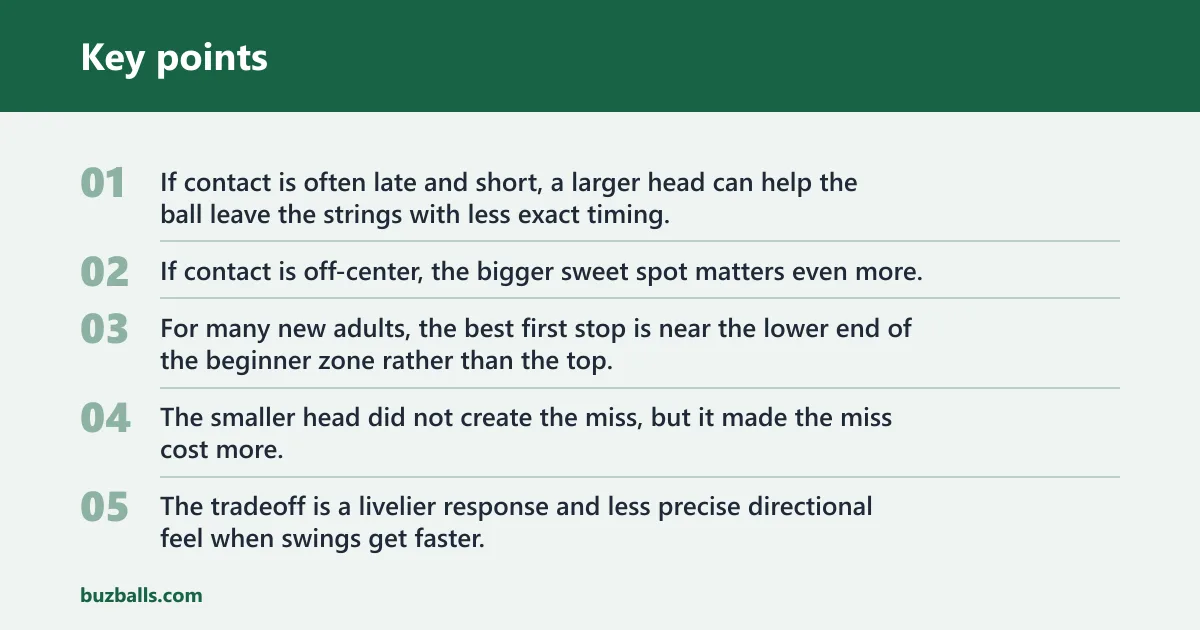
If contact is often late and short, a larger head can help the ball leave the strings with less exact timing. If contact is off-center, the bigger sweet spot matters even more. Smaller heads give up forgiveness for more control, which helps only when you already find the middle of the string bed with some consistency.
For many new adults, the best first stop is near the lower end of the beginner zone rather than the top. That keeps handling more predictable than a very large oversize frame while still giving you a friendlier sweet spot than a small control racket.
Picture a new player using a 98–104 sq in frame because it feels “serious.” If timing is still late and contact drifts toward the upper hoop, the result is often a ball that lands short and feels less solid than expected. The smaller head did not create the miss, but it made the miss cost more.
When oversize makes sense
Oversize means 110+ sq in. That category fits players whose first problem is frequent mishits, slower swing speed, or trouble getting depth from the baseline. It can also help a returning player whose footwork still lags behind eye-hand timing.
The tradeoff is a livelier response and less precise directional feel when swings get faster. That does not make oversize wrong. It means you should accept extra launch and a less exact response in exchange for easier contact quality.
When mid-plus is the better long-term fit
Mid-plus covers 98–104 sq in. That range works well for athletic beginners, quick learners, and former players from other racket sports who already accelerate the frame naturally. These players often need the racket to settle the ball down more than they need extra free power.
Head size also interacts with string pattern. A more open pattern usually feels more powerful and easier to launch; a denser pattern usually feels more controlled. For most beginners, string pattern is a secondary call after head size, weight, balance, and comfort.
Is a lighter or heavier tennis racket better for beginners?

For most beginners, the useful starting zone is 260–285g unstrung because it balances acceleration and stability. Lighter frames around 255–275g help slower swings get moving, while medium frames around 275–310g suit stronger beginners who can handle more mass. Trouble starts when a frame is too light to stay steady or too heavy to reach contact on time.
Use weight to fix late contact or flutter on impact
If the racket feels late through the hitting zone, dropping weight usually helps more than changing almost anything else. A frame in the lightweight category can be easier to start and easier to recover for the next shot.
If the racket twists on contact or feels pushed around by a normal rally ball, the fix may be the opposite. Some beginners buy too light, then squeeze the handle harder to make up for instability. That creates its own comfort problems.
The beginner range and its exceptions
A beginner-friendly frame is often around 260–285g unstrung. That is broad enough to cover many adult beginners without pushing them into a specialist racket too early.
Lightweight frames run around 255–275g. Medium frames run around 275–310g. Heavyweight frames start at 310g and up. A heavy frame is not automatically “advanced only,” but it demands better preparation and more strength.
Say your swing is compact, your forehand lands short, and the racket feels hard to get around on anything fast. A lighter frame is the likely fix. Suppose the opposite: contact is early, the ball flies long, and the racket never feels unstable. Then a slightly heavier choice inside the medium zone may give better control.
How too-light and too-heavy frames fail differently
Too light usually fails at contact. The ball can feel jumpy, the frame can wobble, and off-center shots can feel harsher than expected. Too heavy usually fails before contact. Preparation gets late, swing speed drops, and you start guiding the ball instead of swinging through it.
Returning adults and fitness-focused beginners often land near the upper end of the beginner range or the lower end of the medium category. Brand labels can call these “intermediate,” but if timing and strength support them, they may be the better buy.
What balance is best for beginners?
Many beginners do well with slight head-heavy balance because a little more mass in the upper part of the frame helps the racket drive through the ball, so you get easier depth on compact swings and blocked returns. Even balance is the safer all-round option when the player is still learning everything at once, while head-light balance suits faster swings that need more control and easier redirection at net.
Pick balance by swing speed, not by status
Head-heavy balance helps beginners generate power with less effort. That is useful when the early problem is a short ball, a blocked return, or a serve that dies in the box. A little extra mass toward the head can make a modest swing do more work.
Even balance is the neutral choice. It is often the easiest fit for returning players who want predictable all-court handling and for buyers who are unsure whether they need help with power or control.
Head-light balance favors maneuverability and control. That helps athletic teens, former squash or badminton players, and anyone whose fast swing already creates enough ball speed. For these profiles, adding more head weight can turn an already lively contact point into overhitting.
Balance and weight work together
A light racket can still feel sluggish if too much mass sits in the head. A somewhat heavier racket can still feel quick if the balance is more head-light. That is why balance should be read as part of the whole frame, not as a separate badge on the spec card.
How do you choose the right grip size?
The quickest check is the one-finger rule: if one finger fits between the palm and fingertips when holding the racket, the grip is usually in range. If unsure, sizing slightly smaller is safer because a smaller grip can be built up with an overgrip, while an oversized handle is harder to fix cleanly.
Use the practical fit check
Common adult grip sizes include 4 1/4, 4 3/8, 4 1/2, and 4 5/8. The numbers matter less than the result in the hand. The grip should let the racket stay secure without forcing a constant squeeze.
- Hold the racket normally. Grip it as if starting a forehand, not with the hand spread open. A relaxed, natural hold gives a better fit reading than a tight squeeze.
- Check the finger gap. Use the one-finger rule by seeing whether one finger fits between the palm and fingertips. If there is no room, the grip may be too large in feel; if there is too much room, the grip may be too small.
- Test a looser hold. Shadow-swing a few forehands and backhands without choking the handle. If the racket still feels secure, the size is likely workable; if the hand must clamp down to keep control, fit or balance may be off.
- Choose the smaller option if split. When deciding between two close sizes, the smaller one is usually easier to adjust with an overgrip. Going larger at purchase can leave the handle feeling blocky and harder to turn through contact.
What the wrong grip size does
A grip that is too large can slow grip changes, make topspin harder to produce, and push you into holding the handle too stiffly. A grip that is too small can feel unstable and may encourage extra squeezing, though it is still usually easier to correct with build-up than an oversized grip is to shrink.
Overgrips solve small fit adjustments. They do not solve a racket that feels harsh, too head-heavy, or too stiff. Buyers often blame the grip first because it is easy to notice, but the real issue may be elsewhere in the frame.
Which other specs matter before you buy?
Length
A standard adult racket is about 27 inches long. Longer frames can legally measure as long as 29 inches, and the extra length adds reach and can help on serve. The tradeoff is slower handling and a different contact point, which can be a poor match for someone already struggling to meet the ball on time.
Frame stiffness
Stiffness is often reported as an RA value. Lower RA usually means more flex and a more comfortable response. Higher stiffness can add power but may reduce comfort, especially on mishits or firm strings.
Can the wrong racket cause arm pain? It can contribute. A stiff frame, an overly small or large grip, strings that feel too firm, and a setup that forces constant squeezing can all add up. No single spec guarantees pain or prevents it, but a comfort-sensitive buyer should treat stiffness as a first-order filter, not a footnote.
String pattern and string setup
String pattern affects power, control, and feel. More open patterns tend to launch the ball a bit easier and can feel livelier; denser patterns usually rein in launch and feel more controlled. For a true beginner, the frame choice still matters more than pattern choice, but the pattern can fine-tune whether the racket feels jumpy or predictable.
Pre-strung beginner rackets are acceptable when the buyer wants a simple first purchase and the included strings feel comfortable enough to learn with. Unstrung makes more sense when the player is already particular about comfort or plans to choose strings with a coach or retailer. If a racket feels basically right but contact feels harsh, changing strings may be the better first move than changing the frame.
Beginner profile decision table
| Player profile | Likely first mistake | Head size | Unstrung weight | Balance | Grip-size approach | Stiffness caution | Tradeoff to accept |
|---|---|---|---|---|---|---|---|
| Late-starting adult with low strength | Late contact and short swings | 102–110 sq in | 260–275g | Slight head-heavy | Use one-finger check; if between sizes, choose smaller and add overgrip if needed | Avoid very stiff-feeling frames if off-center hits already feel jarring | Less ultimate control in exchange for easier depth and easier acceleration |
| Athletic teen with fast swing | Overhitting or launching long | 98–104 sq in | 275–295g | Even to head-light | Do not oversize for “room to grow”; fit the hand now | High stiffness can make an already lively swing harder to tame | Smaller sweet spot and less free power in exchange for cleaner control |
| Arm-sensitive beginner | Discomfort on mishits | 100–105 sq in | 270–285g | Even balance | Use the one-finger rule and avoid a too-large grip that forces tension | Prioritize lower-RA comfort over raw power | Less easy pop in exchange for a friendlier feel |
| Returning player after years off | Good timing, but modern frames feel too lively or too stiff | 100–104 sq in | 275–300g | Even or slightly head-light | Check current hand fit instead of re-buying an old size automatically | Modern stiff frames can feel harsher than remembered; comfort matters | More mass to steady contact, with less forgiveness than a pure beginner frame |
Should a beginner buy a cheap or expensive tennis racket?
Price should follow fit, not lead it. An inexpensive beginner racket can be the right buy if the head size, weight, balance, and grip fit the player, while a costly frame can still be a poor match. What extra money usually buys is better stability, better comfort tuning, and more room to grow before replacing the racket.
What entry-level money usually gets
There are playable beginner rackets at the low end. CNN lists the Wilson US Open BLX 100 starting from $99, which shows that a first racket does not need a premium price tag to get somebody on court.
The tradeoffs at this end are often simpler materials, less refined feel, and strings that may be good enough to start but not ideal for comfort or control. That can be fine for a true first purchase.
Where value often improves most
The next budget step usually improves stability, comfort options, and the quality of the stock setup. Buyers who expect to play weekly, take lessons, or return seriously after time away often get better value here than they would by either bottom-shopping or jumping straight to a prestige frame.
When paying more is worth it
Higher-priced frames make more sense when the buyer already knows the needed shape of racket, maybe a softer response, a more controlled balance, or a medium weight that cheaper entry models do not offer cleanly. Paying more for cosmetics or a pro-endorsed paint job is rarely the useful part.
CNN cites a beginner racket at 260 grams for the Volkl Vostra V5. That matters more than the logo because it shows the kind of approachable spec that many new players can actually swing on time.
How do you know if a racket feels right for you?
The right racket feels easy enough to accelerate, stable enough on contact, and comfortable enough that the hand does not tense up to control it. It should let you swing normally without forcing a rescue move: no steering the ball, no clamping the grip, and no bracing for every off-center hit.
What “right” feels like during swings
The frame should come around without effort spikes. If you are repeatedly late, muscling the forehand, or abbreviating the backswing because the racket feels slow, the setup is asking too much.
On contact, the racket should stay reasonably steady. It does not need to feel heavy. It needs to avoid that hollow, twisting sensation that makes a centered strike feel rare and a mishit feel costly.
Signs the fit is wrong
If the hand squeezes harder as the rally speeds up, the grip, stability, or balance may be wrong. If the forearm feels bothered after many off-center hits, the frame may be too stiff, too light at impact, or strung in a way that feels overly firm.
Picture a player with an arm-sensitive elbow using a large-grip, stiff frame. The instinct is to hold tighter to keep the racket stable, and that added tension shows up before the player even thinks about technique. In that case, changing to a softer-feeling frame or a better grip size is more logical than chasing a smaller cosmetic tweak.
When to change strings instead of frames
If the racket shape is workable but the response feels harsh or overly lively, strings are the first thing to revisit. If the frame itself feels late, unstable, or awkward in the hand, changing strings will not solve the main problem. Keep the diagnosis simple: comfort and launch can be string issues; timing and handling are usually frame issues.
Frequently asked questions
What head size is best for a beginner tennis racket?
For most beginners, the best head size sits in the 100–110 sq in range because it offers a larger sweet spot and more forgiveness. Oversize frames help slower swings and frequent mishits, while smaller mid-plus options work better for stronger or faster learners who already create their own pace.
What weight tennis racket is best for a beginner?
A common starting range is 260–285g unstrung because it gives a workable mix of maneuverability and stability. Lean lighter if the swing is late or compact; lean heavier only if the player already swings cleanly and wants the racket to feel steadier at contact.
What is the best tennis racket balance for beginners?
Many beginners benefit from slight head-heavy balance because it helps produce easier depth with less effort. Even balance is the safer all-round choice, and head-light balance fits faster swings that need more control. The best answer depends on whether the first problem is weak contact or overhitting.
Can the wrong tennis racket cause arm pain?
The wrong racket can contribute to arm discomfort, especially if the frame feels very stiff, the grip size is off, or the player must squeeze hard to keep the racket stable. Comfort is shaped by several factors together, including strings, weight, balance, and how harsh off-center hits feel.
Should a beginner buy a pre-strung tennis racket?
A pre-strung racket is fine for many first-time buyers, especially when the goal is a simple, affordable start. It becomes less ideal when the player already knows that comfort is the top priority or wants to fine-tune feel and control through a specific string setup.
How do I know if a tennis racket feels right for me?
The racket should feel manageable to accelerate, steady enough through contact, and comfortable on mishits. If it feels late, twists often, or makes the player grip too tightly, the fit is probably off. A frame that encourages a relaxed swing is usually the better beginner choice.