Pickleball Ball Types: Differences, Uses and How to Choose

Choose pickleball ball types by four checks: court surface, wind and temperature, noise limits, and sanctioning; outdoor balls are harder with 40 holes, indoor balls are softer with 26 holes, and quiet foam balls fit noise-sensitive courts. Pick the wrong ball and you get erratic bounce, cracked plastic in cold weather, extra noise complaints, or practice that feels nothing like match play. This guide maps each ball type to gyms, outdoor courts, driveways, rec games, and tournament prep, with quick rules for weather and playing style.
Pickleball ball types at a glance
The two main categories: indoor and outdoor
Most players hear the basic split, but the useful decision starts one step later. Indoor pickleball balls are typically the larger-hole style built for smooth gym floors and a quieter, slower response. Outdoor balls are typically the smaller-hole style built for rough asphalt or concrete, higher pace, and better stability in moving air.
There is also a practical third bucket for some communities: quiet balls, often foam or soft low-noise designs. They can fit courts where sound is the main issue, but they do not replace standard plastic balls for sanctioned tournament prep.
What changes most when you switch ball types
Ball choice changes five things right away: bounce shape, pace through the air, control off the paddle, sound, and how steady the ball stays when the court or weather gets messy.
Indoor balls are softer than outdoor balls, and a common rule of thumb is that indoor balls weigh about 0.8 ounces while outdoor balls weigh about 0.88 ounces. That small weight gap matters less than the full design, but it helps explain why outdoor balls usually feel firmer and hold line better when the wind picks up.
A quick chooser by court, weather, and goal
If the surface is smooth and the air is still, indoor-style plastic usually gives cleaner control. If the court is rough, open to wind, or used for serious outdoor match prep, outdoor plastic is usually the safer pick. If the court has noise complaints or senior-hour limits, quiet balls can make more sense than either standard category, provided local play rules allow them.
What is the difference between indoor and outdoor pickleball balls?
Indoor and outdoor pickleball balls differ most in hole pattern, plastic firmness, sound, and flight. Indoor balls usually have 26 larger holes and a softer feel for smooth courts, while outdoor balls usually have 40 smaller holes, harder plastic, more pop, and better wind resistance on rough courts.
Hole pattern, feel, and flight
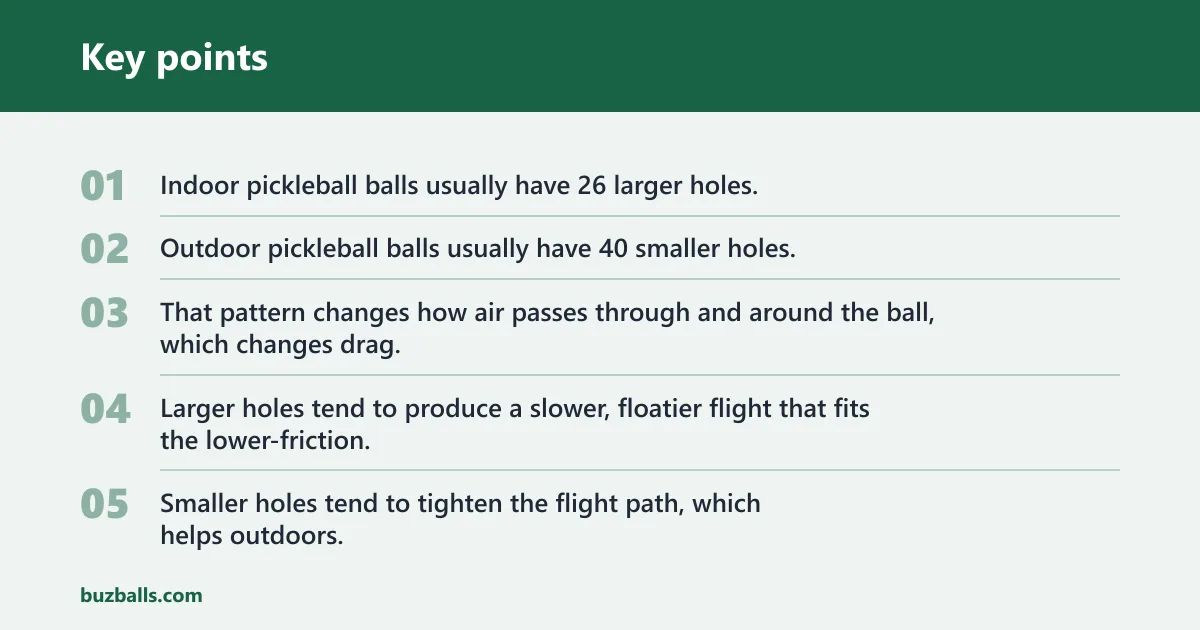
Indoor pickleball balls usually have 26 larger holes. Outdoor pickleball balls usually have 40 smaller holes. That pattern changes how air passes through and around the ball, which changes drag, stability, and how easily the ball gets pushed off line.
Larger holes tend to produce a slower, floatier flight that fits the lower-friction, lower-wind conditions of indoor courts. Smaller holes tend to tighten the flight path, which helps outdoors. Some outdoor balls may use two sizes of holes, so hole count alone does not tell the whole story.
Weight, pace, and bounce differences
A common market average is about 0.8 ounces for indoor balls and about 0.88 ounces for outdoor balls. Combined with harder plastic, that usually gives outdoor balls a faster, firmer response.
On a smooth wood floor or sport tile, an outdoor ball can come off the court and paddle too sharply for players who want touch and long hand exchanges. On rough concrete, an indoor ball can lose shape in the bounce and get pushed around by small gusts.
Noise, durability, and control tradeoffs
Indoor balls are usually quieter. Outdoor balls usually make a louder pop. That sound difference matters in rec centers attached to other courts, apartment-area courts, or senior communities with strict quiet hours.
Durability moves the other way. Outdoor balls are made for rougher surfaces and weather, so their plastic is usually harder. That helps wear life on asphalt and concrete, though cold temperatures can still make some outdoor balls more likely to crack.
How do ball design and official specs affect play?
Ball design affects play through aerodynamics, firmness, seam quality, and whether the ball meets the current USA Pickleball Equipment Standards Manual. The manual governs approved construction, diameter, and hole-count range for sanctioned play, while design details decide pace, bounce, wind stability, and how long the ball lasts on your court.
Hole count and aerodynamics
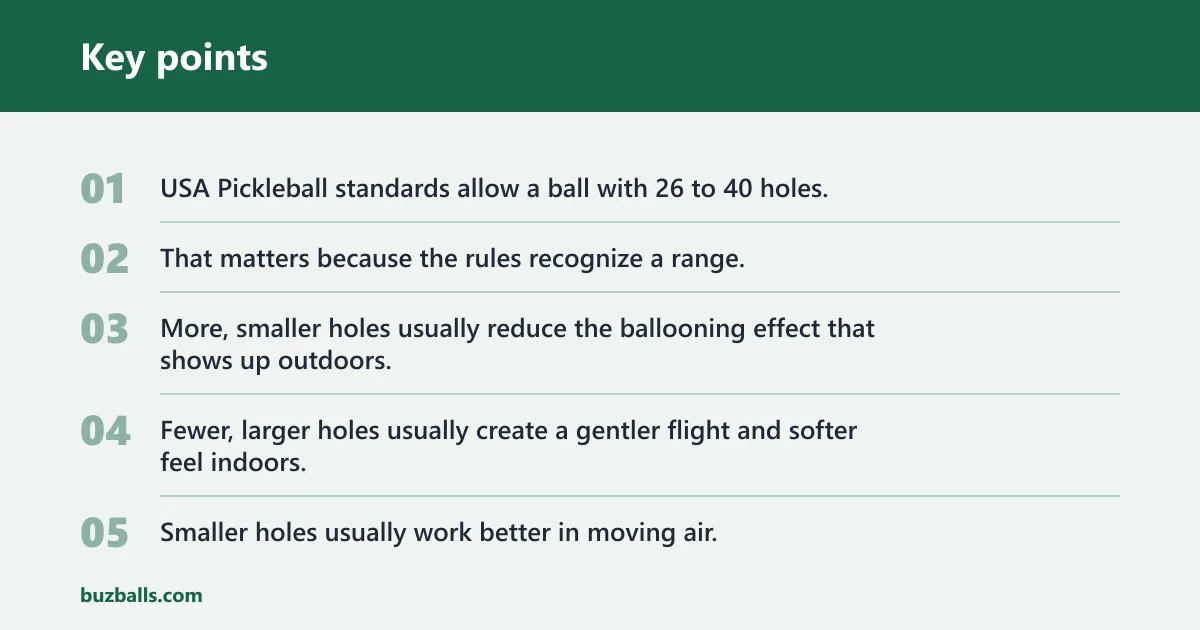
USA Pickleball standards allow a ball with 26 to 40 holes. That matters because the rules recognize a range, not one magic number for every legal ball.
More, smaller holes usually reduce the ballooning effect that shows up outdoors. Fewer, larger holes usually create a gentler flight and softer feel indoors. One pattern is not automatically better. Smaller holes usually work better in moving air, while larger holes often feel better on smooth courts with still air.
Diameter, weight, and bounce behavior
The standards manual sets a legal diameter range, and that is part of tournament legality even though casual players rarely think about it. Diameter affects how the ball sits on the paddle face, how it rebounds off the court, and whether a ball model is approved for sanctioned competition.
Weight also changes bounce character. Heavier outdoor-style balls usually feel more direct through the air. Lighter indoor-style balls often give a little more dwell and shape on controlled shots.
Plastic construction, seams, and durability
Plastic construction matters as much as hole count. Outdoor balls usually use harder plastic for durability and speed. Indoor balls usually use softer plastic for control and lower noise.
You will also see single-piece and two-piece construction. Two-piece balls have a seam, and seam quality can affect consistency and durability. A poor seam can wear unevenly, split earlier, or create a less predictable bounce. That is one reason sanctioned events specify approved models rather than letting any similar-looking ball into the draw.
What the USA Pickleball standards actually govern
For tournament players, the standards are the filter. The current USA Pickleball Equipment Standards Manual governs whether a ball model is approved, including construction and size requirements, and event rules may also specify the ball to be used.
For rec players, the same standards are still useful because they give a quick reality check. If a ball falls outside normal plastic construction, approved diameter limits, or the allowed hole-count range, it may be fine for drills or quiet hours but poor for match-like practice.
Why court surface matters so much
Smooth indoor floors: wood, sport court, and gym tile
Smooth floors reduce abrasion and usually produce a cleaner, lower-friction bounce. That makes indoor-style balls easier to control, easier on sound, and more natural for dinks, resets, and hand speed drills.
Suppose a rec center has polished wood and low ceilings, with no wind at all. An outdoor ball may still work, but the extra firmness can make blocks pop up and speed-ups feel jumpy. An indoor ball usually fits the room better.
Rough outdoor courts: asphalt and concrete
Asphalt and concrete chew up softer plastic faster. They also add more texture to the bounce. Outdoor balls are made for rougher surfaces and weather, so they usually hold shape better and stay more predictable on those courts.
That is also why public-park players often find indoor balls frustrating outside even on a calm day. The issue is not only wind. It is wear, bounce consistency, and the way rough courts make a softer ball feel less exact from shot to shot.
Driveways and mixed-use surfaces
Driveways are the awkward middle ground. Some are smooth enough for indoor-style practice. Many are coarse, sloped, dusty, or lined for another sport, which pushes the choice back toward outdoor balls.
Picture a two-car driveway with expansion joints and a slightly rough broom finish. The ball that feels nice in a school gym can skid, kick oddly, or wear fast there. For mixed-use home courts, surface texture usually matters more than whether a roof is overhead.
Which ball should you use for wind, cold, and quiet play?
For wind, outdoor balls are usually the right call because the harder plastic and smaller-hole pattern hold line better. For cold weather, use an outdoor ball made for low-temperature play if local rules allow it. For noise-sensitive courts, softer indoor-style balls or quiet balls usually make more sense.
Windy conditions and flight stability
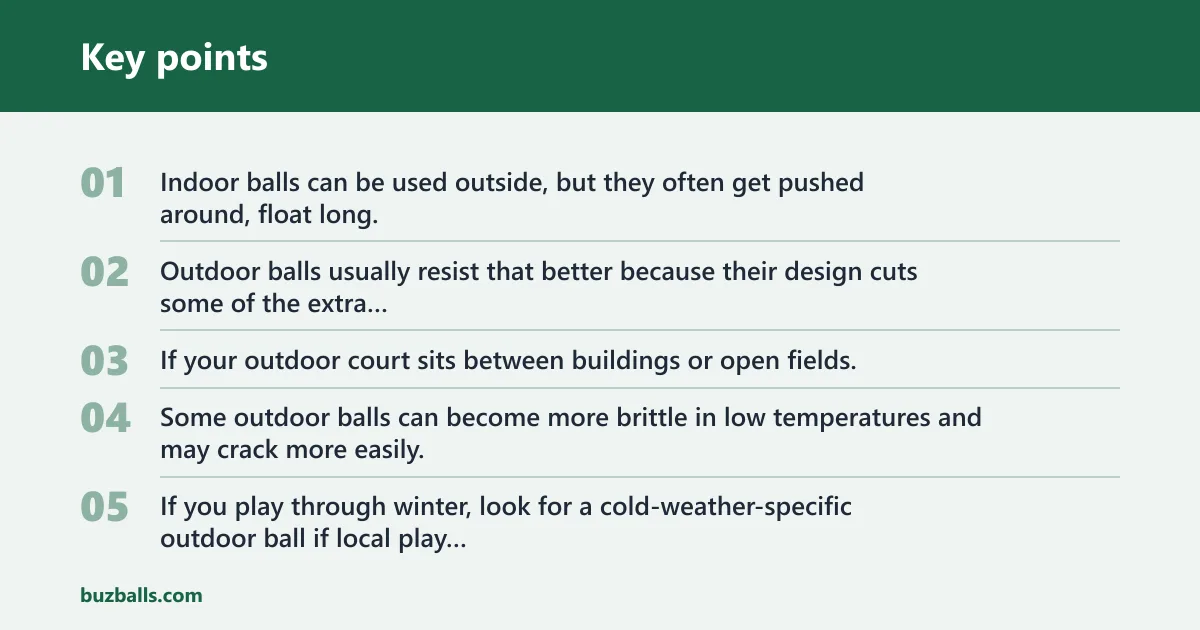
Wind exposes bad ball choices fast. Indoor balls can be used outside, but they often get pushed around, float long, and change direction late in flight.
Outdoor balls usually resist that better because their design cuts some of the extra drift. If your outdoor court sits between buildings or open fields, ball stability matters even when the forecast says only a light breeze.
Cold weather and cracking risk
Cold weather changes plastic behavior. Some outdoor balls can become more brittle in low temperatures and may crack more easily, especially on hard contact or on stiff winter courts.
If you play through winter, look for a cold-weather-specific outdoor ball if local play rules allow it, and match that choice to your practice goal. For casual games, durability may be the main concern. For tournament prep, the event ball still comes first.
Noise-sensitive courts and softer options
Noise complaints often come from ball impact more than paddle choice. Softer indoor-style balls reduce that sharp pop. Quiet balls can cut noise further, but they often change rebound and pace enough that they stop feeling like standard match play.
A common first-timer mistake is using a hard outdoor ball at a quiet community court because the surface is technically outside. If the court rules stress low noise and calm social play, a softer option is often the better fit even if it gives up some wind stability.
Visibility in bright sun and indoor lighting
Visibility matters more than many buying guides admit. Bright yellow or neon shades tend to stand out well outdoors, while indoor players often do better with colors that separate clearly from wood floors, tan walls, or busy divider curtains.
Background matters as much as color. A ball that looks easy to track on blue courts can disappear against fall trees, chain-link fencing, or sodium-vapor lighting. If you split time between venues, buy for the harder visual setting.
Can you use indoor balls outside or outdoor balls indoors?
Yes, both cross-uses are possible, but each comes with a clear penalty. Indoor balls outdoors often drift, wear faster, and bounce less predictably. Outdoor balls indoors often play louder, feel faster, and skid more. Cross-use is fine for casual hits, but poor for matching court conditions or tournament prep.
When cross-use works well enough
Cross-use is reasonable when convenience beats precision. A family game in a calm driveway can be fun with an indoor ball. A gym warm-up with an outdoor ball can still help with hand speed and contact timing.
The key is to know what you are giving up. If the session is social, any decent ball may be enough. If the session is meant to build match habits, use the ball type that matches the real court and conditions.
What usually goes wrong with indoor balls outdoors
Indoor balls outdoors can get pushed around by wind, even when the breeze feels minor at net level. They also tend to wear faster on rough asphalt or concrete.
Say your local park court is calm at 8 a.m., but a crosswind starts around game three. An indoor ball may begin to sail on lobs and wobble on drives, turning solid contact into odd misses. The court did not change, the ball choice stopped matching the conditions.
What usually goes wrong with outdoor balls indoors
Outdoor balls indoors can feel too fast and too loud. On smooth floors they may skid more, rebound more sharply, and make soft-game practice less realistic for players who mostly compete indoors.
That does not mean outdoor balls are unusable in a gym. It means the feedback changes. If a player is working on resets, drops, and kitchen control, a harder outdoor ball indoors can teach the wrong touch.
How do you choose the right pickleball ball for your game?
Choose by matching the ball to your main court, your weather, your tolerance for noise and breakage, and your reason for playing. Rec players usually want a forgiving match for the surface. Tournament players should copy the event ball. Skill-building players may want slower control, while budget-minded players may favor durability.
If you play mostly rec games
Start with the surface. Smooth gym floor: indoor-style plastic. Rough outdoor court: outdoor-style plastic. Then check local issues such as noise rules or heavy wind.
If you rotate among venues, keep both standard types on hand rather than forcing one ball into every setting. That costs less than constantly replacing worn indoor balls on rough courts or practicing touch shots with an overly lively outdoor ball in the gym.
If you are practicing for tournaments
Match the sanctioned environment as closely as possible. That means using the approved ball model named by the event when available, on a similar surface, in similar temperatures.
This is where many intermediate players lose useful practice. They drill all month with a soft rec ball, then enter an outdoor tournament with a firmer approved model and find that speed-ups, returns, and resets leave the paddle differently.
If you want more control or a slower pace
Indoor-style balls usually fit this goal better, especially on smooth courts. They tend to be quieter, a bit less jumpy, and easier to use for controlled kitchen play.
Quiet-play communities and many senior groups also lean this way because the softer response can make rallies more manageable. That benefit comes with a tradeoff: less stability once wind or rough pavement enters the picture.
If durability and cost matter most
On rough outdoor surfaces, outdoor balls usually stretch farther before wear becomes a problem. That often makes them the practical value choice for parks, school blacktops, and driveways.
But durability is not only about shell hardness. Cold weather can shorten life fast, and poor seam quality can ruin consistency before the ball actually cracks. Buy with your season and surface in mind, not only the label on the package.
Pickleball ball types decision table
| Scenario | Recommended ball type | Reason | Main tradeoff |
|---|---|---|---|
| Gym | Indoor plastic ball | Smoother floors reward softer feel, quieter sound, and slower flight for controlled rallies | Less useful for outdoor match prep |
| Rec center | Indoor plastic ball, unless the program specifies otherwise | Shared indoor spaces usually benefit from lower noise and more forgiving pace | Can feel too soft if players want outdoor-style speed |
| Driveway | Outdoor plastic ball on rough concrete; indoor plastic only if the surface is unusually smooth and calm | Mixed-use surfaces often wear softer balls quickly and create uneven bounce | Harder ball is louder and less touch-friendly |
| Public park | Outdoor plastic ball | Rough courts and open air favor harder plastic and steadier flight | More noise and a firmer feel |
| Windy day | Outdoor plastic ball | Smaller-hole outdoor designs usually track better in gusts | Can feel too quick if the court is smooth |
| Cold weather | Cold-weather outdoor ball if allowed, or the event-specified ball for sanctioned prep | Standard outdoor plastic can crack more easily when temperatures drop | Cold-ready options may differ from your usual tournament ball |
| Quiet community court | Softer indoor-style ball or quiet ball where local rules permit | Lower-impact construction reduces the sharp pop that drives complaints | Less wind stability and less realistic tournament practice |
| Tournament practice | The exact approved event ball on a similar surface | Practice should match the bounce, pace, and feel of the sanctioned setting | May cost more and feel less forgiving for casual play |
What makes a pickleball ball legal for tournament play?
A tournament-legal pickleball ball must comply with the current USA Pickleball Equipment Standards Manual and any event-specific ball rule. In practice, that means the model must be approved, its construction and diameter must meet standards, the hole pattern must fall within the allowed range, and the ball must be in playable condition.
USA Pickleball standards and approved balls
The standards manual is the starting point, not the package label. A ball can look like a normal indoor or outdoor ball and still be the wrong choice if it is not on the approved list for sanctioned competition.
This is also where the hole-count question gets simplified. A legal ball is not limited to one exact count, because the standards allow a range. That keeps players from treating every unusual-looking pattern as automatically illegal.
Event-specific ball requirements
Many events go beyond general approval and name the exact ball model for the tournament. That matters because approved does not always mean chosen for that event.
If you are entering a sanctioned outdoor draw, event paperwork may require one specific outdoor ball even if several others are approved. Practicing with the event model is usually the best way to avoid pace and bounce surprises.
A quick legality checklist before you buy
- Check whether the ball model appears on the current USA Pickleball approved list.
- Read the event rules to see whether one exact ball is required.
- Confirm the ball is standard plastic construction for the format you are preparing for, not a quiet novelty ball.
- Inspect the balls for cracks, warping, soft spots, or seam defects before play.
- Match the practice ball to the event surface and conditions whenever possible.
Frequently asked questions
How many holes does an indoor pickleball ball have?
Indoor pickleball balls usually have 26 larger holes. That is the common indoor pattern, but sanctioned legality is broader than one exact design because USA Pickleball allows a range of hole counts. For buying, think of 26-hole balls as the normal indoor starting point, not the only legal possibility.
How many holes does an outdoor pickleball ball have?
Outdoor pickleball balls usually have 40 smaller holes. That pattern helps produce a steadier flight outdoors, especially when air starts moving. Some outdoor balls also use two hole sizes, so count alone does not predict feel, but 40-hole designs are the standard outdoor reference point.
Can you use indoor pickleball balls outside?
Yes, you can use indoor balls outside for casual play, especially in calm conditions. The main downsides are faster wear on rough courts, less stable flight in wind, and a bounce that can feel less consistent on asphalt or concrete. For outdoor practice that should feel match-like, outdoor balls are usually better.
Can you use outdoor pickleball balls indoors?
Yes, outdoor balls can be used indoors, but they often feel too fast and sound louder on smooth floors. They may skid more and give less forgiving touch on resets and dinks. That makes them acceptable for casual hitting, but usually a poor match for indoor-style control practice.
What pickleball ball should I use for wind or cold weather?
For wind, use an outdoor ball in most cases because outdoor designs usually track better and resist drifting. For cold weather, use an outdoor ball suited to lower temperatures if local rules allow it, since some standard outdoor balls become more brittle and can crack more easily when it gets cold.
How do I choose the right pickleball ball for my game?
Choose by working through four checks: surface, weather, noise limits, and playing goal. Smooth indoor floors usually point to indoor balls; rough outdoor courts usually point to outdoor balls. Then adjust for wind, cold, quiet-play rules, and tournament prep, since those factors often matter more than the simple indoor-outdoor label.