How to Stop a Cricket Bat Handle From Coming Loose

If the handle only slips inside the grip, re-wrap it. If the splice at the shoulders moves or cracks, stop using the bat and have it re-glued or replaced. Mixing those two faults can turn a usable bat into a broken handle and a bad hit. This guide shows how to tell grip slip from structural failure, then choose the right fix.
What you’ll need
- Replacement cricket bat grip
- Optional new handle rubber or underlisting
- Wood glue or resin adhesive rated for structural wood repair
- Clamp or binding tape with padding
- Clean cloths
- Fine sandpaper
- Mild cleaner or dry brush for dust removal
- Bat mallet for a gentle post-cure check
- Protective sheet or paper to keep glue off the blade
Handle fault checklist
| Symptom | Likely cause | Recommended fix | Repair at home or send to pro |
|---|---|---|---|
| Grip twists on the handle | Grip wear or loose fit, not structural failure | Remove and regrip the handle | Repair at home |
| Creaking at the shoulders | Movement at the cricket bat handle splice | Inspect the splice; glue and clamp only if the wood is sound | Often send to pro |
| Visible gap where handle meets blade | Joint separation | Stop use and arrange structural repair | Send to pro |
| Handle twists during a gentle squeeze | Internal loosening in the splice | Do not regrip over it; open the handle for inspection | Send to pro |
| Hairline cracks near the splice | Early structural crack propagation | Remove the grip and assess whether the crack reaches the joint | Often send to pro |
| Soft spot under the grip | Broken underlisting or hidden movement | Remove grip and underlisting, then inspect the wood | Repair at home if minor |
| Handle feels fine until impact | Loose splice that opens under load | Do not use the bat; get the joint checked before reassembly | Send to pro |
| Toe damage plus handle movement | General impact wear from the same season | Inspect the toe guard and the splice together | Repair at home for toe only; pro for handle movement |
How do you tell what is failing?
Start by separating a loose cricket bat grip from a loose handle. A grip can rotate on the rubber or underlisting and still leave the wood solid, while a failing cricket bat handle splice may move at the junction between blade and handle. That junction decides repair or replacement.

Check for movement at the shoulders, not only at the outer cover. If the handle twists, creaks, or opens a gap when you press the blade and handle in opposite directions, treat it as a structural problem. A hairline crack, separation, or looseness that returns after a humid spell points to a deeper fault.
What a loose grip looks like
A loose grip usually feels like surface rotation, uneven thickness, or a wrinkled wrap. The bat can still feel solid at the splice. That points to a regrip job, not glue at the joint.
What a broken handle looks like
A broken or loosening handle usually shows movement where the handle enters the blade. Look for a visible split, a step in alignment, or a creak when the bat is flexed by hand. If the wood itself is moving, stop using the bat.
How to fix a loose cricket bat handle
If the splice is only slightly loose and the wood is sound, use clean surfaces, suitable adhesive, even clamp pressure, and full cure time before use. If the joint has a split, a broken section, or repeat movement, a professional repair service is the safer route.
- Strip the handle. Remove the cricket bat grip and any handle rubber or underlisting so the splice is fully visible. Do not glue over a hidden joint.
- Inspect the splice. Check the cricket bat handle splice for movement, hairline cracks, and separation. If the handle twists or the gap opens, stop and move to professional repair.
- Clean and dry the wood. Brush off dust and wipe away residue, then let the area dry completely. Wood glue or resin adhesive bonds best to clean, dry surfaces.
- Apply structural adhesive. Use a wood glue or resin adhesive made for structural wood repair, then work it into fine gaps only. Do not flood the joint; excess glue can prevent proper seating.
- Clamp with padding. Apply even clamp or binding pressure with padding between the clamp and willow. Tighten enough to close the joint, but do not crush the handle or distort the blade.
- Leave it undisturbed. Keep the bat still for the full cure time listed by the adhesive, often about 12 to 24 hours for many repair products. Do not knock in, tap, or test it early.
- Recheck alignment. After cure, confirm the handle sits straight and the blade line has not shifted. A common first-timer mistake is fixing the joint but leaving the face slightly out of line.
Say your junior bat has a grip that spins, but the splice stays tight when the blade is flexed by hand. That points to grip wear, so a regrip is the right first fix. Suppose the handle creaks and a thin gap appears at the shoulders after a wet week. That is a structural problem, not a grip problem.
When should you repair or replace it?
Replace rather than repair when the handle or splice is broken, when the gap keeps returning after a proper cure, or when the bat no longer holds alignment. Move to replacement when the handle or splice is broken, when the gap keeps returning after a proper cure, or when the bat no longer holds alignment. Premium English willow bats deserve a lower tolerance for hidden crack propagation because the wood has more value to preserve.
Junior bats and school kit
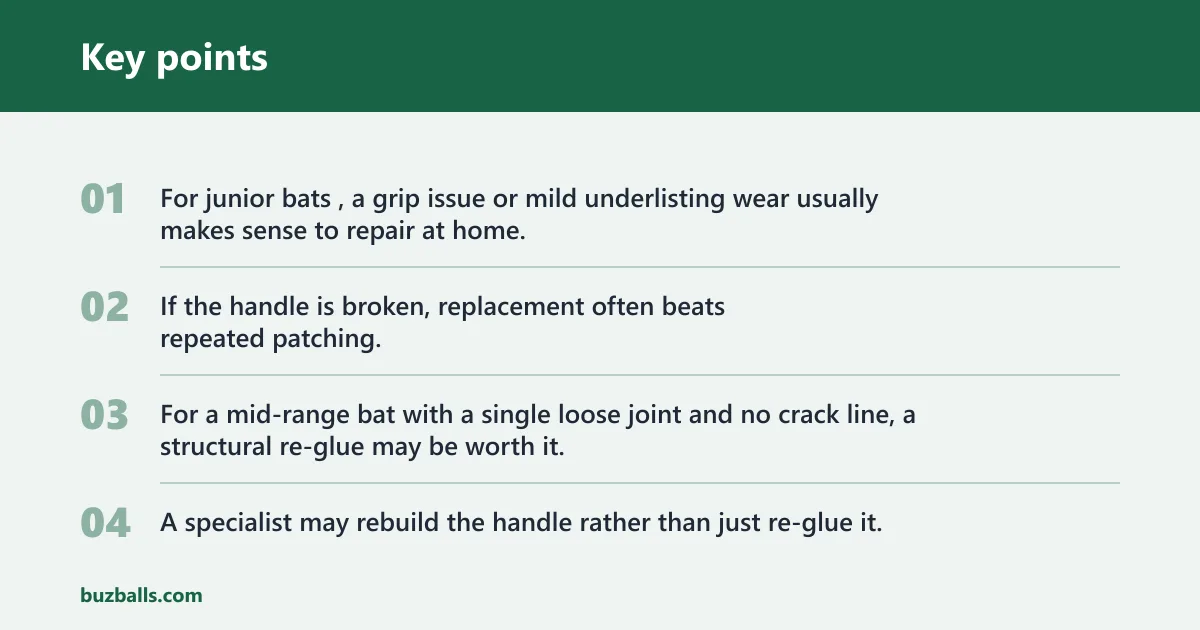
For junior bats, a grip issue or mild underlisting wear usually makes sense to repair at home. If the splice is moving, a school bat is often better sent out only if the blade is otherwise sound and the repair cost stays modest. If the handle is broken, replacement often beats repeated patching.
Mid-range bats with limited wear
For a mid-range bat with a single loose joint and no crack line, a structural re-glue may be worth it. If the looseness returns after a humid season or after an impact, replacement becomes the more practical answer because the fault may be spreading inside the splice.
Premium English willow bats
Premium English willow bats are usually best handled by a professional bat repair service when the splice moves, cracks, or opens under load. A specialist may rebuild the handle rather than just re-glue it. That is the safer call when the bat has higher value or visible structural damage.
Can you regrip it after repairs?
Yes, but only after the joint has cured fully and the handle is straight. Refit the cricket bat grip after the adhesive has set, and replace any underlisting if it was removed or damaged. A tight, even grip helps feel and control, but it should never hide an unresolved splice fault.
Fit the grip after the joint cures
Wait until the adhesive has reached full cure, then install the cricket bat grip. If the grip goes on early, pressure from twisting and stretching can disturb the repair before it hardens.
Check any underlisting before refitting
Replace damaged handle rubber or underlisting if it has compressed, split, or slipped. A worn underlisting can mask early handle movement and make the repaired bat feel dead or uneven.
Do a final alignment and feel check
Before match use, sight down the blade and feel for any twist at the shoulders. A bat mallet can be used gently after cure to check for lingering soft spots, but it is not a tool for an uncured repair.
Common mistakes
The most common error is treating grip rotation as proof of structural failure. That wastes time and can lead to unnecessary repair work. The other error is hiding a cracked splice under a fresh grip, which delays the real fix and lets the damage spread.
- Do not clamp so hard that the willow is crushed.
- Do not use the bat before the adhesive is fully cured.
- Do not skip inspection of the splice just because the grip looks worn.
- Do not ignore looseness that returns after humidity swings or impact damage.
- Do not forget to check the cricket bat toe guard at the same time; toe damage can sit alongside handle trouble.
Frequently asked questions
How do I stop a cricket bat handle from coming loose?
Remove the grip, inspect the splice, and re-glue only if the wood is sound and dry. Use structural wood adhesive, clamp with padding, and leave it untouched through the full cure time. If the handle moves at the joint or shows cracks, send it for repair instead of trying to mask it.
Can I fix a loose cricket bat handle at home?
You can handle a grip issue at home, and you can sometimes do a simple re-glue if the splice is intact. You should not try a home fix on a split joint, a twisted handle, or a bat that keeps loosening after prior repairs. Those cases need a repair service.
How do I know if my cricket bat handle is loose or broken?
A loose handle usually shows movement at the splice, creaking, or a gap that opens under pressure. A broken handle often has a visible crack line, a step in alignment, or a handle that shifts more than a grip ever would. Remove the grip to see the joint clearly.
What glue do you use to repair a cricket bat handle?
Use a wood glue or resin adhesive made for structural wood repair, with clean and dry surfaces before application. Pick a product that can fill fine gaps and bond stressed wood. Follow the cure time on the pack, then leave the bat unused until that time has passed.
Can I regrip a cricket bat handle after repairs?
Yes, once the adhesive is fully cured and the handle is aligned. Fit the new grip after checking any underlisting, because worn rubber can hide movement and change the feel. A regrip should finish the repair, not cover an unresolved joint fault.
When should I replace a cricket bat handle instead of repairing it?
Replace rather than repair when the handle is broken, the splice has a clear structural split, or the bat keeps moving after a proper glue-and-clamp repair. Premium English willow bats often justify professional handle replacement sooner than a junior or low-cost bat would.