What Is Inside a Cricket Ball and Why Does It Matter?

A cricket ball typically has a cork core, tightly wound string layers, and a stitched leather outer cover, often in a four-piece shell with several rows of seam stitches. If those layers are poorly made or worn down unevenly, the ball loses consistent bounce, swing, seam movement, and can become harder and less safe to hit. This guide explains each layer, how it changes the ball in play, and why condition matters for beginners and parents.
This guide is part of our Cricket ball types: what are they and how do they differ? series.
Ball construction and its effects
Inside a cricket ball is a cork core wrapped in tightly wound string, then covered by a leather case. That structure gives the ball its weight, hardness, and shape retention. The seam is part of the outer build too, and it affects how the ball moves through the air and off the pitch.
The core sits at the centre of the ball. Cork and string keep it firm, not soft or hollow, which is why a match ball behaves so differently from a cheap training ball.
Cork core
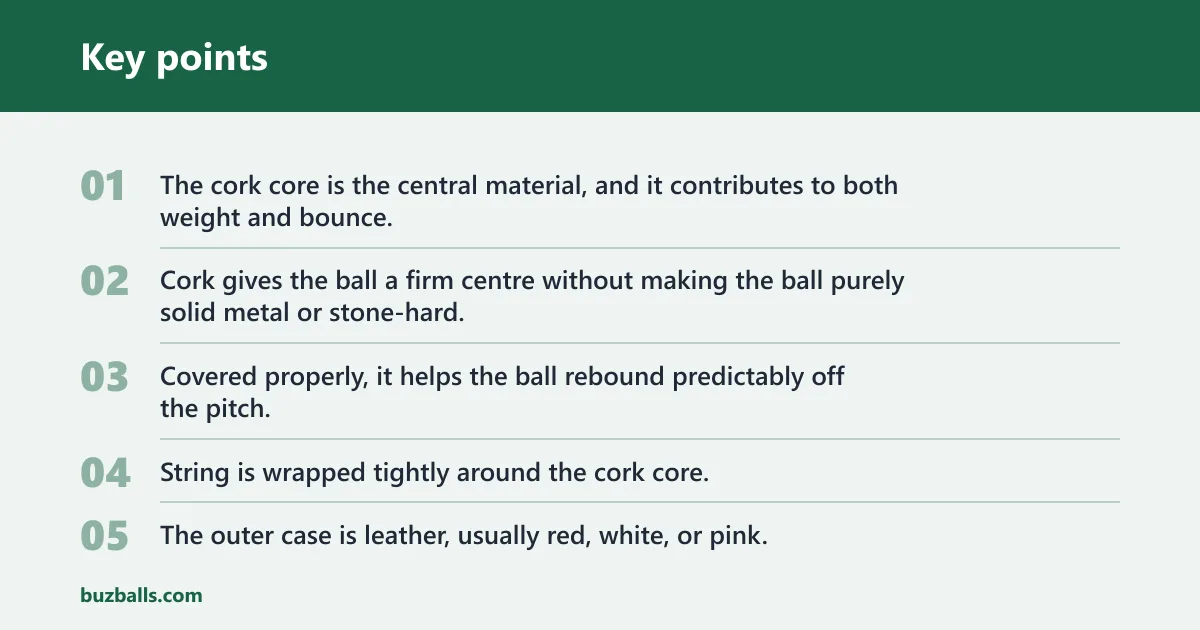
The cork core is the central material, and it contributes to both weight and bounce. Cork gives the ball a firm centre without making the ball purely solid metal or stone-hard. Covered properly, it helps the ball rebound predictably off the pitch.
Tightly wound string
String is wrapped tightly around the cork core. That winding adds firmness and helps the ball keep its shape after repeated impacts. More even winding usually means a more balanced ball, while poor winding can make the ball feel lopsided or lose bounce sooner.
Leather cover
The outer case is leather, usually red, white, or pink. It affects grip, durability, and visibility. Leather takes the brunt of impact from bat, pitch, and fielding, so its finish and condition strongly affect how long the ball stays useful.
Say a junior player notices a practice ball bouncing lower on one side after a few overs. That usually points to a core or winding issue, not just surface wear. The ball can still be leather-covered, but if the inside is uneven, the bounce becomes less predictable.
Why the seam matters so much
The seam is the raised stitched ridge around the ball, made with six rows of stitches. It gives bowlers a grip point and creates a visible edge that can help the ball swing in the air or deviate after pitching. A fresh seam is one reason a new ball behaves differently from an old one.
Six rows of stitches
Those six rows are not cosmetic. They form a raised ridge that bowlers can hold and release with control. Umpires and players also watch the seam because its condition often tells them how much movement the ball may still offer.
New-ball swing
A newer ball with a cleaner seam and shinier leather can swing more, especially when conditions help the seam stay upright. That is why the first overs of an innings can feel so different from later overs. White balls, in particular, are noted for swinging more during the first half of an innings than red balls.
Seam movement off the pitch
The seam can make the ball deviate after it lands if it hits the pitch at an angle or bites into a rough surface. That is seam movement. A good seam gives bowlers more control over this effect; a worn seam reduces it and makes the ball behave more like a generic hard ball.
How is a cricket ball made?
A top-quality cricket ball is often described as using four pieces of leather, with the two hemispheres rotated by 90 degrees. That construction helps the ball hold shape and keeps the seam properly placed. Lower-quality balls often use a two-piece covering and are common for practice because they cost less.
British Standard BS 5993
BS 5993 specifies construction details, dimensions, quality and performance. That matters because a cricket ball is expected to meet a controlled standard, not just look round. The standard helps keep match balls consistent enough that players can trust the bounce, seam, and overall feel.
- Form the core. A cork centre is prepared first, then wrapped with string until the ball reaches the needed firmness. This is where weight distribution starts.
- Build the leather shell. The leather pieces are shaped into the outer case, with the two hemispheres rotated by 90 degrees in top-quality balls. That layout helps the ball keep a stable shape under repeated impact.
- Stitch the seam. The seam is sewn as a raised ridge with six rows of stitches. A clean seam supports grip, swing, and seam movement.
- Finish and inspect. The ball is checked against construction and performance requirements under BS 5993. That step matters because a round-looking ball can still play poorly if the layers are uneven.
Why does what is inside a cricket ball matter?
What is inside a cricket ball matters because every layer changes how the ball behaves for batter, bowler, and fielder. The core and winding shape the bounce, the leather affects grip and wear, and the seam influences movement in the air and off the pitch. Safety changes too, because harder balls hurt more on impact.
For batters, the internal build changes how much the ball rises after pitching and how sharply it can deviate. For bowlers, it changes control, swing, and seam movement. For fielders, it changes how hard the ball feels at catch or stop, especially once the leather hardens or the seam becomes rough.
How the core changes bounce and weight
The cork core and string winding create the ball’s main firmness. A well-built ball rebounds cleanly and stays true through the innings. If the core is uneven or the winding loosens, the ball can lose shape and the bounce can become lower or less predictable.
What players notice off the pitch
Players often notice the effect most after the ball lands. A firm core and tight winding make the ball spring off the pitch in a repeatable way. A damaged core can make one delivery pop up and the next sit low, which is awkward for batters and dangerous for close fielders.
A common first-timer mistake is treating every cricket ball as the same. Picture a white ball in a floodlit one-day match: it may look the same from a distance, but its smoother, newer surface and faster wear can change swing, grip, and fielding feel within a short spell.
What red, white, and pink balls change
Red, white, and pink cricket balls are built around the same basic idea, but the color and finish change visibility and how the ball wears. Red balls are used in Test and first-class cricket. White balls are used in one-day and Twenty20 cricket. Pink balls were introduced for day-night Tests.
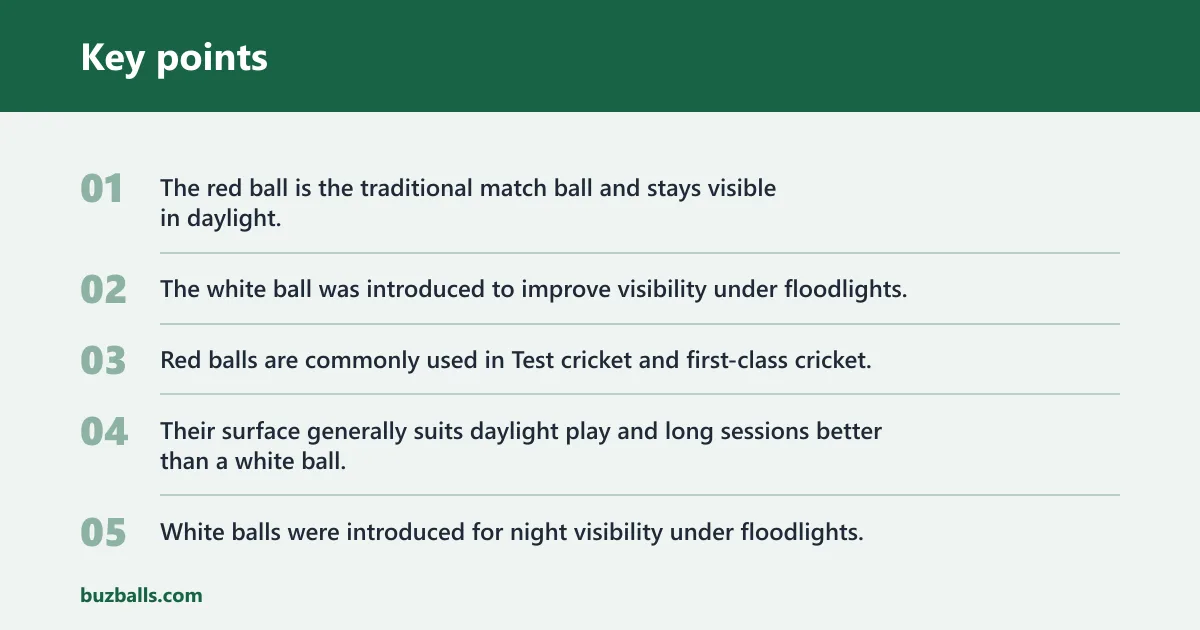
The red ball is the traditional match ball and stays visible in daylight. The white ball was introduced to improve visibility under floodlights. Since around 2010, pink has been used to improve night visibility while still remaining suitable for longer-format matches after dark.
Red balls
Red balls are commonly used in Test cricket and first-class cricket. They are the familiar choice for long matches because they are designed for endurance and a steady change in condition over time. Their surface generally suits daylight play and long sessions better than a white ball.
White balls
White balls were introduced for night visibility under floodlights. They are used in one-day and Twenty20 cricket, and they tend to swing more during the first half of an innings than red balls. They also deteriorate more quickly than red balls, which is why match control matters so much in limited-overs cricket.
Pink balls
The pink ball was designed to work for night Tests and first-class matches. It is a compromise between the visibility needs of white-ball cricket and the longer life expected from red-ball cricket. Since 2010, it has been used to help players and spectators track the ball in evening conditions.
How construction affects wear and safety
A cricket ball becomes rougher, softer, and less predictable as it wears. The leather surface scuffs, the seam flattens, and the core no longer behaves quite the same. That is part of the game, but it also means the ball can become more dangerous for anyone close to it, especially at higher speeds.
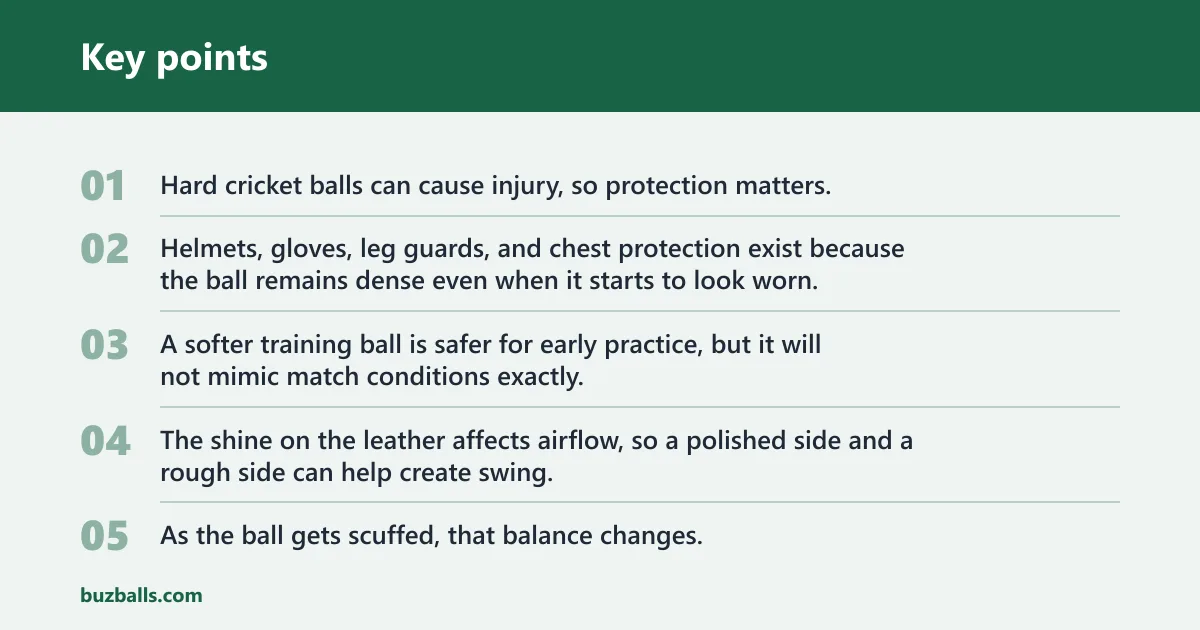
Hard cricket balls can cause injury, so protection matters. Helmets, gloves, leg guards, and chest protection exist because the ball remains dense even when it starts to look worn. A softer training ball is safer for early practice, but it will not mimic match conditions exactly.
How shine and damage change play
The shine on the leather affects airflow, so a polished side and a rough side can help create swing. As the ball gets scuffed, that balance changes. Once the leather is badly worn or the seam is damaged, the ball may lose movement, but it can still hit hard.
Why protection matters for beginners
Beginners should treat every hard cricket ball as a safety risk, especially near the bat, close catching positions, and in junior nets. Practice balls with a two-piece covering are common because they are cheaper and can be easier to manage, but they still need care and suitable protective gear.
| Ball type | Core material | Winding | Outer cover | Seam style | Typical use | What it changes in play |
|---|---|---|---|---|---|---|
| Red ball | Cork core | Tightly wound string | Red leather case | Raised seam with six rows of stitches | Test and first-class cricket | More durable look and feel over long spells; traditional swing and seam movement in daylight |
| White ball | Cork core | Tightly wound string | White leather case | Raised seam with six rows of stitches | One-day and Twenty20 cricket | Better visibility under floodlights; more early swing, then quicker deterioration |
| Pink ball | Cork core | Tightly wound string | Pink leather case | Raised seam with six rows of stitches | Day-night Tests | Built as a visibility compromise for evening play; aims to keep enough life for longer matches |
| Practice ball | Cork core or similar central fill | Often simpler winding | Often two-piece covering | Usually less refined seam profile | Training and lower-cost use | Cheaper and common for practice, but feel, wear, and movement are less like a top-grade match ball |
What ball is used in different formats?
The ball used in cricket depends on the format and the light conditions. Test cricket and first-class cricket use the red ball. One-day cricket and Twenty20 cricket use the white ball. Day-night Tests use the pink ball so the game can continue under lights with better visibility.
Manufacturers matter too. Kookaburra makes red and white balls for international use, while Dukes and SG are named brands used in specific Test-playing nations. Different makers and construction choices can change seam feel, hardness, and how quickly the ball wears, even when the basic rules stay the same.
Practice balls and lower-cost options
Two-piece cricket balls are a lower-quality or practice option, and they are common when cost matters more than match-level performance. They are useful for training, school sessions, and repeated drills, but they do not usually offer the same shape retention, seam detail, or wear pattern as a top-quality four-piece ball.
What a parent or beginner should look
If you are choosing a ball for a beginner, think first about safety, then about realism. A lighter training ball or a lower-cost practice ball may be better for early sessions. For older juniors or match prep, a proper leather ball with a clear seam gives a truer feel and helps players learn to field and bowl correctly.
Frequently asked questions
What’s inside a cricket ball
Inside a cricket ball is a cork core wrapped in string and covered with leather. The core gives the ball its firm centre, the winding keeps its shape, and the leather outer case protects the build while creating grip, seam movement, and wear patterns that players notice during a match.
How is a cricket ball made: a cricket ball is made?
A cricket ball is made by building a cork centre, winding it tightly with string, and enclosing it in leather. Top-quality balls use four pieces of leather, with the two hemispheres rotated by 90 degrees. The seam is stitched with six rows of stitches to help control movement.
Why does what is inside a cricket ball matter: what is inside a cricket?
What is inside a cricket ball matters because the inner build controls bounce, hardness, swing, and seam movement. It also affects safety. A well-made ball behaves more predictably, while a worn or uneven ball can become harder to judge for batters, bowlers, and close fielders.
What is the difference between red, white, and pink cricket balls?
Red balls are used in Test and first-class cricket, white balls in one-day and Twenty20 cricket, and pink balls in day-night Tests. The main differences are visibility and wear. White balls were introduced for floodlights, while pink balls were designed to work better in evening conditions.
Are cricket balls hard?
Yes. A cricket ball is a hard, solid ball used to play cricket. The cork core, tight string winding, and leather outer cover make it firm enough to travel fast and bounce sharply. That hardness is why protective gear matters, especially for batters, wicketkeepers, and close fielders.
What is the seam on a cricket ball?
The seam gives bowlers grip and helps the ball move in the air and off the pitch. It is a raised stitched ridge made with six rows of stitches. A strong seam can help swing and seam movement, while a worn seam reduces control and makes the ball play more evenly.