Soccer Ball Size 3 vs 4: Which Is Right for Younger Kids?

For younger kids, start with size 3. It gives smaller feet a better chance to wrap around the ball, keep it close, and strike it cleanly; move to size 4 only when the player keeps good form with the larger, heavier ball. Using the wrong size can make dribbling, passing, and shooting harder, which can slow skill growth. This guide compares size 3 vs size 4 by age, body size, skill level, and common league rules.
| Decision factor | Soccer ball size 3 | 4 | Winner |
|---|---|---|---|
| Circumference | Smaller circumference; easier for small feet to wrap around and guide | Larger circumference; closer to the ball size used by older youth players | Soccer ball size 3 |
| Weight | Lighter; easier to lift, trap, and strike with less strain | Heavier; can demand more strength and cleaner contact | Soccer ball size 3 |
| Control for younger players | Better for first touch, dribbling, and short passing in early stages | Can be manageable for bigger or stronger children, but often reduces control for smaller players | Soccer ball size 3 |
| Fit for older youth divisions | Usually too small once players move into older youth brackets | Common in many programs before size 5 | 4 |
| Technique development | Usually better for building clean touches and repeating proper mechanics | Useful when the child can still keep good form under a bigger load | Soccer ball size 3 |
Size and weight differences to know
Size 3 is the safer default for younger or smaller kids. Size 4 fits better only when the child can handle the extra size and weight without losing a clean first touch, tidy dribbling, or proper shooting mechanics.
Circumference and weight differences
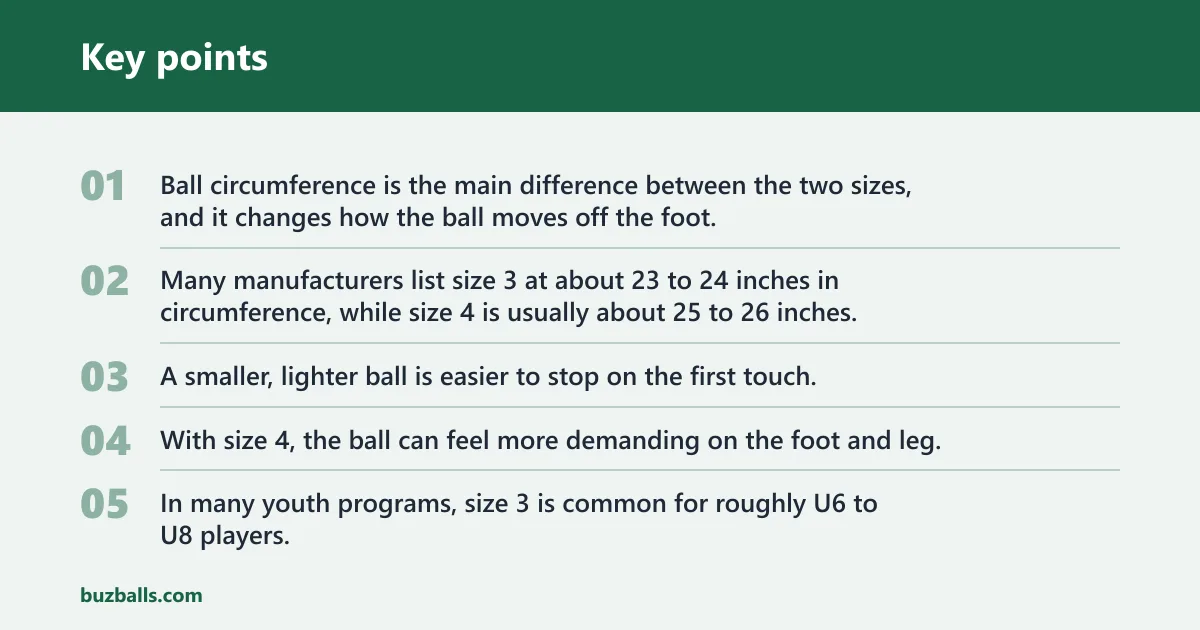
Ball circumference is the main difference between the two sizes, and it changes how the ball moves off the foot. Many manufacturers list size 3 at about 23 to 24 inches in circumference, while size 4 is usually about 25 to 26 inches.
Weight matters too. Size 3 is lighter than size 4, and that lower weight is a big reason small players can dribble, pass, and shoot with less effort.
What those differences mean on the field
A smaller, lighter ball is easier to stop on the first touch. It also stays closer during dribbling, which helps kids repeat clean touches instead of chasing the ball.
With size 4, the ball can feel more demanding on the foot and leg. That matters most in short passing, shooting mechanics, and close-control work, where clean contact is the whole point.
Quick age and skill snapshot
In many youth programs, size 3 is common for roughly U6 to U8 players. Size 4 is common for roughly U8 to U12 players, but the exact age split changes by league and country.
That age split is only a starting point. Height, strength, and skill level can point the other way for some children.
What size 3 is best
Size 3 is best for younger children, smaller players, and beginner programs that want easier control. It is the better training ball when the goal is clean contact, confidence, and repeated technical reps.
Younger age brackets and beginner programs
Many beginner youth programs use size 3 because it is easier for small feet to manage. That makes it a common choice for foundational skill development in dribbling, passing, and shooting.
Smaller players who need easier control
Some kids are small for their age, and age alone does not tell the full story. If the ball keeps getting away on the dribble or the child has to swing too hard to strike it cleanly, size 3 is usually the better fit.
Training uses that favor close touch
Size 3 works well in backyard practice, close-control drills, and short passing work. It is especially useful when you want touch quality to stay high without forcing the child to fight the ball.
What size 4 is best
Size 4 is best for older youth players and for children who can already handle a larger, heavier ball without losing technique. It is also common in leagues that use size 4 before moving up to size 5.
Older youth age brackets
Many programs use size 4 for roughly U8 to U12. That is a common bridge size for players who have outgrown size 3 but are not ready for a full size 5 ball.
Players ready for a larger, heavier ball
If a child can trap the ball cleanly, keep dribbling close, and strike through the ball without changing form, size 4 may be the right next step. The key is not age alone, but whether technique stays intact.
Programs that use size 4 before size 5
Some leagues and coaches want size 4 because it prepares players for later stages. That can make sense in organized training, but the ball should still match the child’s current control, not just the calendar.
Should my child use size 3 or size 4?
Use size 3 if your child is younger, smaller, or still building basic control. Move to size 4 only if the child can handle the larger ball without losing a clean first touch, tidy dribbling, or proper shooting mechanics.
Age, height, and strength checks
- Start with the league rule. If the league or coach specifies a ball size, follow that first. Recreational and travel play can use different rules, so check before buying.
- Match the child’s body size. If a child is undersized for age, or simply struggles to wrap a foot around the ball, size 3 is the safer choice. If the child is clearly strong enough to control a larger ball, size 4 can fit better.
- Watch the technique. Keep the ball size that preserves a steady first touch, accurate short passing, and normal shooting form. If the child has to compensate, the ball is probably too big or too heavy.
Advanced younger kids
Advanced younger kids can sometimes use size 4 early, but only if they stay sharp on touch and form. A strong U7 player who already controls a larger ball in drills may be ready, while another U7 player at the same level may still do better with size 3.
Undersized older kids
Some older kids still fit size 3 better because they are smaller or lighter than teammates. That is not a setback. If size 4 starts causing poor touch or rushed mechanics, size 3 is still the better training ball until control catches up.
Say your child is 7 and can dribble a size 3 with both feet, but size 4 starts popping away on the first touch. In that case, size 3 remains the better choice even if a team mate has already moved up.
How ball size affects technique
Ball size changes more than comfort. It can alter first touch, dribbling, passing accuracy, shooting mechanics, and how tired a child feels after repeated reps.
First touch and dribbling
A smaller ball is easier to cushion and keep close. That helps kids learn to move with the ball instead of kicking it ahead and chasing it.
With a larger ball, young players often need stronger contact and better balance to keep the ball under control. If they do not have that yet, dribbling gets messy fast.
Passing accuracy
Short passes are easier to repeat with size 3 for many younger kids because the ball is lighter and easier to strike cleanly. Size 4 can be fine for stronger players, but weak contact often shows up as off-target passes.
Shooting mechanics and fatigue
A ball that is too large or too heavy can change how a child swings through the shot. Some kids start poking at the ball instead of striking through it, and that can slow the learning of proper shooting form.
Fatigue matters too. A heavier ball can tire younger players faster, especially during longer drills, which can reduce touch quality late in practice.
Soccer ball decision matrix
Use this table when age, size, and skill do not point to the same answer. The league rule still wins if it is specific.
| Child age, size, or skill level | Recommended ball size | Reason to choose it |
|---|---|---|
| U6 beginner, small feet, still learning to stop and dribble | Soccer ball size 3 | Easier first touch and closer control for foundational skill work |
| U7 or U8 player in a beginner program | Soccer ball size 3 | Common youth choice for control, confidence, and cleaner contact |
| Advanced younger kid with strong touch and good balance | 4 | Can handle the larger ball without losing dribbling or shooting form |
| Undersized older child who still struggles with a bigger ball | Soccer ball size 3 | Better comfort, less fatigue, and better technique repetition |
| U8 player in a league that requires size 4 | 4 | League rule overrides the general age default |
| Child training alone in the backyard on close-control drills | Soccer ball size 3 | Best for touch quality and repeated technical reps |
What size soccer ball do U8 players use?
U8 players often use size 3 in many programs, but some leagues may allow or require size 4. The right answer depends on the local rule, the coach’s plan, and whether the child can handle the ball without losing control.
Typical U6 to U8 size 3 use
Size 3 is common across U6 to U8 because it gives young players a manageable ball for dribbling and passing. For many children, that is the point where learning stays cleaner and less frustrating.
When a league may allow size 4
Some U8 leagues use size 4 to prepare players for the next stage. If that is the rule, use size 4 in matches and team training, but keep an eye on touch quality and fatigue during longer sessions.
How to handle mixed-age training
In mixed-age sessions, the smallest or least experienced players may still do better with size 3 even if older teammates use size 4. A coach can split drills by ball size when the group’s control is uneven.
Picture a U8 player who can pass a size 3 cleanly but starts toe-poking a size 4 during short shooting drills. That player is telling you the ball is ahead of the technique, not the other way around.
Choose Soccer ball size 3 if… / Choose 4 if…
Choose size 3 if your child is younger, smaller, new to soccer, or clearly more controlled with a lighter ball. Choose 4 if the child is older youth age, has enough strength for the bigger ball, and can keep first touch, dribbling, and shooting mechanics intact.
Choose Soccer ball size 3 if…
- Your child is in the younger youth bracket, often around U6 to U8.
- Size 4 causes poor touch, extra fatigue, or rushed contact.
- You want the easiest ball for basic dribbling, passing, and shooting work.
- The child is small for age and needs better control more than added ball size.
Choose 4 if…
- The league or coach requires it.
- Your child is older youth age, often around U8 to U12 in many programs.
- The child can control a larger ball without losing form.
- Drills and matches call for a ball closer to the next stage of play.
Frequently asked questions
Should my child use a size 3 or size 4 soccer ball?
For most younger kids, size 3 is the better default because it is lighter and easier to control. Move to size 4 only when the child can handle the larger ball without losing clean first touch, dribbling control, or shooting form, or when the league requires it.
What age should use a size 3 soccer ball?
Size 3 is commonly used for roughly U6 to U8 players, though the exact age range can vary by league and country. It is the usual choice for children who are still building basic control, especially if the ball feels big or heavy in drills.
What age should use a size 4 soccer ball?
Size 4 is commonly used for roughly U8 to U12 players in many programs. It is often the next step after size 3, but age is only a guide. If the child cannot keep good technique with size 4, size 3 may still be better.
Is size 3 or size 4 better for beginner players?
Size 3 is usually better for beginners because it gives them a better chance of clean touches and accurate short passes. A beginner who starts with size 4 too soon may develop poor habits just to keep the ball under control.
Does a bigger soccer ball hurt younger kids’ technique?
A bigger ball can hurt technique if the child is not ready for it. Common problems include weak first touch, off-target passes, and awkward shooting mechanics. The issue is usually control and fatigue, not the ball itself.
How do I know if a soccer ball is too heavy for my child?
If your child has to swing harder than normal, loses control on routine touches, or tires quickly during simple drills, the ball may be too heavy. A good fit lets the child keep balance and repeat clean contact without obvious strain.
Should I choose size based on age or height?
Use age as the starting point, then adjust for height, strength, and skill. A small older child may still need size 3, while a strong younger child may be ready for size 4 if the technique stays sound. League rules still come first.
What happens if a child practices with the wrong ball size?
Practicing with the wrong size can make dribbling, passing, and shooting harder than they need to be. Over time, that can slow skill growth because the child spends more effort fighting the ball and less time repeating good technique.