Cricket Bat Size Guide by Age: What Size for Each Age Group

A common age-based guide is: under 5 = size 1, 5–7 = size 2, 7–9 = size 3, 9–11 = size 4, 11–13 = size 5, and 13+ = Harrow; if the bat reaches the wrist or feels heavy, size down. A bat that is too long or too heavy slows timing, reduces control, and can make batting unsafe. This article maps each age band to a bat size and shows how height and strength decide borderline cases.
Cricket bat size chart
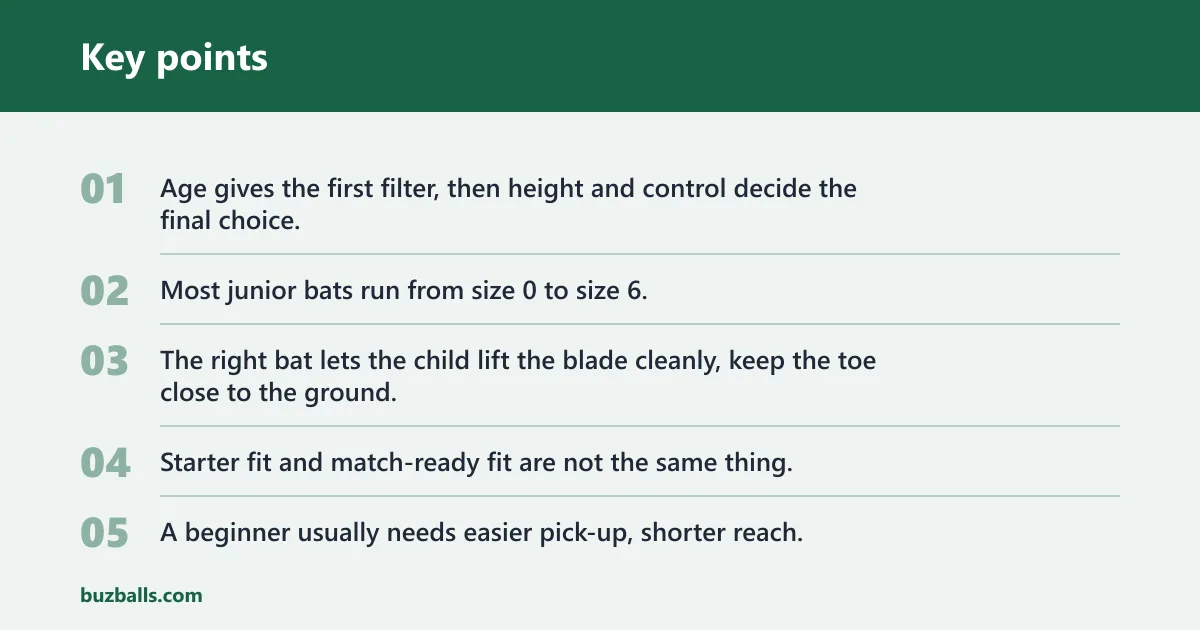
Age gives the first filter, then height and control decide the final choice. Most junior bats run from size 0 to size 6, with Harrow as the bridge before full-size adult bats. The right bat lets the child lift the blade cleanly, keep the toe close to the ground, and swing without strain.
| Age band | Typical height band | Bat size | Choose the smaller size if… | Size up only if… |
|---|---|---|---|---|
| Under 5 | Up to about 110 cm | Size 1 | The bat reaches the wrist, the lift looks stiff, or the child cannot keep the toe near the ground. | The child is tall for age, handles a size 1 easily, and the pickup feels light. |
| 5–7 | About 110–122 cm | Size 2 | The bat feels front-heavy or the backswing shortens to protect control. | The child is near the top of the height band and can swing with relaxed hands. |
| 7–9 | About 122–137 cm | Size 3 | The top hand lifts the shoulder, or the bat drags through the swing. | The child has strong control and the bat still clears the ground easily. |
| 9–11 | About 137–147 cm | Size 4 | Shot timing drops because the bat is hard to pick up and turn. | The child is tall for age and can hold the bat with a smooth, repeatable lift. |
| 11–13 | About 147–157 cm | Size 5 | The child is still learning basic timing and needs lighter handling. | The child is strong for age and can control a longer blade through the stroke. |
| 13+ or taller junior player | About 157 cm and above | Harrow or full-size adult bat | The adult bat feels too long at the wrist or the toe sits too far off the ground. | The child is close to adult height and can keep the bat under control from stance to finish. |
Starter fit and match-ready fit are not the same thing. A beginner usually needs easier pick-up, shorter reach, and a lighter feel that helps contact. A more advanced junior can handle a slightly fuller feel if the bat still lifts smoothly and the stance stays stable.
What size for each age?
Start with age, then check height and strength against the band above. The usual mapping is size 1 for under 5, size 2 for 5–7, size 3 for 7–9, size 4 for 9–11, size 5 for 11–13, and Harrow from about 13 years old or when the child is clearly moving beyond junior proportions.
What size cricket bat for 5 year olds?
A 5-year-old usually fits size 2, though a small child may still need size 1. Check whether the bat lifts with relaxed shoulders and whether the toe stays near the ground when the child stands naturally. If the bat reaches the wrist, it is too much bat.
What size cricket bat for 6 to 8 year olds?
Most 6-year-olds suit size 2, while many 7- and 8-year-olds move into size 3. Use height and control to separate the two. If the child can swing size 3 without twisting the torso or dipping the bat head, size 3 is the better fit. If not, stay with size 2.
What size cricket bat for 9 to 12 year olds?
Most 9- and 10-year-olds move into size 4, while 11- and 12-year-olds often need size 5. A taller 10-year-old may already be close to size 5, but only if the pickup is still clean. If the bat feels heavy in the bottom hand, size down before you size up.
Cricket bat sizes 0 to 6
Junior bat sizes are numbered, but the number alone is not enough. The practical use case matters too: younger beginners need easy control, while older juniors need enough length to match their stance and reach. The chart below gives the common size range, age band, height band, and typical use.
| Bat size | Typical age range | Typical height range | Common use case |
|---|---|---|---|
| Size 0 | Under 4 | Below about 104 cm | Very small beginners, short indoor or starter sessions |
| Size 1 | Under 5 to 6 | About 104–110 cm | First junior bat, easy swing path, short reach |
| Size 2 | 5–7 | About 110–122 cm | Early junior cricket, beginner practice, simple control |
| Size 3 | 7–9 | About 122–137 cm | Junior training and basic match play |
| Size 4 | 9–11 | About 137–147 cm | Growing juniors who need a longer reach |
| Size 5 | 11–13 | About 147–157 cm | Older juniors, stronger players, more match-ready fit |
| Size 6 | About 13–14 | About 157–163 cm | Last junior step before Harrow for some players |
Size 0 to size 2
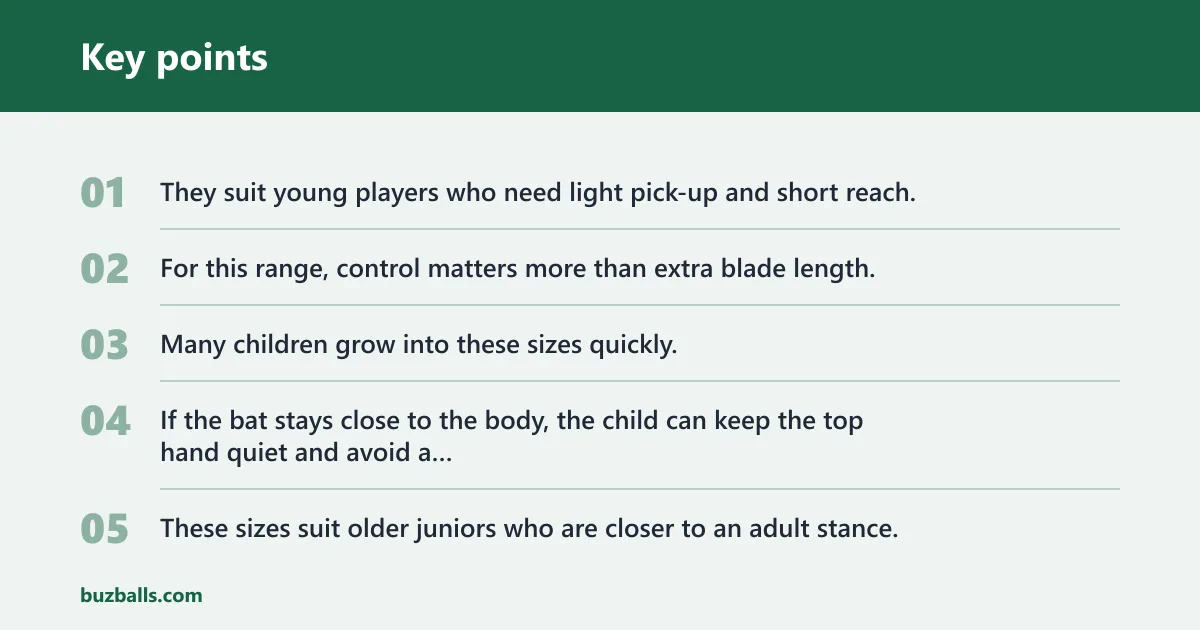
These are the smallest junior bats. They suit young players who need light pick-up and short reach, especially when technique is still basic. For this range, control matters more than extra blade length, because a child who cannot lift the bat cleanly will struggle to time the ball.
Size 3 to size 4
This is the middle junior range. Many children grow into these sizes quickly, but the best choice still depends on standing reach and swing control. If the bat stays close to the body, the child can keep the top hand quiet and avoid a looping, rushed backlift.
Size 5 to size 6
These sizes suit older juniors who are closer to an adult stance. A bat in this range should still feel manageable on the backlift and through the follow-through. If a child is already near adult height, Harrow may be the next step instead of stretching size 6 for too long.
When Harrow is the next step
Harrow is the bridge size between junior bats and full-size adult bats. It is usually the right move when a child outgrows size 6 but an adult bat still feels too long, too heavy, or hard to swing cleanly. Many players reach Harrow around 13 years old, but height and control matter more than age alone.
Typical age range for Harrow
Harrow is commonly used from about 13 years old onward. Some tall 12-year-olds may also fit it if they have the reach and strength to control it. Smaller or less developed players should stay in size 6 longer if the bat lift is still smooth there.
Typical height range for Harrow
Harrow often fits players around 157 cm and above, though exact fit varies by maker and blade profile. It suits juniors who are no longer comfortable in size 6 but are not ready for the full length and feel of an adult bat. Standing reach and toe position decide the final call.
When to move up from junior sizes
Move up when the child can hold the current bat with control, the toe sits too close to the ground or the bat looks short in stance, and the next size still lifts cleanly. Do not move up only because of age. A bat that is long but poorly controlled is the wrong fit.
Suppose a 12-year-old is tall for age and already plays front-foot shots well. If a size 5 lifts easily and the stance stays balanced, Harrow may still be premature. If the same player is cramped in size 5 and the toe is well clear of the ground, Harrow becomes the better next step.
How height and strength decide the fit
Height is the primary fit signal, then strength and control decide whether the child can actually use the bat well. A smaller, lighter player may need to stay down a size even when age suggests moving up. A tall child may still need the smaller option if the bat feels awkward in the hands.
Choose the smaller size if…
Choose the smaller size if the bat reaches the wrist, the child loses a clean backlift, the bat feels heavy in the bottom hand, or the finish of the swing becomes messy. Also choose down if the child is still learning basic timing. Clean contact beats extra length.
Size up only if…
Size up only if the child can lift the bat without shoulder strain, keep the toe near the ground when standing, and swing without reaching for the ball. The bat should feel like part of the stance, not a weight to manage. If there is doubt, stay with the easier size.
Weight, pick-up, and control
Cricket bat weight affects how quickly a child can start the swing and change direction. Lightweight junior options often work better than a longer, heavier bat that looks impressive on paper but is hard to control. Balance matters too: a bat that picks up well can feel easier than a lighter bat with poor balance.
A common mistake is buying based on the bat’s overall look alone instead of checking whether the size matches the player’s height and age. A child who can swing a size 4 smoothly may hit better with it than with a longer size 5 that drags through the hitting zone. The right bat should support confidence, not force a compensating grip.
Use three quick checks at home before you order online or leave the shop. Measure from the floor to the hip, hold the bat in a standing stance, and check whether the arms and hands can manage the lift without strain. These checks catch the most common sizing mistakes.
Floor-to-hip rule
Stand the child straight against a wall and measure from the floor to the hip crease. A junior bat should generally sit around that area when the toe is on the floor and the grip is held naturally. If the blade rises well above that point, the bat is likely too long.
Standing fit check
Have the child stand in a normal batting stance with the bat resting beside the back foot. The toe should sit near the ground, not floating high above it. The hands should be able to hold the bat comfortably without shrugging the shoulders or locking the elbows.
Arm-length check
Ask the child to lift the bat into a ready position and watch the top hand, shoulders, and back. The lift should look free and repeatable. If the backlift collapses or the bat pulls the body off balance, the size is too ambitious for the current strength and technique.
Signs a bat is too big
A bat can be too big in three ways: too long, too heavy, or both. The signs show up in stance, lift, and timing. If the bat interferes with movement before the ball is even bowled, it is not the right fit, regardless of age band.
Toe position and stance
When the child stands naturally, the toe should sit close to the ground. If the toe is hanging high or the bat reaches the wrist, the length is off. A bat that changes the stance forces the player to reach for the ball instead of setting a stable base.
Lift and backswing problems
If the child cannot lift the bat without leaning back, raising the shoulder, or cutting the backlift short, the bat is too much to handle. A proper fit allows the player to prepare the shot without effort. The backswing should stay controlled, not laboured.
Bottom-hand control and timing
When a bat is too heavy, the bottom hand often takes over and timing gets late. The child may swing harder but connect worse. That is a fit problem, not a coaching problem. A lighter or shorter bat usually restores control faster than extra practice with the wrong size.
Frequently asked questions
What size cricket bat should a 5-year-old use?
Most 5-year-olds fit size 2, though some smaller children still need size 1. Use the standing check: if the bat reaches the wrist or feels stiff in the lift, go smaller. If the child is tall for age and handles the bat easily, size 2 is usually right.
What size cricket bat for 6 year old?
A 6-year-old usually needs size 2. If the child is tall, strong, and keeps the bat under control with a relaxed stance, the fit is likely correct. If the bat drags, shortens the backswing, or lifts the shoulder, the next smaller junior size may be better.
What size cricket bat for 7 year old?
Most 7-year-olds are between size 2 and size 3, with size 3 becoming common. Height and pick-up decide the final call. If the child can keep the toe near the ground and swing without strain, size 3 is the better match. If not, stay with size 2.
What size cricket bat for 8 year old?
An 8-year-old usually fits size 3. This is a common transition point, so check control carefully rather than assuming the next size is right. A bat that feels easy in stance and does not upset timing is better than one that looks larger but fights the swing.
How do I know if a cricket bat is too big for my child?
The bat is too big if it reaches the wrist, feels heavy in the hands, lifts the shoulders, or makes the child lose balance in the stance. Another red flag is a toe that sits too far off the ground. Those signs matter more than the age number on the label.
Is age or height more important when choosing a junior cricket bat?
Height is more important than age, but age is still a useful starting point. Use age to narrow the size band, then use height, strength, and control to choose within it. If the child falls between sizes, pick the one that keeps the lift clean and the stance stable.