Golf Ball for Beginners: How to Choose the Right One

Most beginners are often advised to start with a 2-piece ionomer ball in the roughly $20-$30 per dozen range; lower-compression options are commonly suggested only if driver speed is under about 85 mph. Pick the wrong ball and you can pay tour-ball prices for spin you cannot use while losing distance, consistency, and more balls.
What should a beginner look for first?
Start with your usual miss, your speed, and how often you lose balls. For a new player, the first priority is keeping tee shots in play, getting enough carry to clear trouble, and avoiding premium-ball replacement costs that add up fast, so forgiveness and distance come before tour-level stopping power.
Start with your miss, not the label
Marketing names like soft, distance, and tour help only after you know what the ball needs to do for your swing. A player who slices, a player who hooks, and a player who hits it mostly straight but loses balls into ponds do not need the same construction.
That is why generic advice such as “beginners need low compression” misses too much. Compression matters, but so do spin profile, cover material, and whether buying a pricey urethane ball makes sense when several balls disappear each round.
Why forgiveness usually beats greenside spin early
Beginners should prioritize forgiveness and distance. In ball terms, that usually means lower spin on driver and iron shots, a cover that resists cuts and scuffs, and a price that lets you reload without thinking twice. Extra short-game spin can help on chips and pitches, but it usually comes with higher cost and less help on curved tee shots.
Lower spin does not cure a slice or hook. It can, however, trim the amount the ball curves compared with a higher-spin design, which is often enough to keep more drives in play.
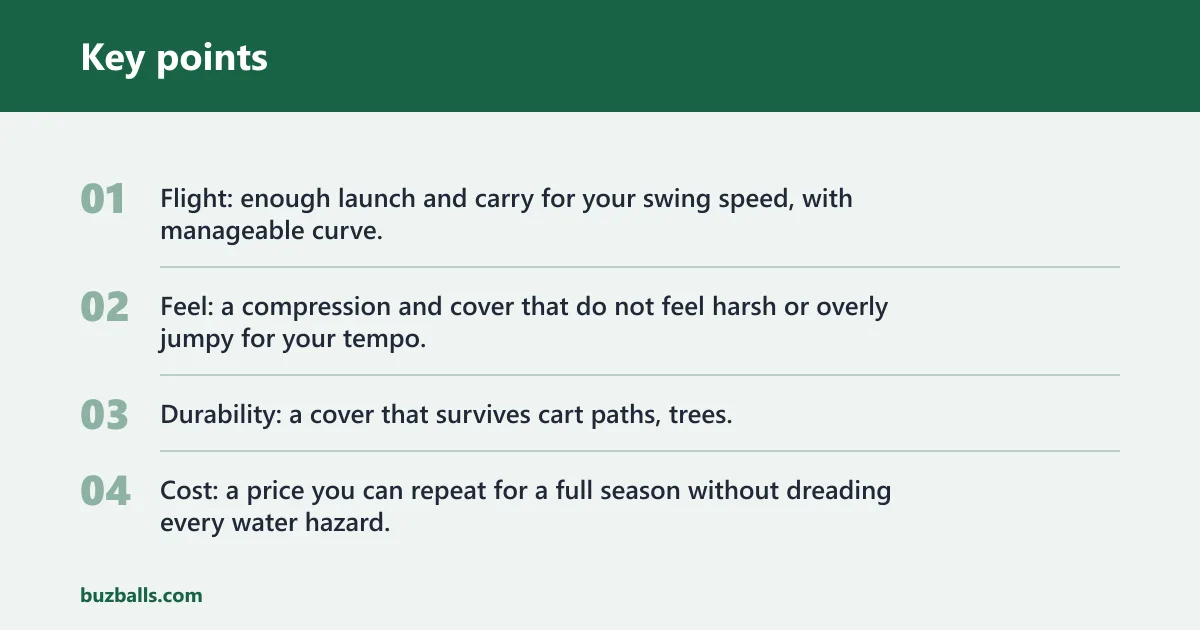
The four priorities that matter most
- Flight: enough launch and carry for your swing speed, with manageable curve.
- Feel: a compression and cover that do not feel harsh or overly jumpy for your tempo.
- Durability: a cover that survives cart paths, trees, and bunker shots without scuffing quickly.
- Cost: a price you can repeat for a full season without dreading every water hazard.
Why 2-piece balls fit most beginners
Core and cover basics
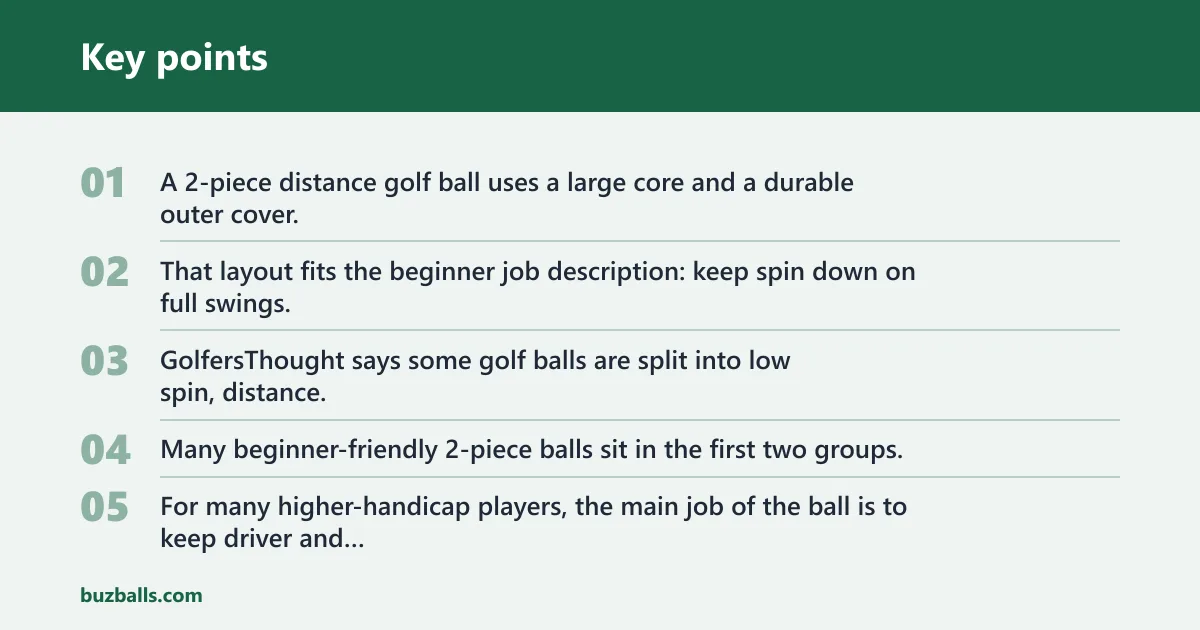
A 2-piece distance golf ball uses a large core and a durable outer cover, often Surlyn or another ionomer blend. That layout fits the beginner job description: keep spin down on full swings, hold up to bad lies and hard surfaces, and keep replacement cost lower when a ball vanishes.
GolfersThought says some golf balls are split into low spin, distance, and soft feel groups. Many beginner-friendly 2-piece balls sit in the first two groups, which is a better starting point than shopping by feel alone.
How lower spin helps full shots
For many higher-handicap players, the main job of the ball is to keep driver and long-iron misses from curving more than they already do. A lower-spin 2-piece ball can do that better than a premium urethane tour ball built to create more stopping power.
Say your tee shot starts ten yards right and keeps drifting. A lower-spin distance ball will not rebuild the swing, but it may turn a big banana ball into a smaller miss that stays short of the trees.
When a 2-piece distance ball is the best value play
A 2-piece distance ball is the best first buy when three things are true: you lose balls often, your main miss is a slice or pull-hook, and you are still learning center-face contact. At that stage, lower driver spin, tougher covers, and cheaper replacement usually matter more than the extra check a pricier ball can produce on a few pitches.
Wilson BOOST™ 2024 Golf Balls 12pk are listed at $9.97, TaylorMade 2025 Distance Plus Golf Balls 12pk at $21.97, Titleist 2026 TruFeel Golf Balls 12pk at $24.97, and Callaway SuperSoft 2025 Golf Balls 12pk at $26.97. That spread matters more when your ball-loss rate is high.
When should you move to a 3-piece ball?
Move to a 3-piece ball when your contact is more stable, you lose fewer balls, and you can tell the difference between a release and a checked pitch. A 3-piece design sits between pure distance and tour performance, giving more greenside spin and feel without always jumping to tour-ball cost.
What the extra layer changes
A 3-piece golf ball adds a middle layer that helps tune launch, spin, and feel. In buying terms, it usually means a middle ground: more control than a basic distance ball, but less extreme spin and cost than a premium multi-layer urethane tour model.
That makes sense for beginners whose swings are improving. If the player is starting to hit more greens, more predictable approach-shot stopping power becomes worth paying for.
The control tradeoff
The tradeoff is simple. A 3-piece ball often gives more greenside spin than a distance ball and a more responsive feel on chips and pitches, but it can also cost more and curve a little more on poor full swings if the spin profile is higher.
A common first-timer mistake is buying a ball for a few wedge shots per round while ignoring twenty or thirty full swings that still miss the center. Early on, the full-swing side of the trade usually matters more.
Signs you are ready
- You lose fewer balls from wild curvature and more from normal golf mistakes.
- You can hit partial wedges with one intended trajectory more than half the time.
- You want the ball to stop faster on short approaches and notice that basic distance balls release too much.
- You are no longer choosing purely by lowest shelf price.
How much does compression matter?

Compression matters, but it is not the whole decision. For beginners, treat compression like a swing-speed match: slower swings usually get better launch and carry from softer balls, while faster swings can use firmer models. Use it after miss pattern and budget, not before them.
Low compression in practical terms
Some guides place low compression at roughly below 70. Medium compression is described as 70-90, and high compression is described as 90 and above. The practical point is straightforward: lower-compression balls deform more easily at impact, which can help slower swingers launch the ball and keep carry from dropping.
Should every beginner buy the softest ball available? No. If the cover spins a lot or the price is high, that softness may not solve the actual problem.
What swing speed should you match?
Use broad bands, not fake precision. Under 80 mph usually points toward lower compression and beginner-friendly distance designs. Low swing speed is shown as under 85 mph, medium swing speed is shown as 85-104 mph, and high swing speed is shown as above 105 mph.
For the middle band, the choice opens up. Many players there still do well with a 2-piece ball, but some can move into a 3-piece model if contact is improving and ball loss is moderate. Above the high-speed band, firmer constructions make more sense because the player can actually compress them and use the added control.
What mismatch feels like
Too firm for a slower swing can feel hard and launch lower, with weak carry and a sense that the ball never quite leaves the face cleanly. Very soft for a fast swing can feel loose, spin inconsistently, and give away control on fuller shots.
Picture a player with a smooth, slower driver swing choosing a very firm premium ball because it sounds advanced. The result is often a flatter flight and less confidence, even before short-game benefits show up.
Which cover material makes sense?
For most beginners, Surlyn or ionomer makes the most sense because it is durable, lower in cost, and commonly paired with lower-spin distance constructions. Urethane is the right cover only when you value extra greenside control enough to accept higher price and more scuff risk.
Surlyn or ionomer
These covers are the value choice. They tend to be tougher, which matters if balls hit cart paths, trees, or hard bunkers. They are also common on 2-piece balls built for straighter full shots and lower cost per round.
If you lose several balls a round, cover durability and price matter more than a few extra yards of rollout on a wedge. That is why an ionomer-covered distance ball is usually the first recommendation.
Urethane
Urethane covers are chosen for spin and feel around the greens. They can help a better player stop pitches faster and shape short shots with more precision. They also cost more and scuff more easily, especially for players who catch shots thin from firm turf or bunkers.
Beginners rarely need a tour ball because they often pay for spin features they cannot use consistently. Worse, that extra spin can make poor full shots less forgiving while raising the cost of every lost ball.
When cover choice matters less
If the main issue is losing balls off the tee, cover material is secondary to spin profile and price. Buy the ball you can keep in play and afford to replace. Save the urethane decision for later, when a missed green leads to a real up-and-down attempt instead of another recovery punch.
How should your miss change the ball choice?
Your usual miss should steer the spin profile and cover choice. Slicers and hookers generally do better with lower-spin distance balls, while players who hit it fairly straight can choose more by speed, feel, and short-game goals. The ball will not fix path or face, but it can make misses less costly.
For a slice
A slice player should lean toward a 2-piece distance ball with an ionomer cover and a lower-spin full-shot profile. That setup usually gives the best chance at straighter flight, better durability, and lower replacement cost.
Avoid assuming every ball labeled soft is ideal. Across brands, similar names can hide different compression, cover, and spin profiles. Model year matters too, because one generation’s “soft distance” ball may not match the next one exactly.
For a hook
Hook players still benefit from lower spin on full shots, even though the curve goes left instead of right. The goal is the same: reduce how violently the ball moves offline. A very spinny urethane ball can exaggerate the punishment on a face-closed strike.
Suppose a player’s common miss is a low left bullet that runs through the fairway. A softer feel alone does not solve that. A durable lower-spin ball is still the safer first buy.
For mostly straight shots
If shots are mostly straight, choose by swing speed, feel preference, and budget. This is the group that can move into a 3-piece ball sooner, because extra spin and feel may actually show up in scoring shots rather than getting erased by big offline misses.
High-visibility colors also fit well here if lost balls come more from rough, leaves, or low light than from major curves. Yellow, orange, and matte options usually perform the same as white versions when the construction is the same; they are simply easier to track and find.
Beginner ball matrix
How to use the matrix
Pick the row that matches three inputs: your typical miss, your swing-speed band, and how many balls you lose in a month. Then buy the ball type, not the marketing story. The last column matters most because every good beginner choice gives something up.
Profile decision table
| Typical miss | Swing-speed band | Monthly ball loss | Recommended construction | Compression range | Cover | Tradeoff accepted |
|---|---|---|---|---|---|---|
| Slice | Under 80 mph | High | 2-piece distance ball | Low, often below 70 | Ionomer or Surlyn | Less greenside check in exchange for easier launch, lower spin, and lower loss cost |
| Slice | 85-104 mph | High | 2-piece distance ball | Low to medium | Ionomer or Surlyn | More firmness and durability, with less short-game spin than a 3-piece ball |
| Slice | 85-104 mph | Low | 3-piece lower-spin ball | Medium | Ionomer or soft urethane | Some added feel and approach control, while accepting slightly more curve on mishits |
| Hook | Under 80 mph | Moderate | 2-piece distance ball | Low | Ionomer or Surlyn | Better launch and less leftward exaggeration, with basic greenside performance |
| Hook | Above 105 mph | Low | 3-piece ball | Medium to high | Ionomer first, urethane only if short-game control is a clear need | More control potential, but less forgiveness than a simple distance ball |
| Mostly straight | Under 80 mph | Low | 2-piece soft-distance ball | Low | Ionomer or Surlyn | Easy compression and value, with limited stopping power on partial shots |
| Mostly straight | 85-104 mph | Low | 3-piece ball | Medium | Ionomer or urethane | Better blend of distance and control, at higher cost per lost ball |
| Mostly straight | Above 105 mph | Low | 3-piece or tour-style multi-layer ball | Medium to high | Urethane if short-game spin is truly used | Maximum control potential, with the highest price and least forgiveness |
Are expensive or colored balls worth it?
Expensive balls are worth it only when your contact and ball-retention rate are good enough to use their extra control. Colored balls are easier to justify sooner, because they usually fly the same as white versions when construction matches and can help you find more of them.
Cost per round beats cost per dozen
Shelf price is only half the math. If a cheaper ball lasts a full round and a premium ball disappears on the fifth hole, the cheaper ball was the better fit even if it spun less on chips.
A simple way to think about it: multiply the per-ball price by how many balls you typically lose in a round. Then ask whether the more expensive ball gives enough scoring benefit to beat that replacement cost. For many beginners, it does not.
When high-visibility colors help
Yellow, orange, and matte finishes can be easier to track in overcast light, dormant rough, and leaf-covered edges. There is no built-in performance gain if the colored and white versions share the same construction. The benefit is visual, and for many new golfers that is enough.
Naming and model-year traps
Do not buy by the word on the box alone. One brand’s “soft” ball may be a very different product from another brand’s “soft” ball. Model-year updates can also shift feel, cover, or spin without changing the family name much.
Compare four things before buying a dozen: construction, cover material, compression category, and intended spin profile. That keeps similar-sounding balls from being treated as identical when they are not.
Frequently asked questions
What golf ball should I use as a beginner?
Most beginners should start with a 2-piece distance ball with an ionomer or Surlyn cover. That type usually gives the best mix of forgiveness, durability, and value. If swing speed is on the slow side, choose a lower-compression version rather than assuming every soft-labeled ball is the same.
What makes a golf ball forgiving for beginners?
A forgiving beginner ball usually has lower full-shot spin, a durable cover, and a construction aimed at distance rather than tour-level greenside control. That combination can reduce shot curvature, survive more abuse, and keep replacement cost down while the swing is still inconsistent.
Should beginners use low compression golf balls?
Often yes, but mainly when swing speed is slower. Lower compression can help launch and carry for players who do not hit the ball very hard. It is still only one part of the choice, because cover, spin profile, and price may matter more than softness alone.
Do beginners need a tour ball?
Usually no. Tour balls are built to provide more spin and control, especially around the greens, but that comes with higher price and often less forgiveness on mishits. Until contact and ball retention improve, paying for those features is hard to justify for most new golfers.
Which golf ball helps with a slice or hook?
A lower-spin distance ball is usually the safest first choice for both slice and hook patterns. It will not fix swing path or clubface problems, but it can reduce how much the ball curves compared with a higher-spin design. Durable 2-piece models are the usual starting point.
Does a yellow golf ball perform differently than white?
No, not when the yellow and white versions use the same construction, cover, and compression. The advantage is visibility, not extra distance or spin. Many beginners find colored balls easier to track in flight and easier to spot in rough, leaves, or low-light conditions.