
Tennis Ball Types for Beginners: Which Are Easiest to Play with?

For many beginners, the easiest start is usually a slower progression ball that matches the court and contact level. Use it for first rallies, then move up only after contact gets cleaner. Pick the wrong ball and beginners miss more, swing harder, and lose rallies before they start. This guide explains which tennis ball type fits your player, court, and first-session goal.
Beginner ball decision table
| Player type | Easiest ball to start with | Why it works |
|---|---|---|
| Young child on a 36-foot court | Red tennis balls | They are the slowest option in the progression, with a lower bounce that makes clean contact easier and helps the ball stay in play longer. Avoid if… the child is already rallying cleanly and the ball is no longer forcing simple, controlled swings. |
| Junior on a 60-foot court | Orange tennis balls | They are the Stage 2 step, the same size as a standard tennis ball, and about 25% lighter than a standard ball. That makes them a good bridge from red balls to full-court play. Avoid if… the player is still struggling to reach the ball cleanly from the service line or deeper. |
| Adult beginner on a full court | Green tennis balls | They are the final transition before standard yellow balls, with slower speed and lower bounce than a normal match ball. Avoid if… the adult already has compact timing and can rally with a standard yellow ball without rushed contact. |
| Practice-heavy beginner | Pressureless tennis balls | They are durable, consistent over time, and good for repeated feeding drills, ball machines, and long practice blocks. Avoid if… the player wants the softest feel possible for the arm, because some pressureless balls can feel firmer and heavier. |
Which tennis ball is easiest for beginners?
For the first session, the easiest ball is usually the one that slows the rally enough for clean contact, and that is often a red, orange, or green progression ball rather than a standard yellow one. The right choice depends on court size, ball speed, and whether the goal is rallying, serving, or feeding drills.
Best ball for the first session
The best pick is the one that matches the player’s court and contact level. If the goal is to get the ball over the net and into play, start with the slowest ball that fits the court. Red balls are the easiest for the smallest courts and the newest players. Orange balls suit 60-foot courts. Green balls make sense when a player is close to full-court tennis but still needs extra time to react.
When a slower ball helps most
A slower ball helps most when contact is late, swings are wild, or the rally dies after one or two shots. Lower bounce and reduced speed give the beginner more time to set the feet, watch the ball, and hit the center of the strings instead of missing the frame.
Say your child is on a 36-foot court and every second ball skips past the racket hip. A red ball can keep the drill alive long enough for the child to track the bounce and finish the swing. The fix is speed and bounce, not more power.
When a standard yellow ball is fine
A standard yellow ball is fine for an adult beginner who already swings with control, can make contact near the center of the strings, and does not need a slower ball to keep rallies going. Standard yellow balls are the normal choice for adult play and competition, but they can overwhelm total beginners who are still learning spacing and timing.
Red, orange, green, or yellow?
The progression is simple: red is the slowest starting point, orange is the middle step, green is the last step before yellow, and yellow is the standard full-court ball. The best pick is the one that matches the player’s current contact quality and the court being used, not the player’s age alone.
Red balls: the slowest starting point
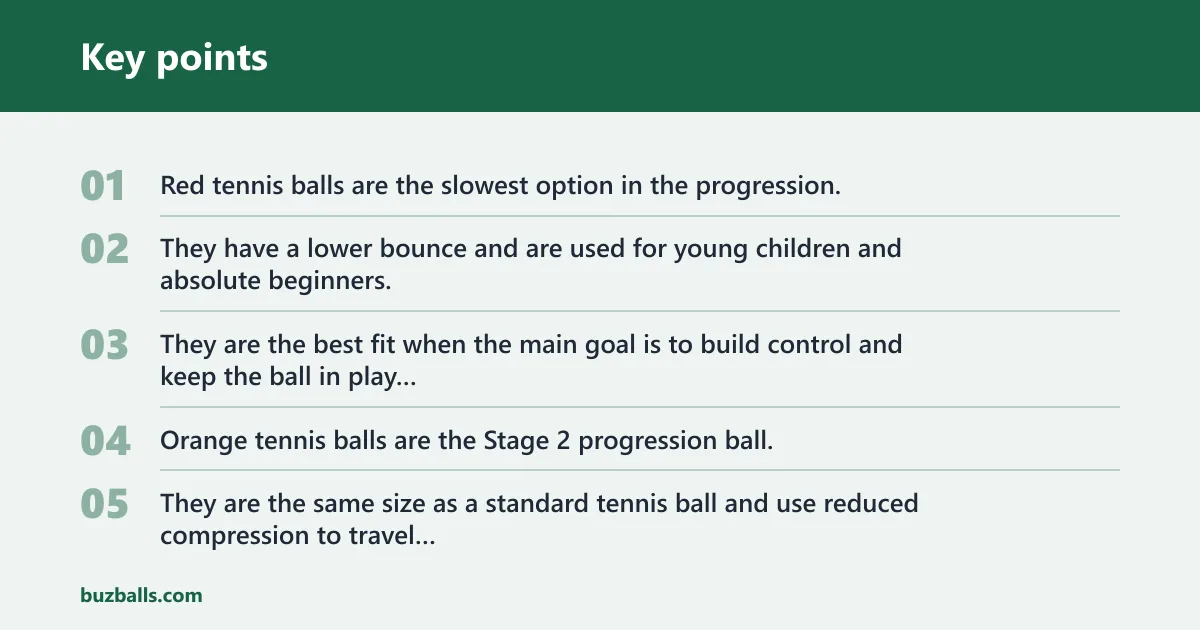
Red tennis balls are the slowest option in the progression. They have a lower bounce and are used for young children and absolute beginners, especially on 36-foot courts. They are the best fit when the main goal is to build control and keep the ball in play long enough for basic hand-eye timing.
Orange balls: the middle step
Orange tennis balls are the Stage 2 progression ball. They are the same size as a standard tennis ball and use reduced compression to travel more slowly without changing shape in the hand or on the racket face. They are commonly used on 60-foot courts.
Use orange balls when the player can rally a little, but a normal ball still causes rushed swings and short points. They are useful for serving practice too, because the reduced pace helps the server track the toss, step, and contact without chasing the ball after every miss.
Green balls: the last step before yellow
Green tennis balls are the final transition before standard yellow balls. They are slower than normal and have a lower bounce, which helps juniors and some adult beginners adjust to full-court spacing without jumping straight to match pace. Green balls are useful when the player is nearly ready for yellow but still benefits from a small speed reduction.
Yellow balls: full-court standard
Standard yellow tennis balls are the familiar choice for regular adult play and competition. They are faster than progression balls, which is fine for players who can already read bounce and control contact. For a true beginner, though, the same speed that suits match play can shorten rallies and produce more shanks.
Pressureless vs pressurised tennis balls
Pressureless balls are built around a thicker rubber shell with bounce that does not depend on internal gas. Pressurised balls are filled with gas, typically nitrogen or air. The first lasts longer and stays more consistent over time, while the second gives more bounce and spin potential and is preferred for professional and competitive play.
What pressureless balls are made
Pressureless tennis balls are often firmer, and their weight and feel can differ from pressurised balls. They are recommended for recreational and beginner players, especially when the session involves lots of repetition. They are a practical choice for basket feeding, machine work, and long drills where durability matters more than match feel.
What pressurised balls do better
Pressurised balls are the better fit for match play because they bounce higher and produce more spin potential. That livelier response helps competition resemble real points. The tradeoff is lifespan: the internal gas is what gives the ball its feel, and that feel fades faster than the core of a pressureless ball.
When firmness matters for beginners
Pressureless balls can be good for beginners, but there is a practical warning: some players feel them as firmer and heavier than they expected. If a new player is already guarding the arm, wrist, or shoulder, the harder feel can be a poor first choice even if the ball lasts longer. Softness and speed matter more than durability in that case.
A common first-timer mistake is using a pressureless ball for a very light first session and assuming it will feel “easy” because it is labeled beginner-friendly. If the ball feels firm off the strings and the player starts stabbing at contact, a softer progression ball is usually the better fit.
Tennis ball types for beginner play
Beginner play is not one thing. A child in a small court, an adult learning a full-court forehand, and a coach feeding balls into a drill all need different ball behavior. The best ball type depends on whether the goal is comfort, rally length, repeated feeds, or match readiness.
Foam tennis balls
Foam tennis balls are soft, lightweight, slow, and low-bounce. They suit children and indoor or small-court use because they reduce speed enough for easy tracking and short swings. They are useful when the priority is getting a beginner to make contact without chasing balls that fly away after every hit.
Pressureless tennis balls
Pressureless tennis balls are a strong pick for practice sessions. They hold bounce consistently over time and work well for beginners who need many strikes in a row. They are less ideal when the player needs the softest possible feel, because the firmer response can be noticeable on off-center hits.
Pressurised tennis balls
Pressurised balls suit match play and stronger beginners who already control pace. Their higher bounce and spin potential make them the right choice once the player is ready for real-point speed. They are less forgiving for total beginners because they tend to move faster off the strings and off the court.
Standard yellow tennis balls
Standard yellow balls are the normal ball for full-court tennis. For adult beginners with decent timing, they can be the easiest choice because they remove the gap between practice and regular play. For beginners who are still late to the ball, though, yellow balls often cause shorter rallies and more wild contact than slower progression balls.
Court size and ball progression
Court size matters because the ball has to travel a different distance at each stage. The usual progression matches the ball to the court: 36-foot courts for red balls, 60-foot courts for orange balls, and 78-foot courts for green balls before standard yellow full-court play.
36-foot courts
On a 36-foot court, red felt balls are the right starting point. The shorter court gives beginners more time to react, and the slowest ball keeps rallies from breaking down immediately. This setup is best for the youngest players and for complete beginners who need the simplest possible contact pattern.
60-foot courts
On a 60-foot court, orange balls usually fit best. They are the middle stage, still easier to control than a standard ball, but not as slow as red. This is a useful step when the player can already rally on a smaller court and needs a ball that begins to resemble real tennis without full speed.
78-foot courts
Green dot balls are used for juniors on a 78-foot court. They are the final transition before standard yellow-ball tennis and help the player adapt to full-court spacing while keeping the bounce and pace more manageable. This stage matters when the jump to yellow would otherwise cut rally length in half.
Practice balls vs match balls
Training balls and match balls do different jobs. Practice sessions, ball machines, and repetitive drills usually call for durability and repeatable bounce. Match play calls for the feel and speed the player will face in competition. Mixing the two can confuse beginners and slow progress.
Practice sessions and feeding drills
For practice sessions and feeding drills, pressureless balls are often the best fit because they keep their bounce and last longer. That makes them useful for coaches, clubs, and households that want a ball stack for repeated reps. They are especially good when the goal is volume rather than match realism.
Ball machines and repeat drills
Ball machines and repetitive drills place more wear on balls than casual rallying does. Pressureless balls handle that workload better because they do not depend on internal gas for their bounce. If a beginner is doing hundreds of contacts, the more durable ball usually makes sense even if it feels a little firmer.
Match play and competition
Match play is where pressurised standard yellow balls belong. They deliver the bounce, spin, and speed that players must learn for real competition. If a beginner only practices with very soft or very slow balls, the jump to match pace can feel abrupt, so some sessions should still use the ball type the player will face in points.
- Match the court size first: 36-foot, 60-foot, or 78-foot.
- Choose the slowest ball that still allows clean contact.
- Use red, orange, or green progression balls for learners who need longer rallies.
- Choose pressureless balls for drills, feeding, and machine work.
- Choose pressurised yellow balls for match play and full-court competition.
Frequently asked questions
What type of tennis ball is easiest for beginners to play with?
For most beginners, the easiest ball is usually the one that matches the court and lets them make clean contact. Red is best for the smallest court and newest player, orange fits the middle step, and green helps when a player is nearly ready for standard yellow balls.
Should a beginner use red, orange, green, or yellow tennis balls?
Use red for the slowest start, orange for the middle step, green for the last step before standard play, and yellow when the beginner can already handle full-court speed. Age alone should not decide the choice. Court size and rally quality matter more than birthday.
Are pressureless tennis balls good for beginners?
Yes, pressureless balls are good for many beginners because they are durable and consistent over time. They work well for practice, feeding drills, and ball machines. The main caution is feel: some beginners find them firmer and heavier than expected, especially on off-center hits or arm-sensitive days.
What is the difference between pressureless and pressurised tennis balls?
Pressureless balls use a thicker rubber shell for bounce, while pressurised balls are filled with gas, typically nitrogen or air. Pressureless balls are usually firmer and last longer. Pressurised balls bounce higher, spin more, and are preferred for competitive play, but they do not last as long.
Can adult beginners start with a standard tennis ball?
Yes, adult beginners can start with a standard yellow ball if they already make decent contact and can rally without chasing the ball immediately. If the ball rushes the swing, causes shanked contact, or cuts rallies short, a slower progression ball is the better first step.
Which tennis balls are best for practice sessions?
Pressureless balls are usually best for practice sessions because they stay consistent and last through repeated contact. They are a strong fit for baskets, feeding drills, and ball machines. For beginner rally work, a softer progression ball can still be better if the main goal is easier contact rather than durability.
