What Are the Key Differences in Pickleball Balls?

Pick a softer, larger-hole ball for smooth gym floors, and a harder, smaller-hole ball for outdoor courts. Then match the ball to wind and temperature, not the label. Choose wrong and you get erratic bounce, extra pop, faster wear, or dead shots that hurt control. This guide explains how surface, wind, and temperature change ball behavior and how to choose the right one.
Indoor vs outdoor balls at a glance
The core trade-off is simple: indoor balls usually give you more touch on smooth floors, while outdoor balls usually track better in wind and on abrasive courts. Hole count, shell hardness, and surface texture drive those differences, and sanctioned play also depends on approved-ball compliance.
| Criteria | Indoor ball | Outdoor ball |
|---|---|---|
| Typical hole pattern | 26 larger holes | 40 smaller holes |
| Shell feel | Softer plastic, often slightly lighter | Harder plastic, often slightly heavier |
| Flight in wind | More easily pushed around | More stable in wind |
| Speed off the paddle | Usually slower and easier to soften | Usually firmer and faster |
| Best surface fit | Smooth gym floors | Concrete or asphalt courts |
| Common failure mode | Mushy feel in heat, faster scuffing on rough surfaces | Cracking in cold weather, more visible wear on rough courts |
USA Pickleball equipment standards allow approved balls with 26 to 40 circular holes, and the approved weight range is 0.78 ounces to 0.935 ounces. That means hole count alone does not make a ball legal or right for your court. Intended use matters.
Hole count and aerodynamics
Hole pattern changes how air moves around the ball. A 26-hole indoor pattern usually gives a softer, slightly slower flight on smooth floors. A 40-hole outdoor pattern tends to hold its line better in wind and keeps the ball from wandering as much on open courts.
Many outdoor models use 40 holes, although 38-hole designs also exist. A 38-hole hybrid sits between the two common patterns, so it can help when court conditions change or when a manufacturer designs it for both indoor and outdoor play.
Hardness and feel
Ball hardness changes how the ball comes off the paddle and off the floor. Softer indoor shells usually mute pace and give more touch on dinks and drops. Harder outdoor shells usually come off firmer, which can help on heavy returns and drives but demand cleaner hands at the kitchen.
Speed, bounce, and control
Indoor balls usually feel slower because they deform more on contact. That can make short-game control easier on a gym floor, especially for dinks and soft drops. Outdoor balls usually move faster off the paddle and can carry more pace through the court, which affects blocks, resets, and third-shot returns.
Suppose a 40-hole outdoor ball is used on a polished gym floor. The ball may skid, jump more sharply after the bounce, and feel harder to slow down at the net. Switch to a 26-hole indoor ball, and the same floor often plays with less pop and more room for control.
Common failure modes
Outdoor balls crack more often because they live under harder impacts and colder conditions. Cold weather can make brittle shells more likely to split at seams or hole edges. Heat can do the opposite, making some balls feel mushier and less responsive. Indoor balls on rough outdoor courts often wear down faster and lose shape sooner.
Pickleball ball decision table
Use the surface first, then the weather, then the intended use printed by the manufacturer. That sequence avoids the common mistake of buying by hole count alone and assuming every 40-hole ball behaves the same.
| Surface | Wind exposure | Temperature risk | Expected bounce | Likely failure mode | Recommended ball type |
|---|---|---|---|---|---|
| Smooth gym floor | Low | Low to moderate | More controlled, less jumpy | Too much speed if a hard outdoor ball is used | Indoor ball, usually 26 holes |
| Hard court indoors | Low | Moderate if the room is cold | More lively than on a gym floor | Indoor ball can feel lively; outdoor ball can be too fast | Indoor ball first, then a hybrid only if intended for both |
| Concrete outdoor court | Moderate to high | High if mornings are cold | Firm and consistent until wear increases | Cracking, seam splitting, or visible warping | Outdoor ball, usually 40 holes |
| Asphalt outdoor court | Moderate to high | High in cold weather | Fast, with more abrasion over time | Surface wear and cracked shells | Outdoor ball, usually 40 holes |
| Mixed-use court with changing conditions | Moderate | Moderate | Balanced, depending on model | Wrong intended-use match | Hybrid 38-hole ball if the manufacturer approves that use |
A common first-timer mistake is buying a ball because it has “more holes,” then using it on a slick school gym floor. The result can be too much pace on soft hands and less control on drops and dinks. The better question is where the ball will bounce, then how the air around it will move.
What changes the ball’s flight?
Hole pattern, shell hardness, and air movement all change flight. A 26-hole indoor ball tends to track more softly, while a 40-hole outdoor ball usually stays steadier in wind. A 38-hole hybrid is a middle ground, but its intended use still matters more than the number printed on the package.
Why 26, 38, and 40 holes behave differently
More and smaller holes usually help the ball cut through air more predictably outdoors. Fewer and larger holes can give a softer, more controllable indoor flight. A 38-hole pattern sits between those two designs, so it may trade some wind stability for a bit more indoor touch, depending on the shell and drilling pattern.
How smaller holes help in wind
Smaller holes reduce the way gusts push the ball around. That matters on open courts, especially on lobs, serves, and deep returns. If the wind changes the ball’s path by a few inches, that can turn a safe return into a miss or force a weaker reply.
Why smoother indoor flight can feel slower
On a clean gym floor, a softer indoor ball usually absorbs more of the hit and leaves the paddle with less spring. That slower feel can help you place dinks and drops with more precision. It can also make resets easier, since the ball does not jump off the paddle as aggressively.
How do court surfaces change play?
Court surface changes bounce consistency more than many buyers expect. Smooth gym floors reward a softer ball because the bounce is cleaner and less abrasive. Rough outdoor surfaces punish soft shells and can speed up wear, while hard courts in between those extremes still demand a firmer ball than a gym floor does.
Smooth gym floors
Smooth indoor floors generally pair best with 26-hole indoor balls. The ball rolls and bounces with less surface drag, which helps control at the kitchen line and on third-shot drops. A harder outdoor ball can feel too lively and may skate or jump more than expected.
Hard courts
A hard indoor court is different from a gym floor. The surface is still inside, but the bounce can be livelier and more demanding on the ball. In that setting, a standard indoor ball may still be the better first choice, yet a hybrid can make sense if the court plays closer to outdoor pace and the maker intended the ball for both uses.
Rough outdoor surfaces
Concrete and asphalt add abrasion. That extra wear shortens ball life and can alter bounce as the shell scuffs. Outdoor balls are built for that job, so they usually hold shape better and keep their flight more predictable than indoor balls used in the same setting.
What that means for bounce consistency
When the surface is smooth, bounce is more about ball design. When the surface is rough, the floor itself starts changing the ball’s behavior. That is why a ball that feels fine for a few games can still become erratic once the shell scuffs, cracks, or softens.
What do wind, heat, and cold do to a ball?
Weather changes the ball’s flight and lifespan. Wind shifts path and depth control. Heat can soften the shell and make the ball feel mushier. Cold makes some plastics brittle, which is one reason outdoor balls crack more often in winter or early morning play.
Wind exposure and stability
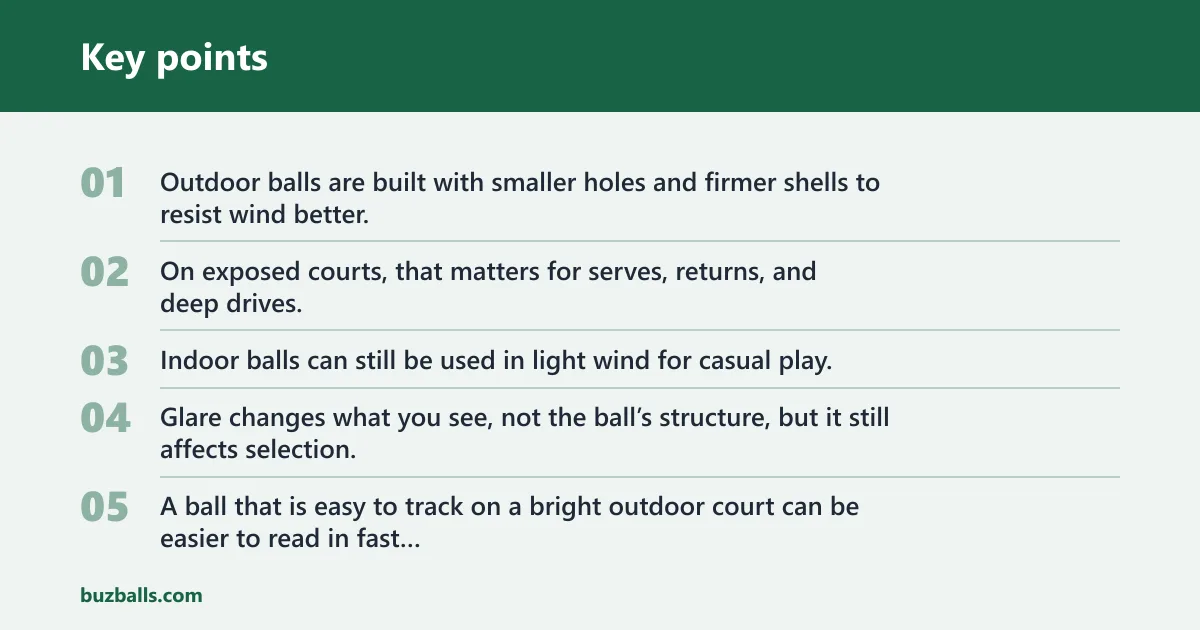
Outdoor balls are built with smaller holes and firmer shells to resist wind better. On exposed courts, that matters for serves, returns, and deep drives. Indoor balls can still be used in light wind for casual play, but they usually lose precision faster when the air is moving.
Sun glare and visibility
Glare changes what you see, not the ball’s structure, but it still affects selection. A ball that is easy to track on a bright outdoor court can be easier to read in fast exchanges. If visibility is poor, choose a ball color that stands out against the court and the sky, then keep the intended-use match intact.
Cold-weather cracking
Cold weather makes shells less forgiving. Outdoor balls face more hard impacts on rough surfaces, and brittle plastic is more likely to crack or split at the seams. That failure mode often shows up as a sudden change in bounce or a visible crack after a sharp hit.
Heat-related softness and wear
High heat can make some balls feel softer and less lively. The ball may seem to die off the paddle or lose crispness on blocks and counters. Heat also speeds wear on some plastics, so a ball can go from stable to inconsistent in a short session.
Choose indoor balls if… / Choose outdoor balls if…
Choose indoor balls when the court surface rewards control more than wind resistance. Choose outdoor balls when the court and weather punish softer shells. If the setting changes a lot, start with the court and weather conditions before you look at the label.
Choose indoor balls if…
- You are playing on a smooth gym floor.
- You want softer touch for dinks, drops, and resets.
- Wind is not part of the equation.
- You want a slower-feeling ball that is easier to control at the kitchen.
Choose outdoor balls if…
- You are on concrete or asphalt.
- You need wind stability for open-air play.
- You want a firmer response off the paddle.
- You need a ball built to handle abrasive surfaces better.
- Start with the surface: gym floor, hard court, or outdoor court.
- Check wind and temperature before play.
- Match the ball’s intended use to those conditions.
- For sanctioned play, confirm the ball is on the USA Pickleball approved balls list and within USA Pickleball equipment standards.
When does a hybrid 38-hole ball make sense?
A hybrid 38-hole ball makes sense when the court setting is mixed and the manufacturer intended it for both environments. It can be a safer choice when you need more control than a typical outdoor ball gives, but more wind stability and firmness than a standard indoor ball provides.
When the same ball sees mixed settings
If the ball will be used on both a protected outdoor court and a hard indoor court, a hybrid can reduce the need to switch equipment constantly. That matters most when the playing group rotates between venues and wants one model that sits between indoor touch and outdoor stability.
When wind and indoor control both matter
Hybrid balls can help when the court is partly exposed, or when a hard indoor surface plays faster than a gym floor. They are not a cure-all. They work best when the manufacturer clearly lists indoor-outdoor use.
When manufacturer intended use supports it
Intent matters. A ball labeled for both indoor and outdoor use should be the one you trust over a generic assumption based on hole count alone. The Franklin X-26 and Franklin X-40 are examples that show why the label and the intended surface both matter.
Picture a rec center with a hard indoor court near the entrance and a windy outdoor court twenty feet away. A hybrid may reduce gear swapping, but only if the maker actually approves both uses. If not, choose the ball that matches the more demanding condition.
Frequently asked questions
What is the difference between indoor and outdoor pickleball balls?
Indoor balls usually have 26 larger holes, softer plastic, and a slower, more controllable feel on smooth floors. Outdoor balls usually have 40 smaller holes, harder plastic, and a firmer response that holds up better in wind and on abrasive courts. Surface and weather should guide the choice.
Can you use indoor pickleballs outdoors?
You can use them casually, but performance usually suffers. Indoor balls tend to be pushed around more by wind and wear faster on rough concrete or asphalt. That can lead to erratic bounce, faster scuffing, and a softer feel that makes outdoor rallies less predictable.
How many holes do indoor and outdoor pickleballs have?
Indoor pickleball balls usually have 26 larger holes. Outdoor pickleballs normally have 40 smaller holes. USA Pickleball standards allow approved balls to have between 26 and 40 circular holes, so hole count is part of the design, not the only factor that matters.
Which pickleball ball is faster, indoor or outdoor?
Outdoor balls are usually faster because they are made with harder plastic and a firmer shell. That gives them a livelier response off the paddle. Indoor balls usually feel slower and easier to place, which helps control on gym floors and at the kitchen line.
Are there hybrid pickleball balls for both indoor and outdoor play?
Some hybrid balls use a 38-hole design and are marketed for both indoor and outdoor play. That said, intended use matters more than the word “hybrid” on the package. A ball should still match the court, wind, and temperature, and it should be approved for the type of play you need.
Why do outdoor pickleballs crack more often?
Outdoor balls face harder impacts, rougher surfaces, and colder conditions. Those factors make shells more likely to crack, split at seams, or deform over time. Heat can also soften some balls enough to change feel, but cold weather is the more common crack risk.
Which ball should I use on a hard court indoors?
Start with the manufacturer’s intended use, then look at how the court plays. If the surface is a hard indoor court rather than a smooth gym floor, a standard indoor ball may still be the better default, while a hybrid 38-hole ball can be worth considering when the maker supports both uses.