How Often Should You Oil a Cricket Bat and What Oil to Use?

For a new English willow bat, a common rule of thumb is to apply a thin coat of bat oil 2–3 times before first use, then about once a year for regular play; some players also use bat wax for low-maintenance touch-ups or pre-oiled bats. Skip it and the face can dry, split, and lose rebound faster, which shortens the bat’s life. This covers a simple schedule by bat type and use level, plus a clear rule for choosing oil or wax.
What you’ll need
- Raw linseed oil or bat oil
- Clean cloth or applicator pad
- Soft brush or dry cloth for cleanup
- Scuff sheet
- Toe guard
How often should you oil it?
Use the bat type, use level, and climate together. New English willow needs the most attention before first use, while seasoned English willow usually needs lighter top-ups. Kashmir willow is generally less demanding, but it still benefits from light protection if it looks dry or is used often.
Dry air pulls moisture from willow faster. Humid storage slows moisture loss, so the bat may need fewer top-ups, but it still needs drying time and a light coat, never a soak.
New English willow
Before first use, oil 2–3 times, with about 24 hours of drying between coats. After that, a bat used for weekly nets or heavy club play usually needs a seasonal top-up rather than frequent oiling. Match-only use often needs less, but the face, edges, and toe still need checking for dryness.
Seasoned English willow
A seasoned bat often does well with one light top-up during the season if it sees regular play. If it lives in a dry room or faces heavy net sessions, check it more often and add a thin coat only when the face starts to look pale or rough.
Kashmir willow
Kashmir willow usually asks for lighter care than new English willow. A thin coat at the start of the season, then another only if the face dries out, is often enough for match-only use. For weekly nets or heavy club use, inspect the toe and edges more often because those areas take the first abuse.
Climate and workload guide
Dry climate, indoor nets, and heavy club use push the schedule toward more frequent inspection. Humid climate and match-only use push it toward fewer top-ups. The rule stays the same: apply a thin coat, let it dry, and stop once the wood looks evenly conditioned instead of shiny-wet.
Cricket bat cadence table
| Bat type | Use level | Dry climate | Humid climate | Drying time before knocking in | Stop-sign symptoms |
|---|---|---|---|---|---|
| New English willow | Match-only | 2–3 light coats before first use, then once a season | 2 light coats before first use, then inspect mid-season | 24 hours after each coat | Shiny patches, sticky feel, darkened wood, oil in the splice |
| New English willow | Weekly nets | 2–3 light coats before use, then one top-up after several weeks of play | 2 light coats before use, then top-up only when the face looks dry | 24 hours after each coat | Soft surface sheen, towel-dark stains, oil pooling at the toe |
| New English willow | Heavy club use | 2–3 light coats before use, then check monthly during the season | 2 light coats before use, then check every few weeks during peak use | 24 hours after each coat | Raised grain, pale face, edge cracking, oily handle joint |
| Seasoned English willow | Match-only | One light top-up once a year | One light top-up only if the face looks dry | 24 hours before knocking in or storage wrap | Dry-looking face, rough edge, toe scuffing, over-gloss |
| Seasoned English willow | Weekly nets | One or two light top-ups per season | One light top-up per season, then inspect after long indoor blocks | 24 hours before use or knock-in touch-up | Fine surface cracks, pale toe, oil beading on the face |
| Seasoned English willow | Heavy club use | Check monthly; oil only when the wood looks dry | Check every few weeks; oil only when needed | 24 hours before any re-prep step | Loss of rebound, rough fibres, chipped edges, tacky finish |
| Kashmir willow | Match-only | Light coat at season start | Light coat only if the bat dries out | 24 hours before play | Dry face, edge wear, toe abrasion, waxy surface from overuse |
| Kashmir willow | Weekly nets | Season start plus one check mid-season | Season start, then inspect after long indoor use | 24 hours before play | Fine cracking, dry toe, brittle feel, oil stains on the handle |
| Kashmir willow | Heavy club use | Inspect monthly and re-oil lightly only when dry | Inspect every few weeks and re-oil sparingly | 24 hours before any prep step | Surface checking, chipping at edges, dark slick spots, soft patches |
How should you apply the oil?
Apply a light coat to the face, edges, and toe. Raw linseed oil and cricket bat oil both sink into the wood grains and help stop drying, but restraint matters most. Keep the coat thin so the willow drinks it in instead of leaving it on the surface.
Picture a new bat with pale, thirsty-looking willow and a dry toe. One thin coat is the right move. Wait for the first pass to soak in before you add more, and only if the wood still looks dry.
- Wipe the bat clean with a dry cloth.
- Put a few drops of oil on the cloth or pad.
- Spread a thin coat over the face, edges, and toe.
- Leave the splice and handle joint dry.
- Let the bat rest for 24 hours before the next step.
- Recheck the wood and add only 1 light pass if it still looks dry.
How long should it dry before knocking in?
Let the bat dry for 24 hours after oiling before knocking in. That drying window gives the oil time to settle into the willow instead of staying wet on the surface. In humid weather, use the full drying time and keep the bat out of direct heat.
Knocking in should follow drying, not replace it. It compresses willow fibres and prepares the bat for hard balls, so it belongs after the oil has set and before serious use.
What is the right follow-up after oiling?
Knocking in is the next step. After that, fit a scuff sheet if the bat will see regular play, and add a toe guard if the toe needs moisture protection. Those accessories help protect the prepared surface, especially on the face and lower edge.
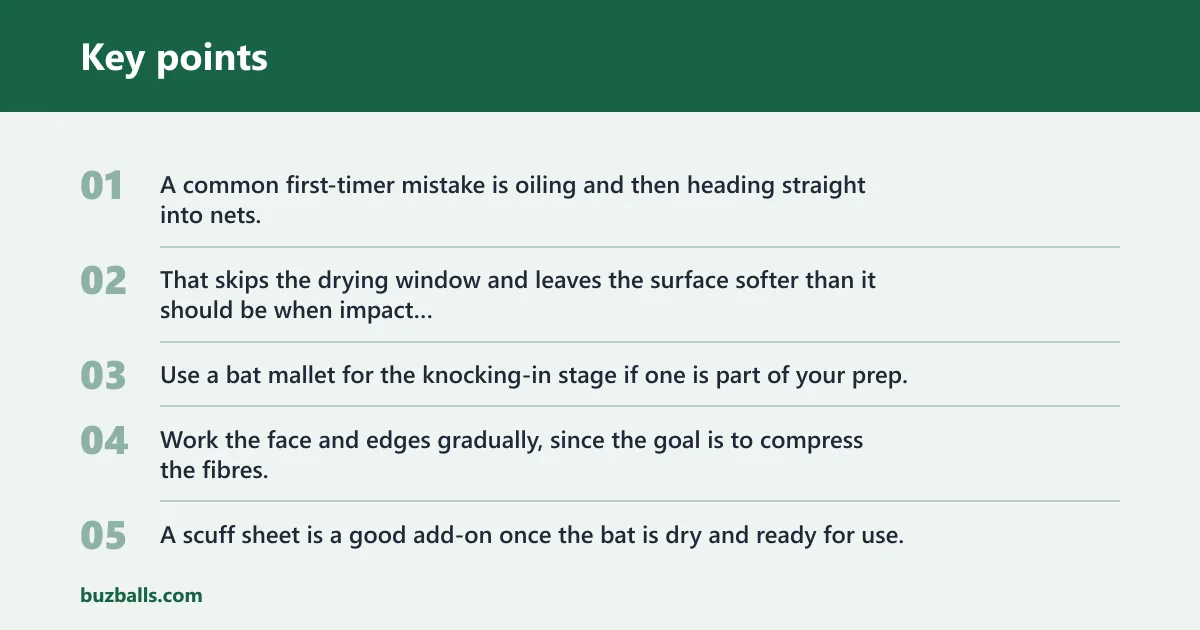
A common first-timer mistake is oiling and then heading straight into nets. That skips the drying window and leaves the surface softer than it should be when impact starts.
Knocking in and protection
Use a bat mallet for the knocking-in stage if one is part of your prep. Work the face and edges gradually, since the goal is to compress the fibres, not bruise them. A scuff sheet is a good add-on once the bat is dry and ready for use.
Common mistakes to avoid
Too much oil is the most common problem. A bat that looks glossy, feels heavy, or leaves wet marks after sitting overnight has had more than a light coat. Over-oiling can make the surface soft and slow the prep down.
A dry bat shows the other extreme. Pale fibres, rough patches, tiny cracks, and a tired toe all point to wood that needs a careful top-up. If the face or edges start to chip, reconditioning may be safer than adding more oil alone.
Wax is another place where confusion starts. Cricket bat wax coats the surface rather than penetrating it, and it adds a glossy finish. Use it for low-maintenance care or pre-oiled bats, not as a substitute for proper oiling on a dry new willow bat.
Suppose a bat used in weekly indoor nets starts showing pale edges after a month. One light coat on the face, edges, and toe is the correct response. Soaking the handle or adding extra layers would only make the repair worse.
Storage warning
Store the bat away from heat and moisture. Hot car boots, damp sheds, and wet kit bags all work against the wood. A dry room with steady air is safer, and it helps the finish last longer between top-ups.
How often should you oil a cricket bat before first use?
For a new English willow bat, use 2–3 light coats before first use, with 24 hours of drying between coats. That schedule is the standard starting point because the willow needs conditioning before hard-ball impact. After that, knocking in should come next.
What oil should you use on a cricket bat?
Raw linseed oil is commonly recommended for bat care. Cricket bat oil is often used as another name for the same type of product, and the rule is the same: apply a light coat to the face, edges, and toe, then let it dry. Avoid the splice and handle.
Can you use too much oil on a cricket bat?
Yes. Over-oiling is harmful because it leaves the surface soft, dark, and sticky instead of conditioned. If oil beads up, pools at the toe, or leaves a greasy sheen after drying, stop and wipe the excess. The bat should look lightly nourished, not wet.
Is raw linseed oil better than cricket bat wax?
For a dry new willow bat, raw linseed oil is usually the better first choice because it penetrates the wood grains and helps stop drying out. Wax is better when you want a surface coating, a glossy finish, or a lighter touch-up on a bat that is already prepared.
Do you oil the splice or handle of a cricket bat?
No. Keep oil away from the splice and handle joint. That area is sensitive during preparation, and oil there can do more harm than good. Focus on the face, edges, and toe, then clean off any stray oil before it reaches the joint.
Should you oil a bat during the season or only before use?
Both can be right, depending on the bat. New English willow usually gets the main oiling before use, then a light in-season top-up if the surface starts to dry. Seasoned English willow and Kashmir willow often need only occasional checks and light maintenance during the season.
What happens if you don’t oil a new cricket bat?
The bat can dry out faster, the fibres can lift, and the face may be more likely to split or lose rebound. The toe and edges are usually the first areas to show damage. That is why oiling comes before knocking in, not after cracks appear.