What to Consider When Buying a Tennis Racket as a Beginner

Choose a beginner tennis racket around 240-270g unstrung, with a roughly 100-105 sq in head and low-to-moderate stiffness. Skip heavy, small-head player frames. The wrong frame costs you late contact, sore arms, and slower progress. This guide ranks the specs that matter most and shows what to skip when you buy.
What matters most first?
Start with fit and comfort, then judge forgiveness, then power. A racket that feels demanding can hide timing problems for a while, but the warning signs show up fast: late contact, a cramped grip, and a tired forearm after a short hit. “Growing into it” often means repeating bad swings with a tool that fights you.
Beginner racket decision table
| Player comfort | Head size | Weight | Grip size | Balance | String pattern | Red-flag symptoms | Pass/fail |
|---|---|---|---|---|---|---|---|
| Arm pain after 15-30 minutes | 100-110+ sq. in. | 240-270g | Fit by ruler and index-finger check | Even or slightly head-light | 16×19 preferred | Stiff feel, jarring mishits, forearm ache, grip squeezing | Pass only if pain is absent; otherwise fail |
| Poor contact consistency | Oversized or mid-plus | Light enough to swing smoothly | No slipping, no finger pinch | Head-light helps timing; head-heavy can feel sluggish | 16×19 for easier launch | Frequent frame hits, floating balls, mistimed contact, rushed preparation | Pass if the sweet spot feels easy to find; fail if contact stays erratic |
| Fast-growing juniors | Mid-plus or oversized | Stay near the lighter end first | Choose room for a correct hold | Even balance is acceptable | 16×19 is the safer default | Rapid growth, sudden hand size changes, frequent grip changes, outgrowing the frame fast | Pass if the racket fits now and can be replaced soon; fail if buying for a child’s future size |
Use that table before you look at brand names. If a racket fails on comfort or fit, skip it. A shinier frame with extra “technology” is a poor trade if it hurts the arm or slows clean contact.
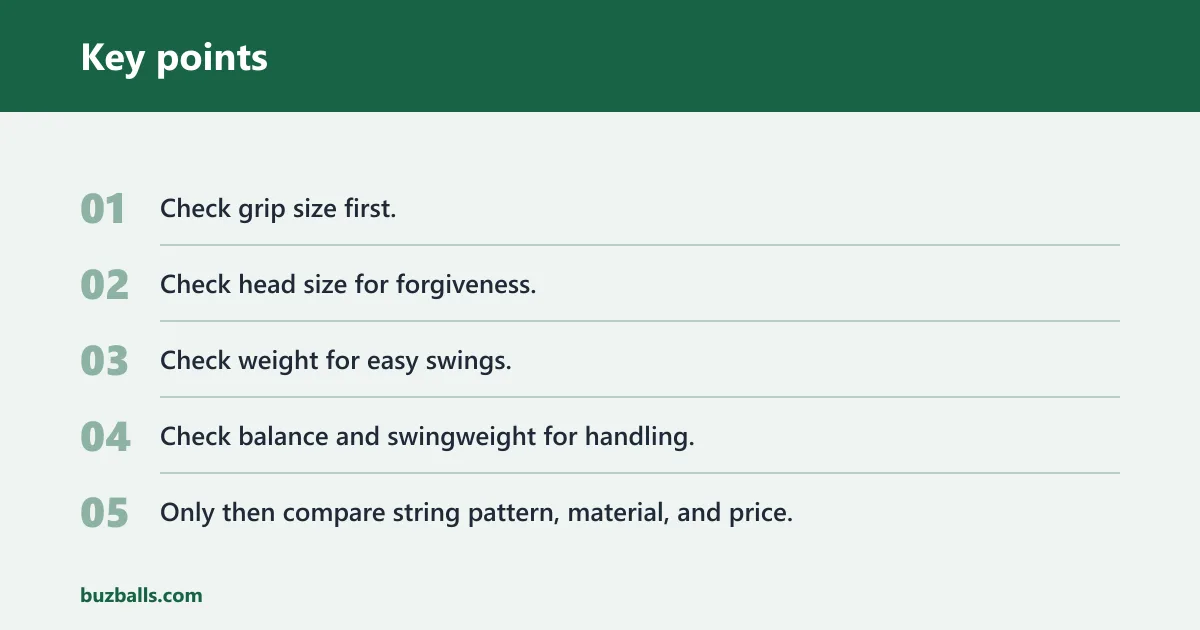
- Check grip size first.
- Check head size for forgiveness.
- Check weight for easy swings.
- Check balance and swingweight for handling.
- Only then compare string pattern, material, and price.
Say your shots keep landing late and the face twists on mishits. A 98 sq. in. player frame with a tight grip may feel “serious,” but it demands more exact timing than most new adults can repeat. A larger head and lighter frame usually fix the problem faster than a small, control-first model.
What head size should you choose?
Most beginners should start with a larger head, usually over 100 square inches. Oversized frames in the 100-110+ sq. in. range give you a bigger sweet spot, which matters most when your contact point keeps moving. Mid-plus frames, around 98-104 sq. in., can also work, but they usually ask for cleaner timing.
Oversized versus mid-plus
Oversized heads forgive off-center hits better. That helps on serves, returns, and rushed groundstrokes, where beginners often miss the center by a little. Mid-plus heads can feel a bit more precise, but they give up some forgiveness. For a first racket, forgiveness usually beats small gains in control.
A common first-timer mistake is buying a smaller head to “learn control.” In practice, a smaller face can shrink the usable sweet spot and make each mishit feel worse. That can slow confidence and make every rally feel tighter than it should.
How much should a beginner tennis racket weigh?

Beginners often do best with lighter rackets in the 240-270g range. That weight band is easier to swing, recover, and position at the net. The tradeoff is stability: a very light frame can get pushed around more on contact, especially against faster balls or off-center hits.
Lightweight, stability, and fatigue
Light rackets reduce swing effort, which helps new players keep mechanics relaxed. They also lower fatigue risk over a longer session. But if the frame is too light, it can feel shaky and produce less solid contact. That is why the target is “light enough,” not “as light as possible.”
Is a lighter or heavier tennis racket better for beginners? Usually lighter, but only within a sensible range. If the racket is feather-light, the ball can knock the face around and force extra gripping. A slightly heavier frame can be steadier, yet too much mass makes late contact and tired shoulders more likely.
Picture a new adult player using a heavy player frame during a first lesson. The first few forehands may feel stable, but the second half of the session brings slower preparation and more arm tension. That is a weight problem, not a skill problem.
What grip size do I need for a tennis racket?
Grip size matters for comfort and injury prevention. Typical sizes range from 4 to 4 7/8 inches, though many beginner choices land around 4 1/8 to 4 5/8 inches. The right grip lets you hold the racket firmly without squeezing. Too small or too large can both create problems fast.
The ruler test
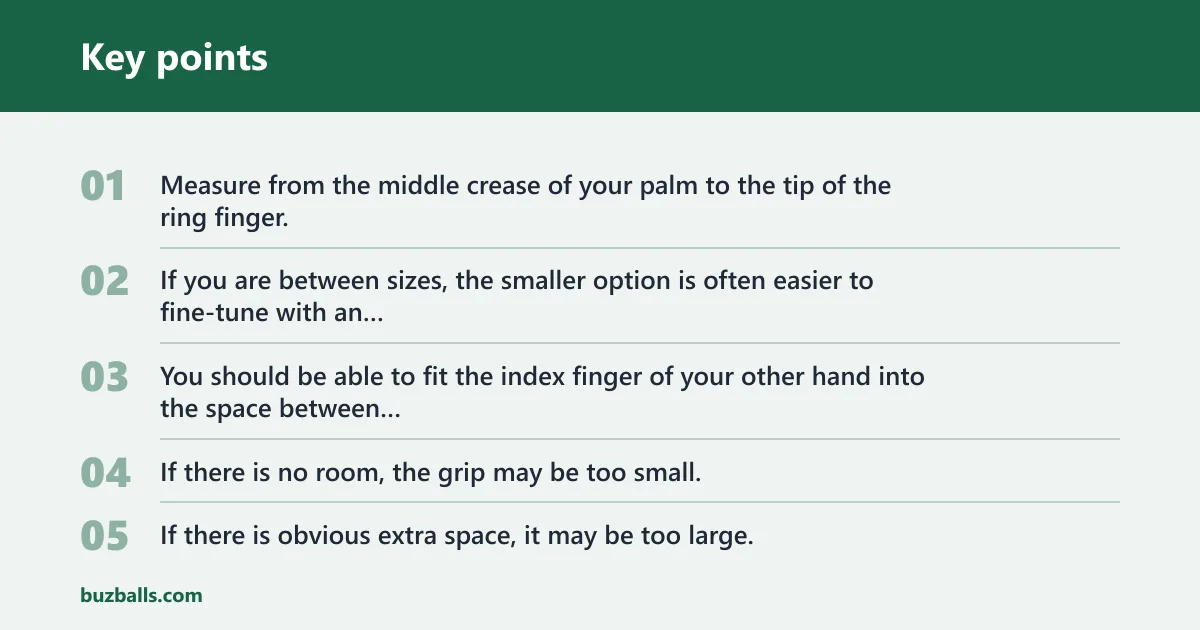
Measure from the middle crease of your palm to the tip of the ring finger. That gives a starting point for grip size. If you are between sizes, the smaller option is often easier to fine-tune with an overgrip. The larger option is harder to shrink.
The index-finger fit check
Hold the racket with a normal grip. You should be able to fit the index finger of your other hand into the space between your fingertips and palm. If there is no room, the grip may be too small. If there is obvious extra space, it may be too large.
A grip that is too small can cause squeezing, twisting, and extra wrist movement. A grip that is too large can limit wrist action and make the hand feel locked in place. Both can show up as forearm fatigue before you even notice the size problem.
Balance point and swingweight
Balance changes how a racket feels in motion. Head-heavy frames add easy power and can help the ball travel, while head-light frames feel easier to whip through contact and recover on defense. Even balance sits between the two. Swingweight matters too: a lower swingweight is easier to handle and helps the move toward intermediate play.
What each balance point feels like
Head-heavy rackets can help beginners generate depth with less effort, but they may feel sluggish on quick reactions. Head-light rackets are easier to maneuver and often feel cleaner on volleys and returns. Even balance is a safe middle choice if the rest of the frame is forgiving.
Do not chase power by default. If a head-heavy frame also has a stiff feel and high swingweight, it can look beginner-friendly on paper and still feel tiring in play. The goal is easy handling first, then enough pop to keep the ball in the court.
What string pattern is easiest for a beginner to use?
An open pattern such as 16×19 is often a good choice for beginners because it can help with power and spin. A denser pattern such as 18×20 offers more control and spin potential, but it tends to reward cleaner swings. For most first-time buyers, 16×19 is the easier starting point.
String pattern and tension
Open patterns give the ball a bit more launch and help with net clearance. Dense patterns can feel firmer and more precise, but they ask for better timing. String tension matters too. A common range is 40-65 lbs, with lower tensions generating more power and comfort and higher tensions giving better control and durability.
For a beginner with arm soreness, lower tension is usually the safer direction. If control becomes a later issue, you can move tension up after the swing is more repeatable. Starting too tight can make a forgiving frame feel harsher than it should.
Does frame material matter?
Yes, but material should come after head size, weight, and grip. Aluminum is often used in cheaper beginner rackets. Graphite is lighter and usually offers better feel, and one beginner recommendation from CNN points to graphite because it can stay light without giving up all control. Titanium and fiberglass also appear in beginner frames, often as part of mixed construction.
What material can and cannot fix
Material can change comfort, weight, and cost. It cannot fix a poor grip size or a frame that is too small for your contact pattern. A well-shaped graphite frame is helpful, but a bad spec mix still feels bad.
Budget tradeoff: if money is tight, sacrifice extras before fit. A simple graphite or aluminum frame with the right head size and weight is a better buy than a fancy model with the wrong grip or an overly small head. Convenience features matter less than those basics.
Should I buy a pre-strung beginner tennis racket?
Pre-strung rackets make sense if you want ready-to-play convenience and lower upfront cost. They remove the extra step of stringing and can get you on court quickly. That said, the included strings are often chosen for broad appeal rather than exact comfort, so the setup may be basic.
What you give up for convenience
Pre-strung options are fine for many beginners, especially if the frame already fits well. If you later want more comfort or control, you can restring it. For a first purchase, a pre-strung racket is often the practical choice when the budget is limited and the spec match is already good.
Suppose you are choosing between a pre-strung 100 sq. in. graphite frame and an unstrung small-head player frame that would need extra stringing cost. The first option usually wins for a beginner, because the fit is right and the setup is ready. The second option asks for more money and more technical judgment.
How do I know if a racket is too advanced for me?
A racket is too advanced when it starts causing timing breakdown, poor contact consistency, arm fatigue, or a loss of confidence. If you keep hitting late, the sweet spot feels tiny, and the frame feels harsh on mishits, it is asking for more precision than your current swing can give.
Signs to watch
Look for repeated frame hits, balls dumped into the net, or shots that fly long because the face is hard to control. Also watch for soreness in the forearm, elbow, or shoulder after short sessions. Those are practical warning signs, not badges of progress.
Do not buy a racket because it looks like a “future” frame. Buy the one that lets you make cleaner contact now. If your technique improves later, you can move toward a smaller, more control-oriented frame with better confidence and timing.
Frequently asked questions
What head size should a beginner tennis racket have?
A beginner racket should usually have a larger head, often over 100 square inches. That gives a bigger sweet spot and more forgiveness on off-center hits. Oversized frames in the 100-110+ sq. in. range are the easiest starting point for most new adults.
Is a lighter or heavier tennis racket better for beginners?
Lighter is usually better for beginners, but only up to a point. A frame that is too light can feel unstable and get pushed around on contact. A slightly heavier racket can add steadiness, but too much mass can hurt timing and tire the arm.
Should beginners choose an oversized or mid-plus racket head?
Oversized is usually the safer pick because it offers a bigger sweet spot and more forgiveness. Mid-plus can still work, especially if you already make consistent contact, but it asks for cleaner timing. For most first-time buyers, the larger head is the easier route.