Basketball Size for Kids: Guide by Age and Skill Level

For kids, start with age: size 4 for ages 4-8, size 5 for 9-11, size 6 for most 12+ girls and ages 12-13 boys, and size 7 for boys 14+ or league-required play. A ball that’s too big can break shooting form, reduce control, and waste money if a child stops wanting to use it. This guide starts with the age chart, then checks it against hand fit, one-hand shooting control, dribbling control, and league rules.
Standard basketball sizes for kids and teens
The usual progression is size 4, then size 5, then size 6, then size 7. Age gets you close, but fit still matters because two kids the same age can have very different hand size, pickup strength, and shooting control.
Size 4
Size 4 has a 25.5-inch circumference. It is recommended for ages 5 to 8 and is common in mini or beginner youth play, especially while a child is still learning to control the ball with one hand instead of pushing it with both.
Size 5
Size 5 has a 27.5-inch circumference. It is the standard youth ball and is commonly assigned to ages 9 to 11, though some programs start using it earlier. That is why many parents see size 5 listed for ages 7 to 11 or 8 to 10 on store charts and league pages.
Size 6
Size 6 has a 28.5-inch circumference. It is commonly used around ages 12 to 13 for boys, and it is the official women’s ball from age 12 through high school, college, and the pros.
Size 7
Size 7 has a 29.5-inch circumference. It is the official men’s ball and is commonly used by boys from about age 14 onward in regulation play.
What size basketball should kids use by age?
Start with the child’s age bracket: ages 4-6 usually start with size 4, ages 7-8 are still often on size 4, ages 9-11 usually move to size 5, and age 12+ splits by league path. Girls generally move to size 6 from age 12 on, while boys usually move through size 6 before size 7.
Ages 4-6
For most kids ages 4-6, size 4 is the best starting point. It keeps the ball manageable for basic dribbling, catching, and early shooting mechanics. Development guidance often pairs ages 5 to 7 with size 4 and a 6- to 7-foot hoop.
Ages 7-8
Most kids still fit size 4 here, even if some store charts push size 5 early. If the child can control the larger ball only by turning the guide hand into a second shooting hand, staying with size 4 for practice usually protects form.
Ages 9-11
Size 5 is the standard youth ball for this group. Development charts commonly pair ages 8 to 10 with size 5 and an 8-foot hoop. At age 11, some stronger kids begin handling the next size in short drills, but game use should still follow league rules.
Ages 12 and up
At 12+, the path splits. Girls and women use size 6 from age 12 through high school, college, and pro play. Boys around ages 12 to 13 commonly use size 6, and boys 14 and up commonly move to size 7. Development charts pair ages 11 to 12 with size 6 and a 9- to 10-foot hoop, then ages 13 and up with size 7 and a 10-foot hoop.
Ball size decision table
Choose the right ball in 60 seconds
| Check | Use this as the main read | If the child is between sizes |
|---|---|---|
| Age | 4-6 usually points to size 4; 7-8 usually still size 4; 9-11 usually size 5; 12+ depends on girls’ size 6 path or boys’ size 6 to size 7 path. | Start with the lower size for practice unless the league requires the bigger game ball. |
| Hand fit | If the shooting hand can sit under and slightly behind the ball without the guide hand taking over, the size is probably workable. | If the ball sits too wide in the hands and the child cannot get under it, stay down a size for skill work. |
| Current shooting form | Clean one-hand release with the guide hand staying on the side points to a good fit. | If shots turn into two-hand heaves or flat chest pushes, train with the smaller ball and use the larger one only when the rules demand it. |
| Dribbling control | The child should be able to dribble at waist height, change hands, and pick the ball up cleanly without constant fumbles. | If the bigger ball slows the handle or causes pickup trouble, stay smaller for practice until control returns. |
| Recommended size | Choose the age-based size if hand fit, one-hand control, and dribbling all look normal for that age band. | Choose the smaller size for training, but keep a second ball in the required game size once league play starts. |
When should skill level override age?
Skill should override age when the age-chart ball forces bad mechanics. If a child cannot control the ball with one hand, cannot keep the guide hand out of the shot, or loses normal dribbling rhythm, the smaller size is usually better for practice even when the child is old enough for the next age band.
Hand fit and one-hand control
Age charts are broad. Hands are specific. If the shooting hand cannot get under the ball, the child will push from the front or side instead of lifting and releasing with control.
That shows up most on longer shots, free throws, and shots taken after a dribble. The guide hand starts steering. The elbow flares. The release comes late.
Shooting form breakdown that means the ball is too big
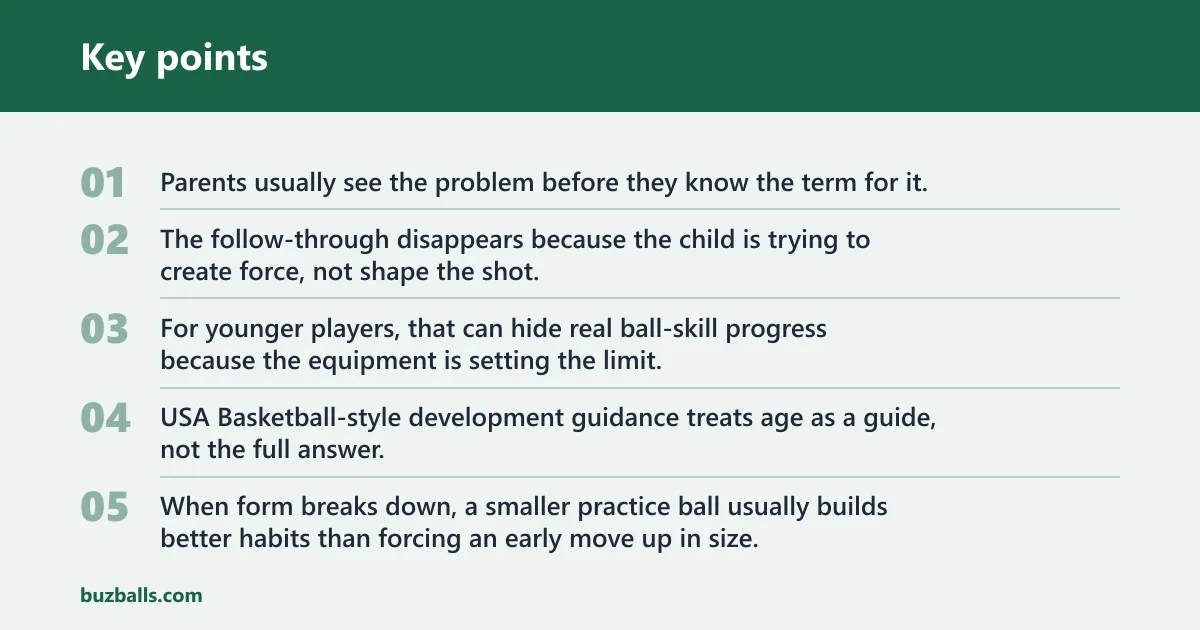
Parents usually see the problem before they know the term for it. The shot turns into a two-hand heave. The ball starts on the chest. The follow-through disappears because the child is trying to create force, not shape the shot.
Other common warning signs are flat shots, a heavy off-hand push, and a visible pause while the child re-grips the ball before shooting. Those are fit problems, not motivation problems.
Dribbling control and pickup strength
A too-large ball also changes the handle. The dribble gets higher than intended, the off hand starts trapping the ball on crossovers, and pickups after a bounce or rebound become slow. For younger players, that can hide real ball-skill progress because the equipment is setting the limit.
When a smaller practice ball helps more than sizing up
USA Basketball-style development guidance treats age as a guide, not the full answer. When form breaks down, a smaller practice ball usually builds better habits than forcing an early move up in size.
That does not mean advanced kids should always size up, either. Bigger is not automatically better. If the larger ball hurts shot quality and handle quality, the tradeoff is poor.
Picture an 8-year-old moved from size 4 to size 5 because an older sibling uses it. The child can dribble in a straight line, but every jumper becomes a chest push with both hands. In that case, age overlap matters less than the clear form breakdown.
How do you check if a ball fits?
A ball fits when the child can hold it with the shooting hand under control, keep the guide hand on the side during shots, dribble without losing pace, and pick it up cleanly after a bounce. If any one of those fails badly, the ball is probably too large for skill work.
At-home fit check
- Start with the age size. Hand the child the ball that matches the usual age chart first. This gives a clean baseline before trying the next size up or down.
- Check under-ball position. Ask for a set-shot hold from close range. The shooting hand should get under and slightly behind the ball, while the guide hand stays on the side rather than sliding under to help lift.
- Watch three close shots. Use a short distance where strength should not be the issue. If all three shots need a chest heave, a double-thumb release, or a big off-hand shove, the ball is too large for practice shooting.
- Test basic dribbles. Have the child dribble with each hand, change hands in front, and stop the ball on command. Loss of rhythm, repeated off-hand trapping, or trouble controlling the bounce points to poor fit.
- Test pickup control. Let the ball bounce once, then ask for a quick pickup into a shot-ready position. If the child has to hug the ball into the body before resetting the hands, move down a size for training.
What a good fit looks like
The child does not need to palm the ball. That is not the standard. The useful signs are simpler: one-hand control on short shots, a guide hand that guides instead of powers, and dribbling that looks normal rather than survival-based.
Suppose a 10-year-old can use a size 5 on drives and layups but loses guide-hand position on every outside shot. That does not mean the ball is wrong for all practice. It means shooting drills may still benefit from a smaller ball while game prep stays on size 5.
What if your child is between sizes?
If a child is on the cusp, use the smaller size for skill development unless a league requires the larger one for games. That protects shooting mechanics and handle quality, while still leaving room to introduce the bigger ball in short game-prep sessions so the transition is not abrupt.
Buying for a child on the cusp of moving up
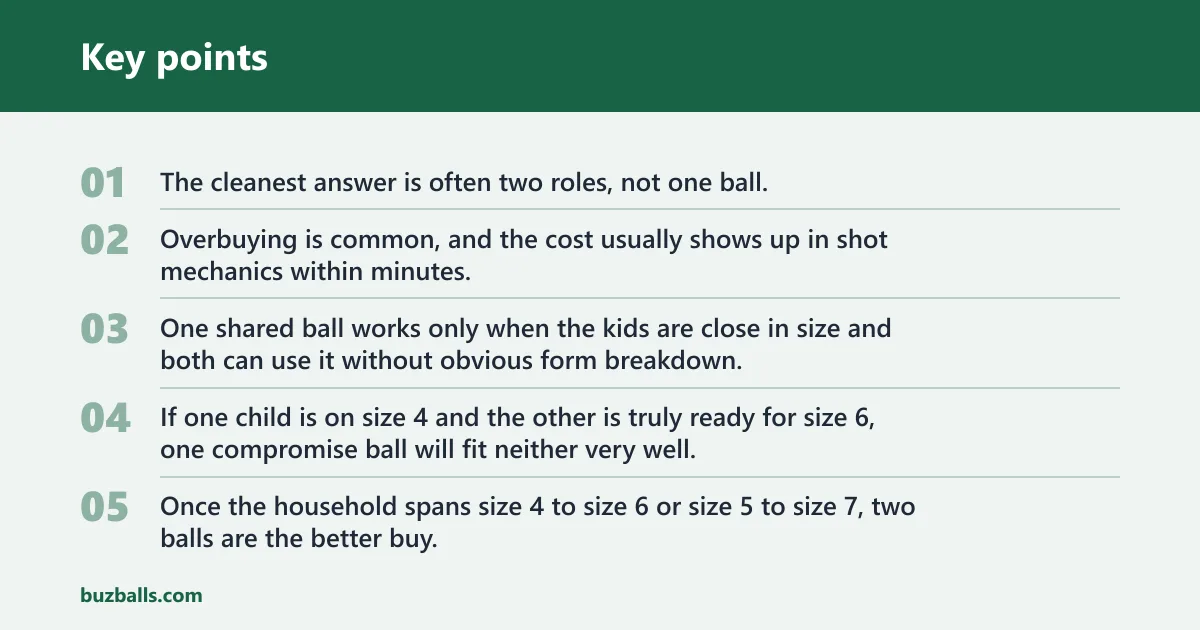
The cleanest answer is often two roles, not one ball. Use the smaller size as the practice ball when form still looks better there, and add the next size up when game rules or team workouts make it necessary.
If buying one ball only, staying down a size is usually the safer choice for a child who cannot yet shoot with one-hand control. Overbuying is common, and the cost usually shows up in shot mechanics within minutes.
One ball for siblings with different ages
One shared ball works only when the kids are close in size and both can use it without obvious form breakdown. If one child is on size 4 and the other is truly ready for size 6, one compromise ball will fit neither very well.
A practical split is to share within the same band: two younger siblings can often share a size 4, or two grade-school players can often share a size 5. Once the household spans size 4 to size 6 or size 5 to size 7, two balls are the better buy.
Practice size versus game size when league rules differ
League rules should govern game-ball choice. Practice-ball choice can be more flexible. If a 12-year-old girl plays games with a size 6, that remains the game standard. But if one-hand control is still weak, some shooting reps with a smaller ball can help build cleaner mechanics.
The same logic applies to boys in transition years. The required ball for games is not always the best ball for every driveway drill.
When should kids move from size 4 to 5, 5 to 6, and 6 to 7?
Kids should move up when the current ball looks controlled and the next size does not break form. The transition is less about birthday timing than about whether the larger ball still allows one-hand shooting control, stable dribbling, and clean pickups while also matching any league requirement.
Moving from size 4 to size 5
This is the most common gray zone because age charts overlap. Size 4 is recommended for ages 5 to 8, while size 5 is recommended for ages 9 to 11, but beginner programs and rec leagues often blur the handoff.
If an 8-year-old can shoot a size 5 with the guide hand staying on the side and no chest push, the move can make sense. If not, size 4 is still the better training ball.
Moving from size 5 to size 6
This move usually shows up around 11 to 13. For girls, size 6 becomes the official path from age 12 on. For boys, size 6 often works as the bridge size before the jump to regulation size 7.
The move is ready when the larger ball does not flatten the shot or wreck pickup speed. If outside shots suddenly become two-hand launches, the change came too early for skill work.
Moving from size 6 to size 7
For boys, this is the regulation move. Size 7 is recommended for boys 14 and up. It should come in once the player can keep normal shooting mechanics and ball control on a 10-foot hoop, which is the common pairing from ages 13 and up.
A common first-timer mistake is moving to size 7 the moment a child enters an older age bracket, then ignoring a month of flat shots and off-hand pushes. If the league requires size 7, use it in game prep, but keep some form work lighter if mechanics are slipping.
What size do girls and boys use in official play?
Official play splits by sex and age path. Girls and women use size 6 from age 12 through high school, college, and the pros. Boys commonly use size 6 around 12 to 13, then move to size 7, the men’s regulation ball, from about age 14 onward.
Girls from age 12 through high school and beyond
Size 6 is the official women’s basketball size, and that continues through high school, college, and pro play. For parents, the practical takeaway is simple: if a girl is 12 or older and playing organized games, size 6 is the default unless a local league says otherwise.
Boys in middle school transition years
Boys around 12 to 13 often land on size 6. This is the transition band where league rules matter a lot, because some programs move to the larger ball earlier than others. Practice can still size down when the larger ball clearly breaks form.
Boys in high school and older
Size 7 is commonly used as the men’s ball and is often used by boys from about age 14 onward in regulation play. For boys in high school, that is the standard expectation unless a specific league runs different youth rules.
What happens if a basketball is too big or too small?
A basketball that is too big usually causes faster damage than one that is too small. Big balls create two-hand heaves, off-hand dominance, flat shots, slower handle development, and weaker pickup control. A ball that is too small is easier to manage, but staying there too long can reduce transfer to the required game ball.
Too big: common form and control problems
When the ball is oversized for the child’s hands, the shooting hand slides to the side, the guide hand turns into a second power hand, and the release gets pushed from the chest. That can teach habits that take months to clean up.
Dribbling also suffers. The child needs more force to bounce the ball, tends to dribble too high, and may stop trying new moves because the ball feels heavy and slow. Confidence drops for a simple reason: the task got harder than the skill level warranted.
Too small: where skill transfer can fall off
A smaller ball gives cleaner control and often better-looking form. That helps up to a point. The limit comes when the child never practices with the game ball and then struggles to transfer timing, release strength, and handle pace in actual league play.
That is why the best answer is often split use: smaller for some skill work, required size for some game-prep reps.
Frequently asked questions
What size basketball should a 6 year old use?
A 6-year-old should usually use size 4. That matches the common beginner range and gives a child a better chance to dribble, catch, and shoot without turning every shot into a two-hand push. If the ball still looks heavy, check hoop height and shooting distance before sizing up.
What size basketball is best for a 9 year old?
For most 9-year-olds, size 5 is the standard youth choice. That said, some 9-year-olds still show better shooting mechanics and better pickup control with size 4 in practice. If games require size 5, use it for game prep, but a smaller ball can still help form work.
What size basketball should an 11 year old use?
An 11-year-old will usually be on size 5. Some stronger players begin trying size 6 in limited drills, especially boys nearing the next age band, but the move should wait if the larger ball creates chest pushes, flat shots, or obvious dribbling-control loss.
What size basketball do girls use after age 12?
Girls use size 6 after age 12 in official play, and that continues through high school, college, and the pros. For practice, size 6 should stay in the mix, but some players still benefit from occasional smaller-ball shooting drills if one-hand control is not yet steady.
Should my kid use a smaller ball if they can’t shoot one-handed?
Yes, for skill development that is usually the right move. If a child cannot shoot with one-hand control and the guide hand keeps powering the ball, the larger size is teaching bad mechanics. The exception is league-required games, where the official ball still governs competition.
When should a child move up to a regulation basketball?
A child should move up to a regulation basketball when age and league rules point there and the larger ball does not break shooting form or dribbling control. For boys, that usually means moving to size 7 around age 14. Until then, transition work matters more than rushing the jump.