Soccer Cleats for Beginners: How to Choose

Choose your first soccer cleats in this order: match the outsole to the surface, leave about 1/4 to 1/2 inch of toe room, and favor forgiving synthetic or soft leather over elite speed models. Get this wrong and you risk slips, blisters, toe pain, or buying cleats your league or field will not allow. This guide narrows your options by surface, fit, stud type, comfort, and budget so you can buy the right first pair fast.
What should a beginner buy first?
A beginner should buy by elimination, not hype: surface first, fit second, forgiveness third, then playing style, then price tier. That order cuts off the biggest mistakes early, especially wrong plates, painful uppers, and overbuilt speed cleats that look exciting in the box but punish new footwork in real sessions.
The beginner buying order
Start with the field, because the outsole decides if the cleat is suitable at all. Nike says cleats should be chosen for firm ground, turf, artificial grass, or indoor surfaces. If the plate is wrong, the rest of the boot can be perfect and still make it the wrong purchase.
Next comes fit. Beginners need secure heel hold, usable toe room, and no hard pressure at the little toe joint, big toe joint, or top of the midfoot. After fit comes forgiveness: a boot that breaks in with less fuss, feels stable during basic cuts, and does not require polished technique to stay comfortable.
Playing style matters, but later than most shopping pages claim. Position matters even later. A new player does not need to buy as if every sprint, drag-back, and first touch has to match a pro template.
The safest first-cleat profiles
For most new players, the safest first buy is an Academy or Pro tier boot in the correct surface type with a forgiving fit. Nike groups its cleats into four performance tiers: Elite, Pro, Academy, and Club. That matters because beginners usually get better cost per wear from Academy or Pro than from Elite.
- Best all-around first profile: correct surface, medium-width fit, comfort-leaning upper, Academy or Pro tier.
- Best for uncertain style: a balanced control or comfort family rather than an ultra-thin speed boot.
- Best for wider feet: avoid narrow speed-first shapes and prioritize softer uppers with less aggressive lockdown.
Why brand and position come later
Brand names can help organize choices, but they should not lead the purchase. A speed line can still be wrong if you need width. A comfort line can still be wrong if you buy the wrong outsole for the field.
Position is also a weak starting point for a beginner. Fullbacks sprint, midfielders defend, strikers receive with their back to goal, and most new players rotate spots anyway. Use position as a tie-breaker after surface and fit are settled.
Which surface type do you need?
You need the cleat made for the field you use most often, because traction, pressure underfoot, and allowed footwear all change by surface. Firm ground works for most outdoor natural grass, turf shoes are safer on older carpet-like fields, artificial grass cleats target newer synthetic grass, and indoor shoes belong on flat courts.
Firm ground for natural grass
Firm ground is the default outdoor category for many beginners on natural grass. Firm ground cleats are generally built around molded studs for traction into the ground, release on turns, and basic stability during stops and starts.
If your local field is real grass and not waterlogged or rock hard, firm ground is often the first place to look. It is also the category many outdoor beginner packages and club recommendations assume, which makes availability easier.
Do not treat firm ground as the universal answer. FG on turf is a common mistake because the studs can feel too tall and too grabby on a shallow synthetic surface. That can make pivots harsher on ankles and knees, especially for new players whose footwork is still inconsistent.
Artificial grass and turf are not the same
Artificial grass and turf get lumped together too often. For buying, separate them. Artificial grass cleats target synthetic grass fields. Turf shoes are typically used on shorter, denser carpet-like surfaces and use many small rubber nubs.
That outsole difference changes feel. Turf shoes spread pressure across more contact points, which can make long practices easier on your feet and reduce the sharp pressure some players feel under isolated studs. Artificial grass cleats usually sit between FG and turf in traction and field bite.
Suppose your week includes one match on newer synthetic grass and two practices on a hard, older turf field. A turf shoe is often the safer compromise if practice time is higher and comfort matters more than maximum outdoor bite.
Indoor shoes for flat courts
Indoor soccer shoes have flat rubber outsoles. They are for smooth indoor courts, not outdoor grass and not synthetic turf. Outdoors, they give too little bite for starts, stops, and sharp direction changes.
Indoor shoes also solve a specific problem: some futsal or gym spaces ban studs entirely. If that is your main setting, do not try to force a turf or FG pair into the job.
What to buy if you play on multiple surfaces
If one surface clearly dominates your week, buy for that surface first. If your schedule is split, choose the safer compromise rather than the most aggressive option.
- Count your weekly sessions. Write down how many sessions happen on FG, AG, turf, and indoor in a normal week. Buy for the surface where you spend the most time, because that pair will shape your comfort and cost per wear.
- Check the harshest mismatch. Eliminate the option that creates the worst conflict. FG on older turf is usually a worse mismatch than turf on a good AG field, and indoor shoes outdoors are a bad idea on either surface.
- Favor training safety. If most of your touches come in practice on a hard synthetic field, prioritize the more forgiving outsole for that setting. Beginners improve through repetition, so the training shoe often matters more than the once-a-week match shoe.
- Add a second pair later. Once surface needs are clear, then split roles. A turf pair plus an FG pair is a common two-shoe setup for players who bounce between school fields and weekend grass matches.
How should soccer cleats fit?
Soccer cleats should fit close, secure, and stable without numbness, burning, or toe jam. A common rule of thumb for a beginner is to buy cleats with about 1/4 to 1/2 inch of toe room, no heel slip during hard steps, no sidewall pressure at the forefoot, and lockdown that holds the foot without pinching the ankle.
Toe space, width, and pressure points
That 1/4 to 1/2 inch of toe room is a practical starting check, not a license to buy roomy shoes. Your toes should not curl, hit the end on a lunge, or slide forward enough to bang the front of the boot.
Width matters just as much. A narrow boot can feel acceptably snug at first, then create hot spots once your foot swells during a long session. Fit should feel snug but not painfully tight, with the heel held in place and the forefoot wrapped without sharp pressure at the little toe joint, big toe joint, or top of the foot. Watch for pressure at the widest points of the forefoot and for material pulling sideways across the little toe.
A common first-timer mistake is buying a speed cleat because it looks sleek, then feeling side pressure after ten minutes of cutting drills. Nothing else changed. The last was simply too narrow for the foot.
Heel hold and ankle or heel lockdown
Heel hold should feel planted. When you rise onto the forefoot, cut, or brake, the heel should stay down instead of lifting and rubbing. That is the easiest at-home predictor of blister risk.
Lockdown includes the midfoot and, on some designs, the ankle opening. If you are looking at Nike examples, the Phantom Luna is described as having an Asym Fit for a snug, comfortable fit around the ankle. That kind of design can help if you want a more wrapped-in feel, but it should still feel secure rather than restrictive.
How snug is too snug?
“Snug” should not mean pain. Beginners often confuse compression with performance. If the boot causes tingling, numb toes, or a pressure line across the top of the foot while standing still, it is too tight before training even starts.
Picture a player who normally wears a size 9 sneaker and buys a size 9 speed cleat with a very thin upper. The heel is locked, but the forefoot burns during simple passing. The answer is not “break it in more.” The shape is wrong.
Fit checks before you keep the pair
- Wear game socks. Try cleats on with the sock thickness you will actually use. Thin try-on socks can hide pressure points and leave the real fit tighter than expected.
- Lace them fully. Pull the laces snug from toe to ankle, then walk and make hard planted steps. This shows whether the heel lifts, the midfoot slides, or the tongue digs in once the boot is properly secured.
- Test toe clearance. Stand tall, then lunge forward and stop hard. Your longest toe should not crash into the front, and your foot should not slide forward enough to jam the nails.
- Check hot spots. Keep them on for at least several minutes indoors and note any burning, tingling, or sharp pressure. Mild close fit is fine, localized pain at rest is a return sign.
- Simulate a cut. Plant, pivot gently, and push off side to side on a safe floor. If the heel lifts or the forefoot spills over the edge of the sole, the lockdown or width is off.
How do you choose by playing style and position?
Choose by the job your feet do most: speed-focused players need quick release and low weight, precision-focused players need cleaner touch and passing confidence, and comfort-focused players need softness and stability. Position only helps after that, because most beginners rotate roles and need a boot they can learn in.
Speed-focused players
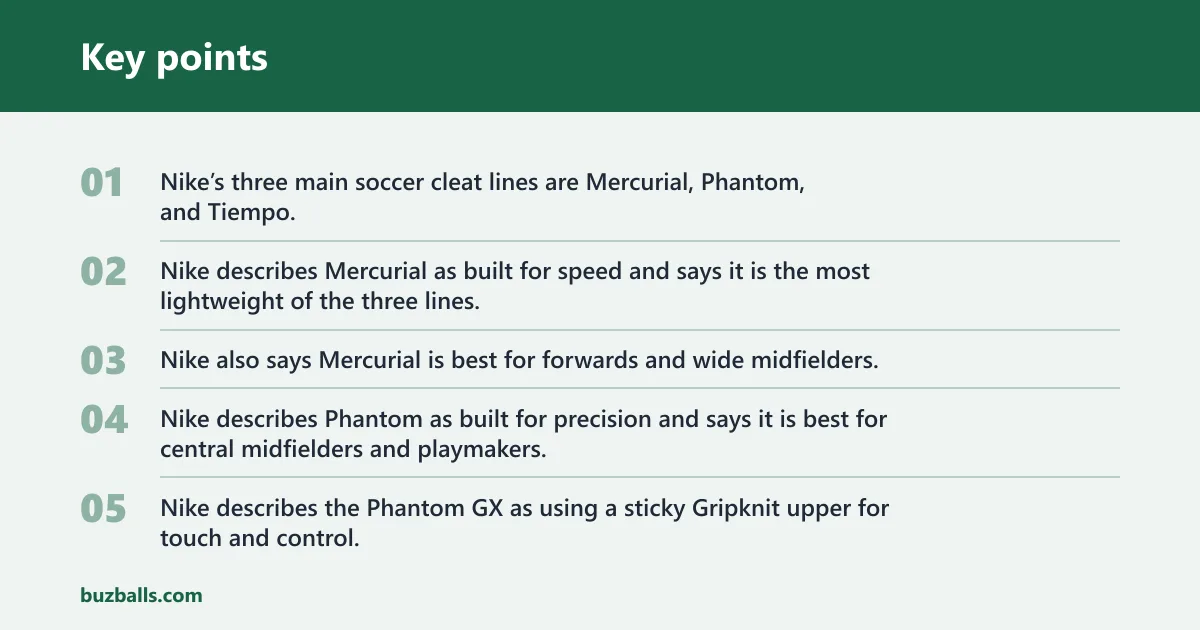
Nike’s three main soccer cleat lines are Mercurial, Phantom, and Tiempo. Nike describes Mercurial as built for speed and says it is the most lightweight of the three lines. Nike also says Mercurial is best for forwards and wide midfielders.
That profile makes sense if your game already depends on sprinting into space and changing direction aggressively. It makes less sense if you need width, easy break-in, or a softer touch platform while learning.
Precision-focused players
Nike describes Phantom as built for precision and says it is best for central midfielders and playmakers. That points toward players who value receiving, passing, striking through the ball, and a more connected touch profile.
Nike describes the Phantom GX as using a sticky Gripknit upper for touch and control. If you like the idea of extra grip on the ball, that can fit a precision-first shopper, but upper feel still comes after the basic fit test.
Comfort-focused players
Nike describes Tiempo as built for comfort and control. Nike also says Tiempo uses TECHLEATHER material that molds to the foot. For many beginners, that comfort-led category is the safest place to start because it is often more forgiving during longer sessions, when your feet swell, studs press harder underfoot, and stiff uppers start rubbing.
Comfort-focused does not mean slow or only for defenders. It means the boot gives you more margin if your movement patterns are still developing or if you value touch without an ultra-tight shell.
Use position as a tie-breaker
If two pairs fit equally well and match your surface, then let position guide the final call. Wide players and strikers may lean speed. Central passers may lean precision. Players who spend long minutes defending, receiving pressure, and playing through contact may lean comfort or control.
Most beginners still should not buy purely by position. A narrow speed boot remains a bad buy for a wide-footed winger.
What cleat families match each need
Cleat families help once your surface and fit are sorted. The broad map is simple: Mercurial for speed and quick cuts, Phantom for touch and accuracy, and Tiempo for comfort and control. Use those as family types, then look for the same ideas across other brands instead of locking onto one logo.
Mercurial for speed and quick cuts
Mercurial is the obvious speed family in the Nike range. It is described as built for speed, lightweight, and suited to forwards and wide midfielders. If your priority is sprinting and fast directional change, this is the reference point many brands try to match.
It is not the automatic first choice for everyone. Speed families often trade some forgiveness for a closer, racier fit.
Phantom for touch and accuracy
Phantom is the family to compare when passing, receiving, and striking precision matter most. Gripknit is the named upper technology most associated with that line, and some models use shape features aimed at a more wrapped feel.
Nike says the Phantom Luna uses a circular stud pattern near the toes. Circular forefoot elements tend to suit pivots and rotational release differently from sharp directional studs, which matters for midfielders and players who turn in traffic.
Tiempo for comfort and control
Tiempo is the comfort-first benchmark in this set. TECHLEATHER is the key named material here, and the selling point is a softer, more foot-conforming feel rather than the thinnest possible shell.
Across brands, the translation is straightforward: look for comfort or heritage-control families when you want a less punishing first boot.
What features matter on day one?
On day one, the most important features are the ones you can feel right away: stud pattern, upper feel, lockdown, plate stiffness, and break-in demand. Marketing terms matter less than whether the outsole releases cleanly on your field, the upper avoids pressure points, and the boot stays stable during basic cuts.
Stud pattern basics
Stud shape changes how the boot enters and exits the surface. Chevron studs usually bias forward drive and hard directional cuts. Circular stud patterns usually make pivots and rotational release feel smoother.
Stud pattern affects traction and turning. Longer, more aggressive studs can bite harder on grass but may feel grabby on shallow synthetic surfaces, while shorter or more numerous studs usually spread pressure better and let you pivot with less resistance. Beginners should avoid the most aggressive bite if their footwork is still raw, because over-grabby traction can punish clumsy planted turns.
Upper materials and what they really change
Upper names help describe feel, but they do not override shape. Gripknit, FlyWeave Ultra, Atomknit, and TECHLEATHER can all sound advanced, yet the buying question is still simple: does the upper give you the touch and comfort profile you actually need?
- Gripknit: used in precision-focused models for touch and control claims.
- TECHLEATHER: the comfort-led Tiempo material that Nike says molds to the foot.
- FlyWeave Ultra and Atomknit: material names often associated with lighter, tighter, more speed-oriented constructions.
For a first pair, ultra-thin uppers are often less forgiving than slightly softer ones. That is a tradeoff, not a flaw.
Lockdown, plate feel, and break-in
Lockdown should secure the heel and midfoot without forcing the toes into a narrow front end. Plate feel matters too. Stiffer, sharper-feeling speed plates can feel responsive, but they may also feel less forgiving over long beginner sessions.
Break-in time is not something to gamble on. If a boot hurts badly in the house, do not assume several practices will rescue it.
Are expensive cleats worth it for beginners?
Usually, no. Expensive cleats can offer lighter builds and premium materials, but beginners rarely need the most advanced version of a family to learn safely and comfortably. Academy or Pro commonly gives the better value because the fit concept remains similar while the price, break-in risk, and cost-per-wear stay more reasonable.
What changes by tier
Nike groups its cleats into Elite, Pro, Academy, and Club. Elite is the top tier, then Pro, then Academy, then Club. The higher you go, the more likely you are paying for lighter construction, premium upper execution, and small performance refinements rather than beginner-proof comfort.
The price gap can be large. Nike says the Mercurial Superfly 11 starts at $295. That alone explains why Elite-level speed models are hard to justify as a first purchase for many new players.
Where Academy or Pro makes the most sense
Academy often hits the sweet spot for first-time buyers: enough structure, enough identity from the cleat family, and lower replacement pain if your preferences change after a season. Pro can make sense if the fit is excellent and you train often enough to spread the cost across many wears.
Club is the lowest-risk spend, but fit and outsole choice still matter more than the savings. A cheap wrong pair is still a bad value.
When paying more does and does not make sense
Pay more if you already know your surface, your fit needs, and your style preference, and if you train often enough to justify the extra cost. Do not pay more just because the top tier is marketed as fastest, lightest, or most advanced.
For most beginners, the better upgrade is correct surface plus correct fit, not Elite plus regret.
Can beginners wear sneakers for soccer?
For most beginners, the answer depends on the surface: sneakers can work for short sessions on smooth indoor floors or dry, flat grass, but turf and natural grass usually call for soccer cleats. This sneakers vs cleats guide explains when each shoe is acceptable, which surfaces make cleats the safer option, and why the wrong choice can lead to slips, ankle twists, blisters, and weaker ball control.
It matters because matching footwear to the field helps new players stay more stable, protect their feet, and get better traction from the first practice onward.
Beginner cleat decision table
| Surface | Foot shape | Skill level | Position | Budget tier | Safest recommended cleat category | Do not buy |
|---|---|---|---|---|---|---|
| Firm ground natural grass | Medium | True beginner | Mixed or rotating | Academy | FG comfort/control cleat with stable molded studs | Elite speed FG with ultra-thin upper if comfort is a concern |
| Firm ground natural grass | Wide | True beginner | Defender or mixed | Academy or Pro | FG comfort-focused cleat with softer upper and easier break-in | Narrow speed cleat bought by position alone |
| Artificial grass | Medium | Beginner | Midfielder | Academy | AG or balanced control cleat with moderate traction | FG plate with aggressive long bite for weekly AG use |
| Turf | Any | Beginner | Any | Club or Academy | Turf shoe with many small rubber studs for training volume | FG studs on hard old turf |
| Indoor court | Any | Beginner | Any | Club or Academy | Indoor flat-sole shoe | Turf or FG used on slick indoor court |
| FG matches, turf practices | Medium | Beginner | Winger | Academy | Turf first if practice dominates; FG second later | One aggressive FG pair expected to cover both equally well |
| Firm ground natural grass | Narrow | Beginner with sprint focus | Forward | Pro | FG speed cleat only if fit is clean and heel is locked | Elite speed boot bought for looks before fit is proven |
| Artificial grass or turf | Wide | Beginner | Playmaker | Academy or Pro | Control or comfort family in the correct AG or turf outsole | Precision model that pinches width just to get Gripknit branding |
Common beginner buying mistakes
Buying speed when the foot needs comfort
The most common mismatch is chasing a speed silhouette while needing width or softness. If the fit is borderline in the store, it usually gets worse during play.
Overspending on Elite too early
Beginners often cannot predict whether they will prefer speed, touch, or comfort after a month of actual sessions. Spending Elite money before that is usually poor value.
Picking the wrong plate for the field
This mistake creates the biggest day-one downside: unstable traction, rejected footwear, or underfoot pain. Surface is the first filter for a reason.
Ignoring forgiveness
Forgiveness means easier break-in, less punishing fit, more stable traction, and more tolerance for imperfect footwork. Those traits help a beginner more than a razor-thin race feel.
Frequently asked questions
What soccer cleats should a beginner buy?
A beginner should usually buy an Academy or Pro tier cleat in the correct surface type, with 1/4 to 1/2 inch of toe room and a forgiving fit. Comfort or balanced control families are safer first buys than elite speed models unless the player already knows they like a narrow, aggressive fit.
What surface type do I need for soccer cleats?
You need the outsole built for the field you use most: firm ground for many natural grass fields, artificial grass for synthetic grass, turf for short dense turf, and indoor for flat courts. Do not assume one pair works equally well across all four, because traction and pressure differ too much.
Should beginner cleats be tight or roomy?
Beginner cleats should feel close and secure, not roomy, but they also should not create numbness or sharp pressure. Aim for 1/4 to 1/2 inch of toe room, no heel slip, and no pinching at the forefoot. Tight enough to lock the foot in place is good, painful compression is not.
Are expensive soccer cleats worth it for beginners?
Usually they are not. Elite cleats can offer lower weight and premium materials, but beginners often get better value from Academy or Pro because those tiers reduce cost and still cover the main fit and family traits. A cited example: the Nike Mercurial Superfly 11 starts at $295, which is a steep first-buy gamble.
Which soccer cleat line is best for comfort, speed, or touch?
In Nike’s lineup, Mercurial is the speed reference, Phantom is the precision and touch reference, and Tiempo is the comfort and control reference. Nike describes Mercurial as built for speed, Phantom as built for precision, and Tiempo as built for comfort and control. Fit still decides whether any of them are right for you.
How do I know if my soccer cleats fit correctly?
They fit correctly when the heel stays down during planted steps, the toes do not jam on a lunge, the forefoot does not burn at rest, and the midfoot feels secure without tingling. Test them with game socks, fully laced, and make quick side pushes indoors before removing tags.