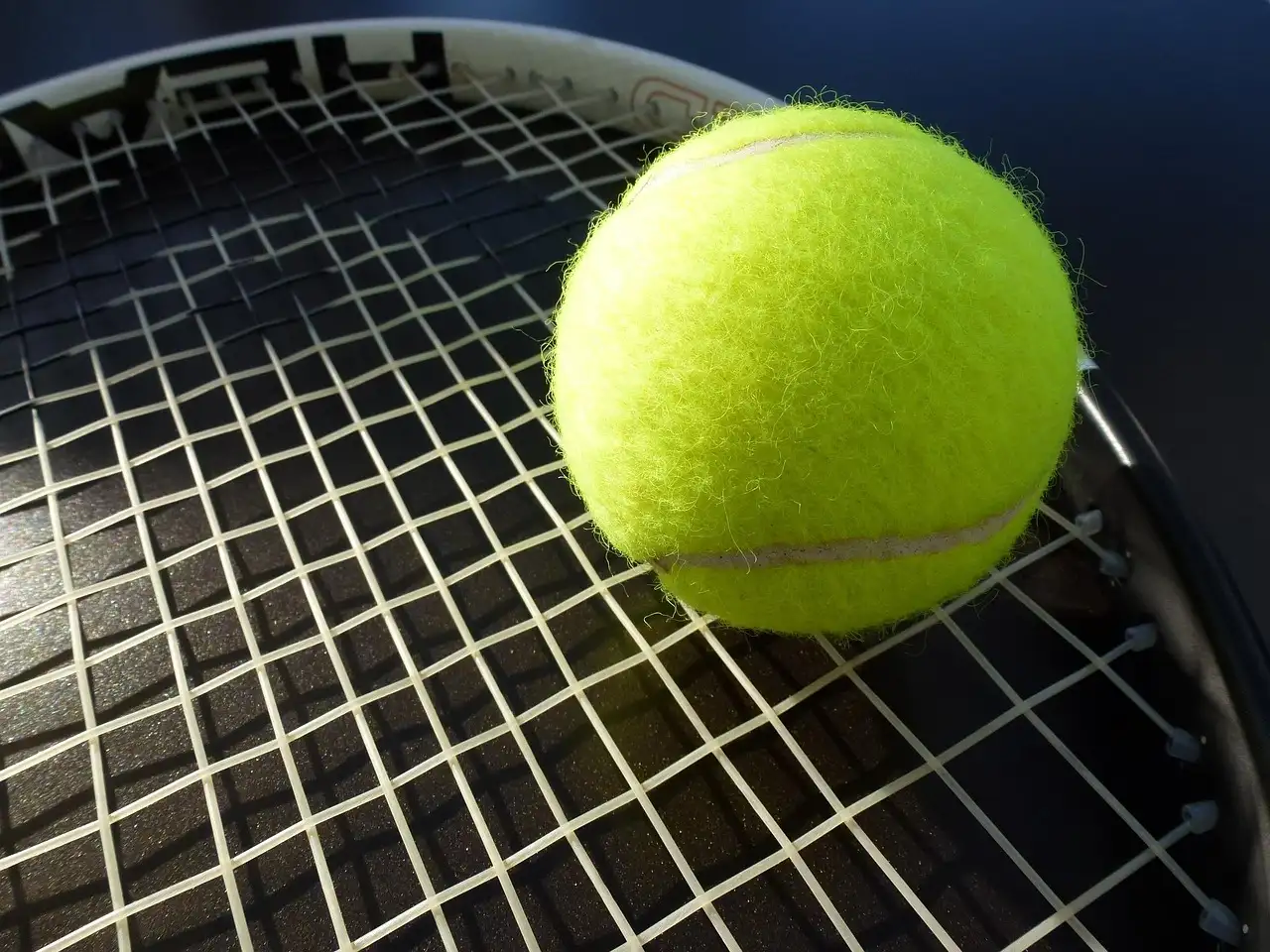
How to Choose a Tennis Racket for Beginners: Key Factors

Choose a first adult tennis racket with roughly a 100–105 sq in head, about 10.0–10.6 oz unstrung weight, and a 4–5 point head-light balance; if your swings feel slow or late, go lighter before adding power. Pick the wrong frame and you can end up with extra weight in the hand, more strain on the arm, and slower early progress. This guide shows how body strength, comfort, and learning goals map to practical racket specs.
Beginner racket basics

Start with fit, not prestige. For most beginners, the safest order is skill level first, then head size, grip size, weight, and balance, because those choices change how easy the racket is to swing, how much of the string bed you can use, and how much stress reaches your arm.
A beginner frame should give you forgiveness on off-center contact and enough comfort to keep swings relaxed. Pro-style rackets often expect earlier contact, cleaner mechanics, and faster racquet-head speed, so they can feel demanding even when the published specs look reasonable.
What beginners should optimize for first
Choose a racket that lets you swing with control. The practical beginner target is a lighter frame, a larger head, and the correct grip size. That combination usually helps you make contact, recover between strokes, and avoid over-gripping the handle.
Power should come second. A racket that gives easy pace but feels harsh or slow can make timing harder, especially early on.
Why comfort and forgiveness matter more than power early
Comfort matters because beginners are still building repeatable contact. A larger head gives you a bigger sweet spot, which cuts the penalty for slight mishits. A lighter frame is easier to move, but too much lightness can make the racket unstable on contact, so the goal is easy handling without a flimsy feel.
Forgiveness matters because the ball will not strike the center every time. A racket that stays usable on off-center hits helps you learn without fighting the frame.
What head size should you choose?
For most beginners, start in the 100–110 sq in band. Oversize heads are 110+ sq in, mid-plus heads are 98–104 sq in, and mid heads are 97 sq in or smaller. The larger the head, the more forgiving the response usually feels on mishits.
Oversize, mid-plus, and mid
Oversize frames can feel easier to launch the ball with because the string bed is bigger. Mid-plus frames are the most practical starting point for many adults because they still offer forgiveness without feeling overly large. Mid frames can work for some stronger beginners, but they ask for cleaner timing and better contact.
If you want the simplest answer, look first at 100–105 sq in. That range usually gives a useful mix of sweet-spot size and control.
When a smaller head makes sense
A smaller head can make sense if you already swing fast and want a more precise response, but that is a narrower case. A beginner who is unsure should not choose a smaller head just because it sounds “more advanced.”
Suppose two rackets feel similar in weight and grip. The 100 sq in frame will usually be easier to live with than a 97 sq in frame for a first adult racket.
What grip size do you need for a tennis racket?
Grip size should feel secure without forcing your hand open. Common adult sizes are 4 1/4, 4 3/8, 4 1/2, and 4 5/8 inches; 4 1/4 is often listed for small hands, 4 3/8 for average women, 4 1/2 for average men, and 4 5/8 for large hands. The finger-fit check is the easiest test: one finger should fit between your palm and fingers when you hold the handle.
How to check grip size
- Hold the racket normally. Wrap your hand around the handle with a relaxed grip, then slide the index finger of your other hand into the gap between your palm and fingertips. One finger should fit without forcing.
- Adjust before you decide. If the gap is too tight, the grip is likely too small. If there is extra space, the grip may be too large for clean hold and quick changes of position.
Overgrips can increase size, so a racket that is slightly small may be corrected more easily than one that is too large. If you are between sizes, many beginners start smaller and add an overgrip if needed.
When to size up with an overgrip
Add an overgrip when the handle feels just a touch small, or when you want a little more cushioning and tack. Do not use an overgrip to rescue a grip that already feels bulky; that usually makes the handle harder to control.
How heavy should a beginner racket be?
A beginner-friendly weight range is 260–285g unstrung. That range supports easier swinging and lower fatigue than heavier frames, while still leaving enough mass for stable contact. A racket that is too heavy can slow your swing, make late contact more common, and leave your forearm tired before the match is over.
How weight changes power and control
More weight can add stability and control, but it asks for more strength and timing. Less weight swings faster and often feels easier at first, yet it can give up some steadiness if the frame is too light for your swing style.
For a first racket, easy handling is usually the better trade. A frame in the beginner range should feel manageable on the first few swings, not only on a short demo rally.
Balance, length, and stiffness
Balance changes where the mass sits in the frame. Head-heavy rackets put more weight toward the tip and can help with power, even balance feels neutral, and head-light rackets place more mass in the handle area for quicker maneuvering and better control. On a standard 27-inch racket, the midpoint is about 343 mm, so balance is usually judged around that point.
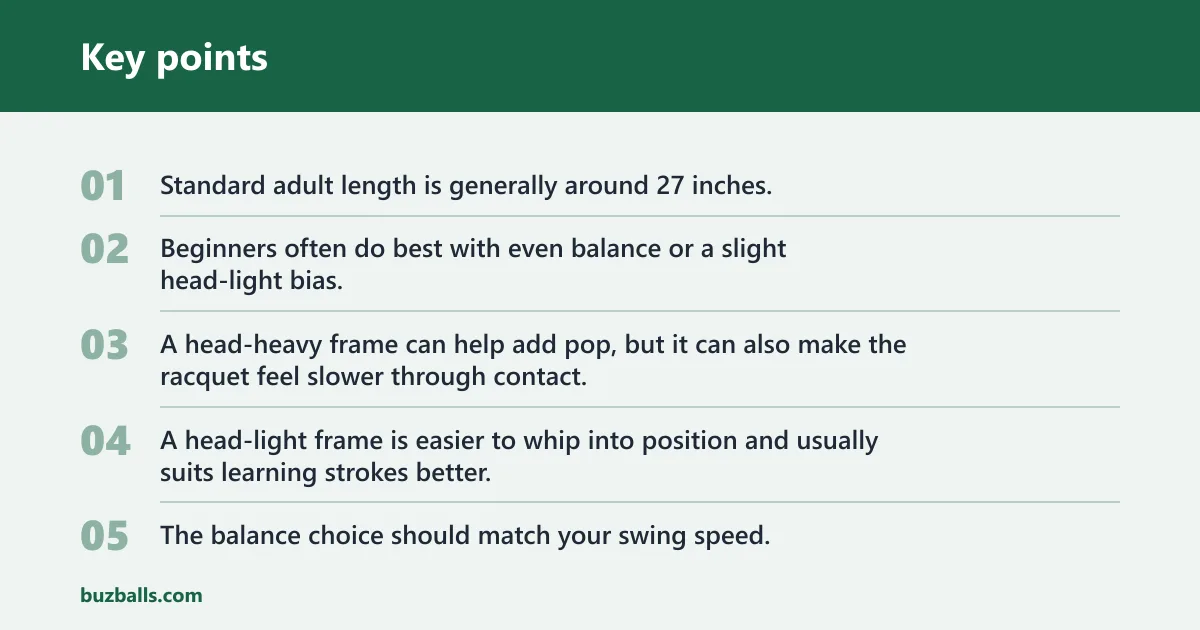
Standard adult length is generally around 27 inches. Longer frames up to 29 inches can add reach and speed through the ball, but they also make the racket harder to move quickly and can reduce control for new players. Frame stiffness matters too: higher RA values are commonly reported to feel stiffer and can send a harsher hit, while more flexible frames often feel gentler on the arm.
Head-heavy, even, and head-light
Beginners often do best with even balance or a slight head-light bias. A head-heavy frame can help add pop, but it can also make the racquet feel slower through contact. A head-light frame is easier to whip into position and usually suits learning strokes better.
The balance choice should match your swing speed. If the racket feels late on volleys or quick changes of direction, a more head-light setup is usually the safer direction.
Standard length versus longer frames
Stick with the standard 27-inch length unless you have a clear reason to go longer. Extra length can help with reach, but it also raises the coordination demand. That trade-off is usually not worth it for a first racket.
Frame stiffness and arm comfort
Stiffer frames can feel harsher on contact, especially when paired with a very light frame and a small grip that encourages squeezing. If your priority is comfort, choose a frame that does not pair extreme stiffness with a very light build and the wrong grip size.
A common first-timer mistake is assuming that a lighter frame automatically feels easier on the arm. If the frame is too stiff or too small in the handle, the hand and forearm may work harder than expected.
Tennis racket decision table
| Buyer profile | Ideal head size | Ideal weight | Ideal grip size | Ideal balance | Avoid at all costs |
|---|---|---|---|---|---|
| Very new beginner | 102–105 sq in | 260–275g unstrung | 4 3/8 or a size that passes the finger-fit check | Slightly head-light or even balance | 97 sq in or smaller, 11 oz or 310 g upward, and a very head-heavy frame |
| Athletic beginner | 100–104 sq in | 270–285g unstrung | 4 1/2 if the finger-fit check agrees | Even balance or slight head-light | 29-inch length with a stiff, very head-heavy build |
| Smaller-framed beginner | 105–110 sq in | 260–270g unstrung | 4 1/4, with overgrip if needed | Slightly head-light | Too-large grip, heavy frame, and a long body plus stiff frame combination |
| Comfort or arm-sensitive beginner | 100–105 sq in | 260–275g unstrung | 4 3/8 or 4 1/4 if the fit checks out | Head-light bias | Heavy, stiff, and head-heavy together |
How to test a racket before you buy
Do not shop by spec sheet alone. A racket can look ideal on paper and still feel late, harsh, or awkward once you swing it. Your aim is to confirm that the frame helps you swing freely, find contact, and recover for the next shot.
- Check the grip first. Hold the handle with a normal forehand grip and verify the finger-fit check. If your hand has to clamp hard just to hold the racket, the grip is probably wrong.
- Take easy shadow swings. Swing the racket without a ball and notice whether the tip feels sluggish or the handle feels bulky. A first racket should feel easy to accelerate and easy to stop.
- Hit a few gentle balls. Start with slow rallies or controlled feeds and note where the frame feels most solid. If mishits sting, or if the racket twists hard on off-center contact, the setup may be too demanding.
- Compare the recovery feel. After contact, see whether the racket returns to ready position without effort. A frame that feels tiring after a short session may not suit a beginner.
Suppose two rackets share the same head size. If one has a 4 1/4 grip that fits cleanly and the other needs a forced grip with an overgrip stacked on top, the first one is the better starting point.
If you cannot demo a racket, use the listing and the return policy together. Check the manufacturer’s specs for head size, weight, length, stiffness, and grip options, then choose the model closest to the beginner ranges in this guide. If the seller allows returns, that gives you a backup if the frame feels too slow or too harsh on court.
Frequently asked questions
How do I choose a tennis racket as a beginner?
Choose comfort, forgiveness, and easy handling first. Avoid pro-style frames until your timing and swing speed catch up.
What size tennis racket should a beginner use?
That pairing gives a usable sweet spot without making the frame feel oversized or hard to control. Longer frames up to 29 inches are usually a later choice.
How heavy should a beginner tennis racket be?
A good starting point is 260–285g unstrung. That range is light enough for easier swings but still substantial enough to feel stable in contact. If a racket feels slow or causes your arm to tire quickly, move lighter before thinking about more power.
Should beginners choose a head-heavy or head-light racket?
Most beginners should lean toward even balance or slight head-light bias. Head-heavy frames can add power, but they often feel slower and less precise for early technique. A head-light frame is usually easier to move and helps you keep swings under control.
Can the wrong racket cause arm pain?
Yes. A frame that is too stiff, too heavy, or the wrong grip size can force your arm to absorb more shock or make you squeeze harder than necessary. If comfort is a priority, avoid combining high stiffness, extra weight, and a poor grip fit.