Best Way to Store Your Pickleball Paddle to Prevent Warping

Store a pickleball paddle flat, dry, and around 50–80°F. Use a cover for transport or short-term protection, but remove it if the paddle is damp or hot. Poor storage can bow the face, soften adhesives, and shorten paddle life fast. This guide covers material-specific storage rules, safe spots, and the cases where a cover helps or traps damage.
Why paddle storage matters
Pickleball paddles fail in predictable ways when storage goes wrong. Moisture can swell wood, soften adhesives, and linger in seams, while heat and cold can stress the face, core, and edge guard. The safest storage is clean, fully dry, and kept away from extreme temperatures and moisture.
Material matters here. Graphite, composite, fibreglass, raw carbon fibre, and wood do not react the same way to dampness or temperature swings, so one storage rule does not fit every paddle.
What you’ll need
- Microfibre cloth
- Mild dish soap
- Clean water
- Soft cloth or toothbrush
- Paddle eraser or carbon fibre cleaning block
- Padded cover
- Dry towel for the grip
- Climate-controlled storage spot
How do you dry and clean it first?
Clean the paddle before storage, then make sure every surface is dry. Use a damp microfibre cloth for routine wipe-downs, mild dish soap only when water alone does not remove grime, and a paddle eraser for raw carbon fibre faces. Do not store the paddle until the face, seams, grip, and overgrip are dry.
-
Wipe the face gently. Use a microfibre cloth dampened, not dripping, with water. If grime remains on graphite or composite, add a drop of mild dish soap and wipe again, then follow with a clean damp cloth so residue does not stay on the surface.
-
Clean raw carbon fibre carefully. Use a paddle eraser or carbon fibre cleaning block on ball marks and plastic residue. Keep pressure light. The goal is to remove buildup without abrading the face texture that helps spin and control.
-
Dry the grip and overgrip. Wipe after each use to remove sweat and oils. If the overgrip feels slick, replace it before storage, because trapped moisture and salt make the handle less sanitary and can work into seams over time.
-
Check the edge guard and seams. Use a soft cloth or toothbrush around taped edges, trim lines, and the handle junction. These spots collect residue and moisture, and they are also the places where damage tends to start if the paddle is put away damp.
-
Air-dry before packing. Leave the paddle in open room air until the face, edge guard, grip, and overgrip feel dry to the touch. A common first-timer mistake is closing the paddle into a cover right after wiping it, which can hold moisture against the paddle overnight.
Say your composite paddle has a sticky film after an outdoor session. A damp microfibre cloth with a trace of mild dish soap clears most grime, then a dry cloth removes the last trace of moisture before it goes back into storage. That sequence protects the finish and keeps residue from hardening.
Should you use a cover?
A padded cover helps when the paddle is already clean and fully dry. It blocks dust, reduces light knocks, and makes short-term transport easier. It should not be used as a moisture trap, and it does not fix storage in a hot car, damp garage, or other poor location.
When a padded cover helps
Use a padded cover after cleaning and full drying. It is useful for a paddle that goes into a gym bag, gets carried between matches, or sits in a closet where dust and knocks are a concern. That protection is about handling, not warping prevention by itself.
When a cover traps moisture
Do not zip a cover over a paddle that is warm, wet, or even slightly damp around the seams or grip. The cover can trap residual dampness against the face and edge guard. That is especially risky for wood paddles, which can swell or warp if exposed to too much moisture.
How to store it after cleaning
Once dry, place the paddle in a cover only if the cover itself is dry. Then store the covered paddle in a room with stable temperature and ordinary indoor humidity. Keep the handle and grip dry, because sweat-soaked overgrips are a common source of hidden moisture.
Suppose a raw carbon fibre paddle is cleaned after play, but the grip still feels cool and slightly damp. Putting it in a padded cover right away is the wrong move. Leaving it open until the grip and edge guard are fully dry avoids trapping moisture under the cover.
Can heat or cold warp a paddle?
Yes. Extreme temperatures can stress the core, soften adhesives, and change how the face and edge guard hold together. Heat is the bigger risk in cars, trunks, garages, and sheds, but prolonged cold in uninsulated spaces is also a problem. Climate-controlled storage is the safest option.
Car and trunk storage
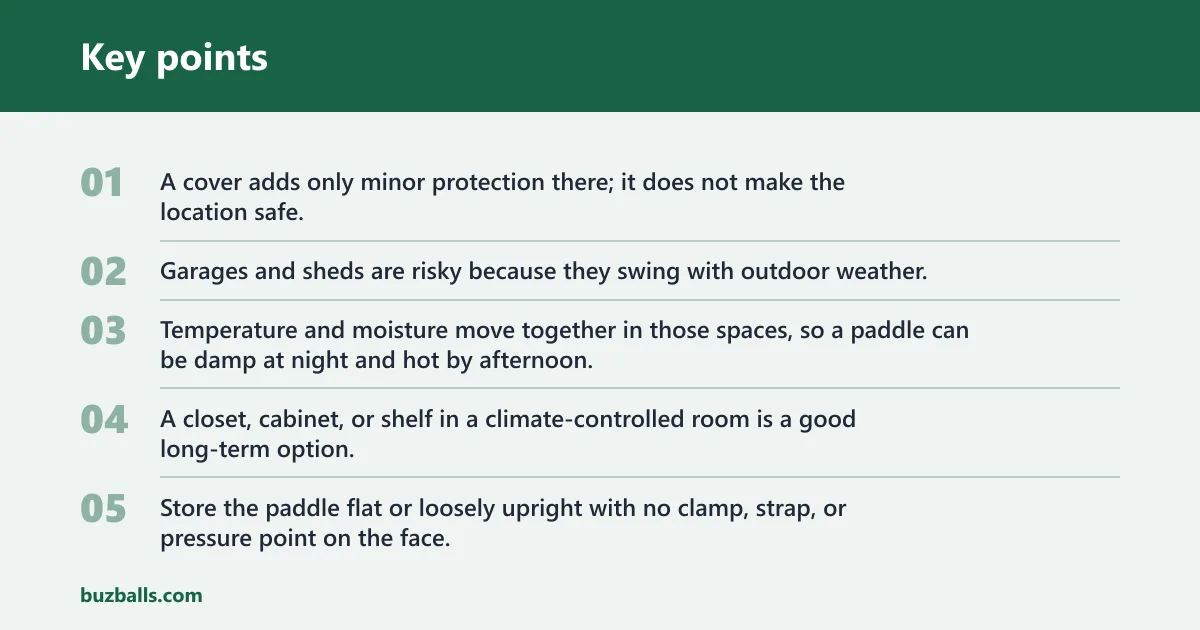
Do not leave a paddle in a car or trunk. Those spaces can heat-soak in sun and chill sharply in cold weather, which raises the chance of face bowing, core stress, and adhesive failure. A cover adds only minor protection there; it does not make the location safe.
Garage and shed storage
Garages and sheds are risky because they swing with outdoor weather. Temperature and moisture move together in those spaces, so a paddle can be damp at night and hot by afternoon. That combination is hard on wood paddles and still unkind to graphite, composite, and raw carbon fibre.
Climate-controlled home storage
A closet, cabinet, or shelf in a climate-controlled room is a good long-term option. Store the paddle flat or loosely upright with no clamp, strap, or pressure point on the face. In most homes, stable temperature matters more than whether the paddle stands up, lies flat, or hangs.
| Paddle material | Storage location | Humidity risk | Temperature risk | Use a cover? | Safe-action rule |
|---|---|---|---|---|---|
| Graphite | Climate-controlled room | Low | Low | Yes, if fully dry | Clean, dry, then store in a padded cover away from direct heat. |
| Composite | Gym bag or closet | Medium if sweaty | Low indoors | Yes, after drying | Wipe sweat, dry the grip, and avoid sealing in dampness. |
| Fibreglass | Indoor shelf | Low to medium | Low indoors | Yes, after cleaning | Keep away from wet gear and let seams dry before covering. |
| Raw carbon fibre | Closet or gear bin | Low | Low indoors | Yes, if dry | Use a paddle eraser for residue, then dry fully before storage. |
| Wood | Climate-controlled room only | High | Low to medium | Only after complete drying | Keep it driest of all, because too much moisture can warp it. |
Paddle storage checklist
Use this before the paddle goes away for the night. It is the fastest way to reduce warping risk without overcomplicating storage.
-
Inspect the face. Look for residue, wet spots, and grit on the surface. Clean first if anything is visible or sticky.
-
Dry the seams. Run a dry cloth around the edge guard, trim lines, and handle joint. These spots hold water longer than the center face.
-
Check the grip. If the grip feels slick, replace the overgrip or let the handle dry before storage. A damp grip is a storage problem, not just a comfort issue.
-
Confirm the cover is dry. A dry paddle can still pick up moisture from a damp cover. Check both before zipping anything closed.
-
Place it indoors. Store it in a stable room, not a car, trunk, garage, or shed. The room should stay away from heat spikes and cold swings.
-
Choose an unstressed position. Flat storage is safest, but standing or hanging also works if nothing presses on the face or edge guard. Avoid clamps, tight straps, and stacked weight.
What storage mistakes shorten the life of a pickleball paddle?
The biggest mistakes are storing the paddle damp, leaving it in a hot or cold space, and sealing it inside a cover before the grip and seams are dry. Soaking the paddle is also a problem because moisture can damage the core. Strong cleaners can hurt the core and surface finish.
Another common problem is ignoring the overgrip. Sweat and oils soak in fast, and a slick overgrip can keep the handle damp even when the face looks dry. That hidden moisture matters, especially on wood paddles.
Common mistakes
- Putting a damp paddle into a padded cover
- Leaving the paddle in a car or trunk
- Storing it in a garage or shed with wild temperature swings
- Using too much soap and leaving residue behind
- Soaking the paddle or wiping it with dripping cloths
- Scrubbing textured faces, edge guards, or seams too hard
- Letting a slick overgrip stay on too long
One practical failure case is a wood paddle left in a damp gear bag after a rainy match. The bag holds moisture, the handle stays cool, and the face can start to bow. A second case is a graphite paddle sealed in a cover after a sweaty session; the cover helps with dust, but not with trapped dampness.
Frequently asked questions
What is the best way to store a pickleball paddle so it doesn’t warp?
Store it clean, fully dry, and indoors at stable room temperature. A padded cover is fine only after the paddle is dry. Keep it away from cars, garages, trunks, wet bags, and any place with heat spikes or cold swings. Flat storage is the simplest safe choice.
Should I keep my pickleball paddle in a cover or bag?
Use a padded cover for transport or dust protection after cleaning. A bag is fine for carrying gear, but it should not trap moisture against the paddle. If the grip, seams, or face are still damp, leave the paddle out until it dries completely.
Can heat or cold warp a pickleball paddle?
Yes. Extreme temperatures can stress the face, core, and adhesives. Heat in a car or trunk is especially risky, and prolonged cold in an uninsulated space is also a problem. Keep the paddle in a room that stays close to ordinary indoor conditions.
How dry should a pickleball paddle be before storing it?
Dry enough that the face, edge guard, seams, grip, and overgrip all feel dry to the touch. If the handle still feels cool, slick, or damp, wait longer. A cover should go on only after that check passes, not before.
How do I store a wood pickleball paddle without warping it?
Keep it extra dry, indoors, and away from moisture-heavy areas. Wood paddles are the most moisture-sensitive type here, so even a slightly damp grip or a humid storage spot raises risk. Clean gently, dry completely, and avoid garages, sheds, and wet bags.
Do paddle covers actually protect against warping?
Only partly. A padded cover helps with dust, light moisture protection, and impact protection, but it cannot fix bad storage conditions. If the paddle is damp, hot, or stored in an extreme-temperature space, the cover may trap the problem rather than solve it.