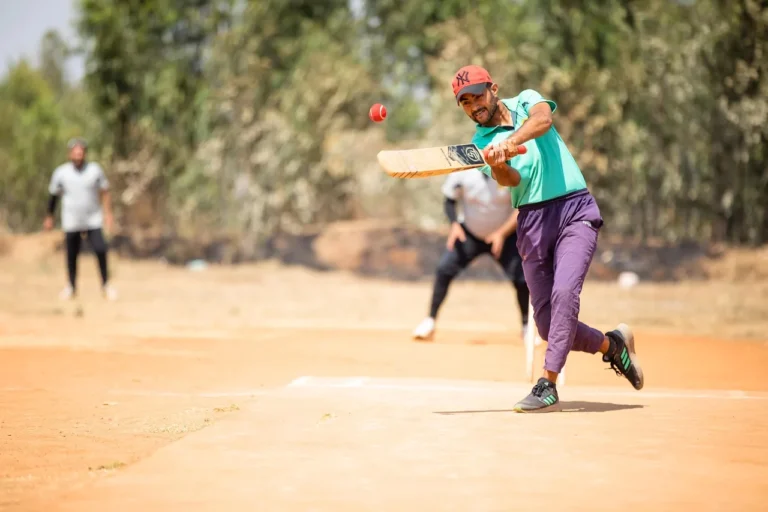

How to Travel with a Cricket Bat Without Damaging It

Put the bat in a padded bat tube or hard case, then stop it moving with bubble wrap and clothing. Protect the edges and toe. Use a hard case for expensive bats or trips with multiple flights. Loose packing leads to cracked edges, a split toe, or a bent handle, and airline handling can turn one knock into a ruined bat. This guide shows how to pack, pad, and choose the right container for plane travel.
Can you fly with a cricket bat?
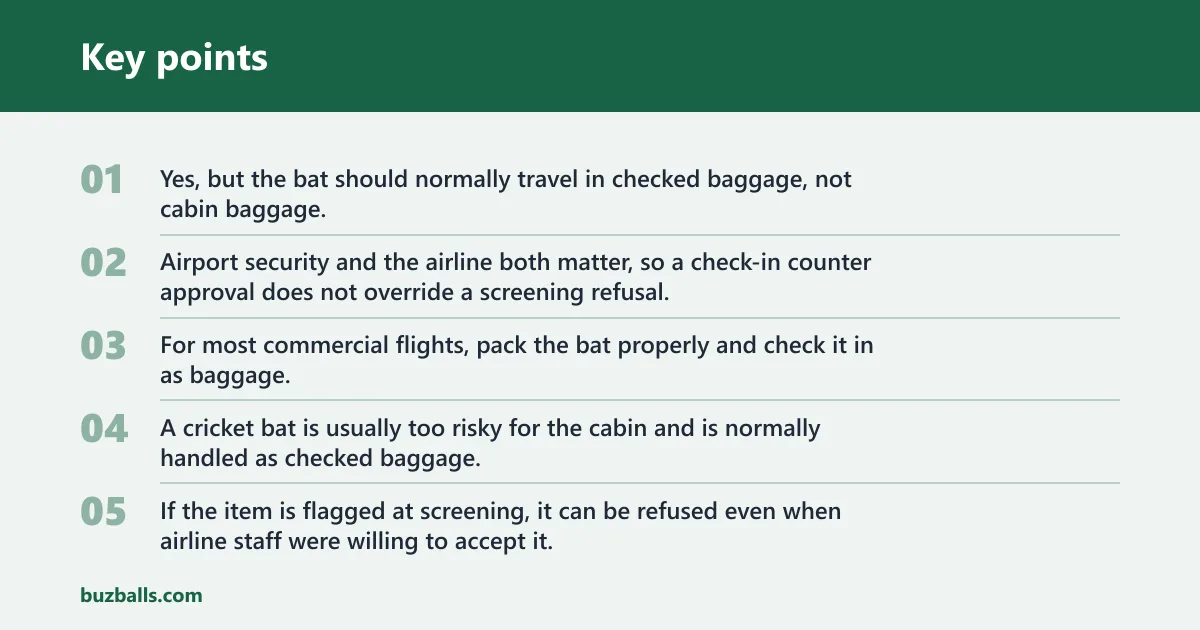
Yes, but the bat should normally travel in checked baggage, not cabin baggage. On the India-Gulf route, cricket bats are banned from cabin baggage and allowed in checked baggage, and Dubai’s hand-luggage prohibited list names cricket bats directly. Airport security and the airline both matter, so a check-in counter approval does not override a screening refusal.
Checked baggage is the usual route
For most commercial flights, pack the bat properly and check it in as baggage. A cricket bat is usually too risky for the cabin and is normally handled as checked baggage. Some airlines may allow a cricket bag as part of checked baggage if it meets weight and size limits, but that is a baggage-rule question, not a cabin-bag exception.
Why cabin baggage is the wrong category
Most commercial flights do not allow cricket bats in carry-on luggage, and a small or child’s bat has no cabin exemption. Security staff can treat the bat as a blunt or striking weapon category item, which makes the final decision stricter than a simple size check. If the item is flagged at screening, it can be refused even when airline staff were willing to accept it.
How security screening changes the answer
The final decision at airport security rests with the security officer. That is why a bat that seems acceptable on paper can still be stopped at the checkpoint. If there is no time to re-check it, you may need a backup plan such as gate-side repacking into checked baggage, airport storage, or leaving the item out of the trip.
Cricket bat packing matrix
This matrix gives a practical choice based on trip length, handling risk, and bat value. It favors a padded cricket bag or hard case over a loose bat, because protective packing should prevent movement so the bat does not damage other gear.
| Travel scenario | Ideal container | Internal padding method | Orientation | Risk level | Likely fee trigger |
|---|---|---|---|---|---|
| Domestic direct flight | Padded cricket bag | Bubble wrap on edges and toe, clothing around the blade and handle | Toe-first, handle braced at the top | Low to medium | Checked-bag weight limit or sports-equipment fee |
| International connection | Hard case | Dense wrap around toe, face, and handle; no empty space | Toe-first with the handle locked so it cannot shift during transfers | Medium to high | Oversize, excess-weight, or sports-equipment charge |
| Tournament trip with full kit | Full cricket kit bag | Bat wrapped separately inside the bag, shoes and pads used as side support | Toe guarded, handle braced against soft gear | High | Checked-bag allowance overrun or special sports-equipment baggage fee |
How to pack the bat so it cannot move
The goal is restraint. The bat should be immobilized so baggage handling cannot turn one impact into repeated edge or toe strikes. Toe-first orientation and handle bracing matter because they stop the bat from sliding lengthwise inside the case.
-
Clean and inspect first. Check the edges, toe, splice, and handle for existing dents, cracks, or loose fibers before packing. If the bat already has damage, add more restraint and consider a hard case.
-
Wrap the toe tightly. Use bubble wrap around the toe and lower edges, then secure it so the wrap does not unwind. The toe often takes repeated impacts when luggage is tipped, dropped, or set down on its end.
-
Pad the blade edges. Add clothing or additional wrap along both edges, especially around the middle and lower blade. This reduces dent risk where pressure points usually form inside bags.
-
Brace the handle. Place rolled clothing, socks, or a soft towel around the handle so it cannot rattle. A bent or struck handle is harder to repair than surface scuffs.
-
Fill every gap. Push soft gear around the bat until it cannot shift when the bag is turned sideways. If the bat can slide, it can also strike the zipper end, shoe studs, or bag frame.
Bubble wrap is generally enough only when it is part of a rigid, tightly packed, and well-supported system. On its own, it does not stop the bat from sliding. Clothing padding works best when it fills empty spaces, while the wrap protects the toe and edges from direct knocks.
Say your bag has a bat, pads, and one pair of shoes. Put the bat toe-first against the denser gear, then use the pads and shoes as side bracing. The result is a fixed load, not a loose shape that can shift at every transfer point.
Which container should you use?
Choose the container by bat value, route, and how many times baggage will be handled. A padded cricket bag is often suitable for most bats. A hard case is often a better choice for expensive bats or for trips with multiple flights. A full kit bag works when the bat is traveling with the rest of your gear and the total weight still fits the allowance.
Padded cricket bag for most bats
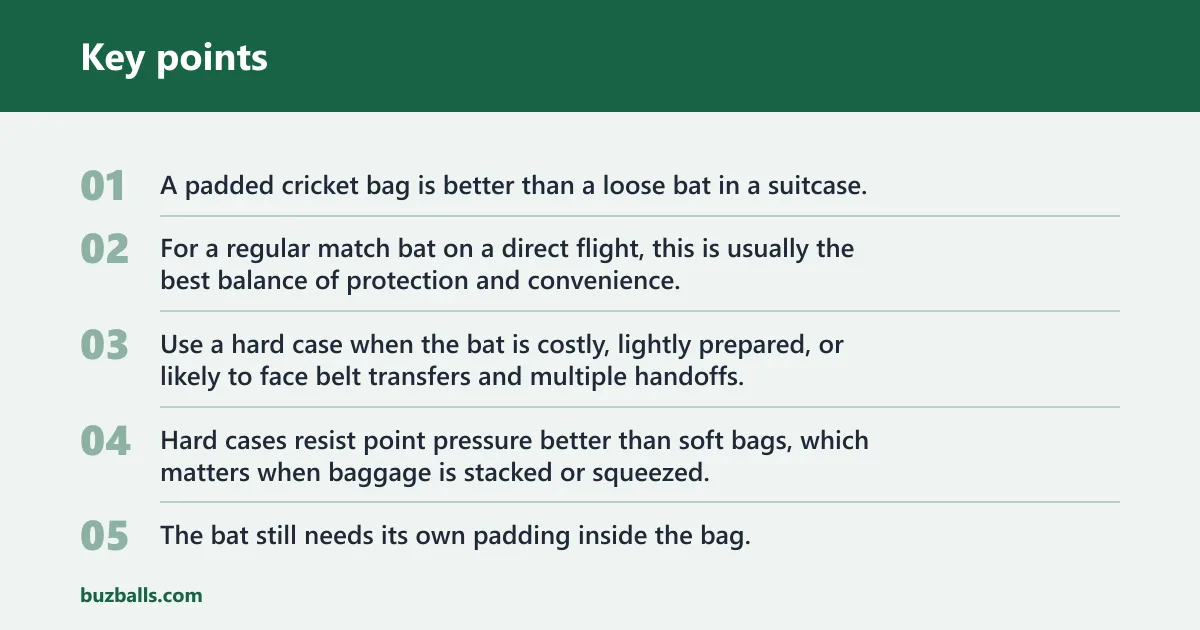
A padded cricket bag is better than a loose bat in a suitcase. It cuts dent and crack risk while giving you a simple way to keep the bat fixed in one position. For a regular match bat on a direct flight, this is usually the best balance of protection and convenience.
Hard case for expensive or heavily handled bats
Use a hard case when the bat is costly, lightly prepared, or likely to face belt transfers and multiple handoffs. Hard cases resist point pressure better than soft bags, which matters when baggage is stacked or squeezed. They also help if the bat has already been knocked in and you want to protect that work.
Full kit bag when the bat travels with gear
A cricket kit bag can hold the bat plus pads, stumps, shoes, and other gear, but the total weight can exceed free allowance. That is useful for tournament travel, yet it also increases the chance of sports-equipment baggage charges. The bat still needs its own padding inside the bag.
What changes if the bat is new or recently knocked in?
New and recently knocked-in bats need more protection because they are more vulnerable to dents and cracks. English willow bats need oiling and four to six hours of knocking in before match use, and travel should not undo that preparation. Keep oiling light before departure so the surface does not become overly soft.
Protecting a new bat from dents and cracks
A new bat should travel with extra restraint around the toe and edges, plus enough padding to stop any movement. Avoid tossing it loose into a kit bag with hard items. If the bat is lightly prepared, even minor vibration from the baggage system can mark the face or edge.
Raw linseed oil and travel timing
Raw linseed oil matters when the bat is new or recently prepared. Do not over-oil before travel, because excess oil can leave the blade softer and less stable. If the bat still needs knocking in, complete that work before the trip when possible, then let the surface settle before packing.
When extra restraint is worth it
If the bat has only limited knocking in, add more wrap, a firmer shell, and tighter bracing inside the bag. A common first-timer mistake is packing a new bat like an old one, then assuming a soft bag alone is enough. That usually leaves too much room for movement.
What fees and baggage rules should you expect?
Checked baggage is the default place for a bat, but sports-equipment baggage, oversize limits, and excess-weight limits can all apply. Search airline websites for sports equipment, special baggage, or oversized baggage before you go. On some carriers, the cricket bag may be counted separately from standard checked baggage.
Checked baggage versus sports-equipment baggage
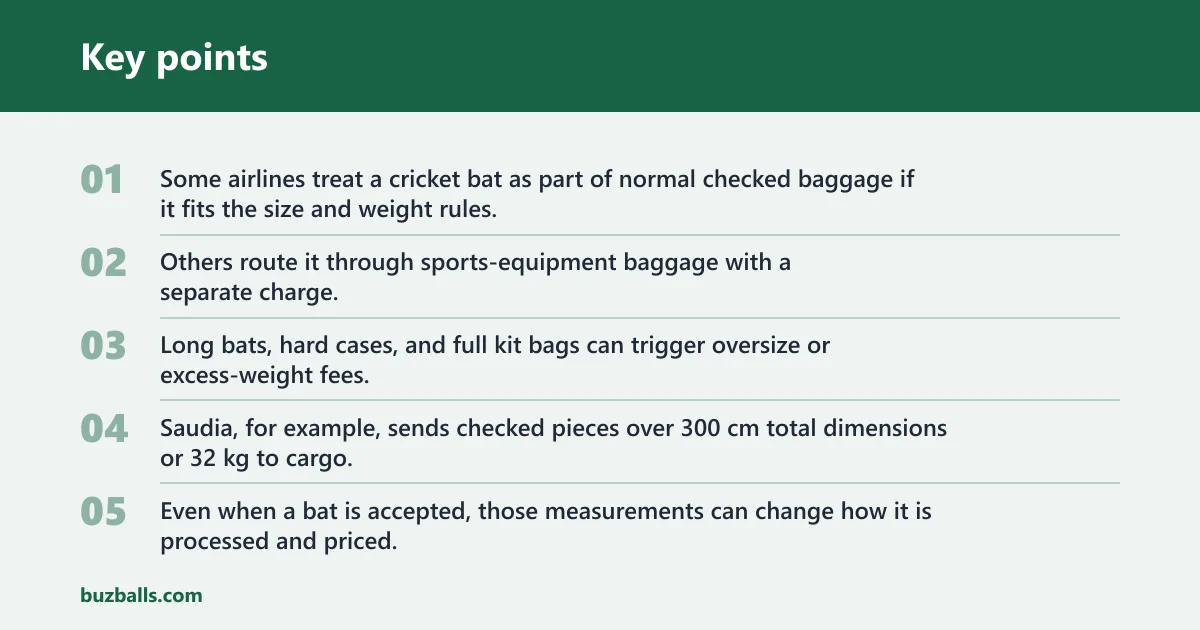
Some airlines treat a cricket bat as part of normal checked baggage if it fits the size and weight rules. Others route it through sports-equipment baggage with a separate charge. That is why the same bat can be cheap on one carrier and fee-bearing on another.
Oversize and excess-weight triggers
Long bats, hard cases, and full kit bags can trigger oversize or excess-weight fees. Saudia, for example, sends checked pieces over 300 cm total dimensions or 32 kg to cargo. Even when a bat is accepted, those measurements can change how it is processed and priced.
Why a full kit bag can push you over allowance
A full kit bag can hold the bat plus pads, shoes, and other gear, but that convenience often pushes total weight over the free limit. Add proof of value for expensive gear, because baggage claims are easier to support when you can identify the item clearly. Arrive early so there is time to resolve a sports-equipment question at check-in.
Suppose a parent packs a junior bat, pads, and shoes into one kit bag for a two-leg trip. The bag is accepted at check-in, but the scale shows it over the allowance. In that case, a separate checked bag or a hard case for the bat alone may be cheaper than paying a combined excess charge.
What should you do for longer or higher-risk trips?
Use the level of handling risk to choose the container. A direct domestic flight is the simplest case. An international connection raises the chance of transfer damage. A tournament trip with full kit creates the heaviest bag and the most fee pressure, so the packing needs to be tighter and the container stronger.
Domestic direct flight
For a direct flight, a padded cricket bag is often enough if the bat is in good condition and the rest of the bag is not overstuffed. Put the bat toe-first, brace the handle, and keep the bag within checked-baggage limits. This is the lowest-risk flight profile for a bat.
International connection
For connections, choose a hard case if the bat matters enough to protect aggressively. Transfer points increase the chance of drops, belt handling, and stacking. If the bat is expensive or recently knocked in, hard-case protection is often worth the extra weight and bulk.
Tournament trip with full kit
For a tournament trip, pack the bat inside the kit bag only if the bag can still stay within the carrier’s checked-baggage or sports-equipment rules. Otherwise, split the load: bat in a dedicated padded case, gear in the kit bag. That reduces both damage risk and fee surprises.
Frequently asked questions
Is cricket bat allowed in flight?
Yes, but usually only in checked baggage and only within airline and airport rules. On the India-Gulf route, cricket bats are banned from cabin baggage and allowed in checked baggage. Security screening still has the final say, so approval at booking does not guarantee acceptance at the checkpoint.
Can I take a cricket bat in checked baggage?
Yes. Checked baggage is the usual route for cricket bats, and some airlines may count a cricket bag under checked baggage if it fits weight and size limits. Watch for sports-equipment, oversize, and excess-weight charges before you pack.
Do small or junior cricket bats count as carry-on?
No. A small or child’s bat has no cabin exemption, and it is generally treated the same as a full-size bat for carry-on purposes. If you need to fly with one, pack it for checked baggage and follow the same protection rules.
Should I use a bat case, kit bag, or hard case for flying?
Choose a padded bat case for most trips, a hard case for expensive or heavily handled bats, and a full kit bag only when the bat is traveling with the rest of your gear. The best container is the one that stops movement and still fits the baggage rules.
What extra fees can sports equipment baggage trigger
Sports-equipment baggage can trigger separate carrier charges, and it may also count toward oversize or excess-weight rules. Some airlines accept a cricket bag as checked baggage if the size and weight fit the allowance, while others charge it separately. Always check the carrier’s sports-equipment policy before the trip.