
What Are Common Mistakes Beginners Make When Choosing a Paddle?

Beginners should choose a paddle that matches grip, weight, and control needs; if one starting point is needed, a midweight paddle around 7.8–8.4 oz with a control-focused face is a common choice. The wrong choice makes the ball harder to control, cuts forgiveness on mishits, and slows your learning. This guide lists the most common beginner mistakes and shows how each one affects control, forgiveness, and progress on court.
What matters first in a beginner paddle?
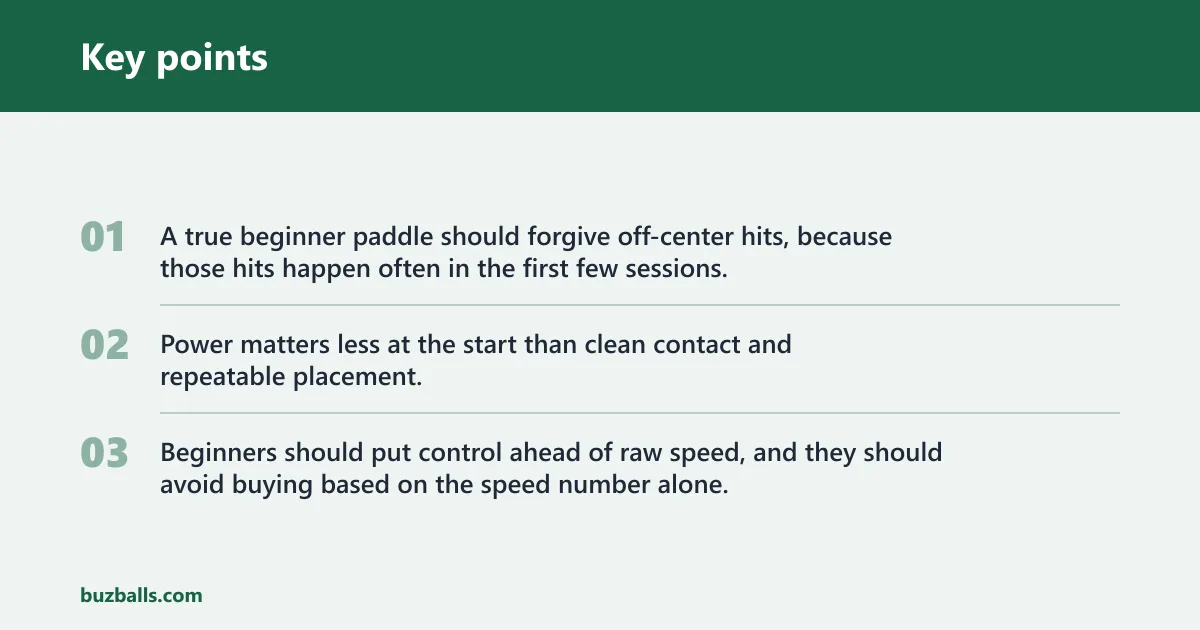
Control and forgiveness come first. A true beginner paddle should forgive off-center hits, because those hits happen often in the first few sessions. Comfort and grip fit come next, since a paddle that twists, slips, or strains your hand makes every other feature less useful.
Power matters less at the start than clean contact and repeatable placement. Beginners should put control ahead of raw speed, and they should avoid buying based on the speed number alone. A speed rating of 5-6 is described as more playable for beginners, but the number still matters less than how the paddle feels on contact.
Paddle mistake checklist
| Mistake | On-court symptom | Who is most affected | Safer alternative |
|---|---|---|---|
| Choosing a paddle that is too heavy | Late swings, wrist fatigue, and slower resets at the kitchen line | Small-handed beginners and players with limited upper-body strength | Start with a midweight paddle around 7.8–8.4 oz |
| Choosing a paddle that is too light | Paddle twists on blocks and drives feel unstable against pace | Backyard players moving into faster games | Move up to a slightly heavier, more stable frame |
| Picking the wrong grip circumference | Slippage, squeezed fingers, or a grip that feels hard to control | Players with very small or very large hands | Choose a grip that fills the hand without forcing a tight squeeze |
| Buying an elongated shape too early | Less forgiveness, smaller sweet spot, and shakier dinks | Beginners who are still learning soft hands | Choose a standard shape first for easier defense and dinking |
| Chasing the face material with the most spin | More spin than you can control, with pop that sends balls long | New players who already struggle with depth control | Pick a control-focused face before chasing extra spin |
| Buying a thin core for more power | Harder impact, less forgiveness, and more vibration on mishits | Players who miss the center often | Choose a thicker core for control and dampening |
| Ignoring core material | Unexpected noise, different feel, or durability that does not match the setting | Apartment players and frequent open-play users | Start with polymer honeycomb for balanced feel and broad use |
| Buying by price alone | Either a flimsy paddle that deadens quickly or a costly one with features you cannot use | First-time buyers trying to save money or overspend | Use value, control, and comfort as the filter |
| Ignoring USAP approval when league play is ahead | Paddle may be fine for casual play but not legal for sanctioned events | Players who plan to enter tournaments or league matches soon | Check approval status before buying if competition is likely |
| Buying a pro-style paddle too early | Harder learning curve, less forgiveness, and more missed resets | Beginners who still miss the sweet spot often | Choose a beginner paddle that supports consistency first |
| Choosing the wrong use case | A casual backyard paddle feels fine at first but blocks progress in league play | Players who expect to improve quickly | Match the paddle to casual play or near-term league progression |
| Ignoring the sweet spot | Off-center hits fly short, sail long, or drop dead on contact | True beginners and players with inconsistent contact | Prioritize a larger sweet spot and more forgiveness |
Should a beginner choose a lighter or heavier paddle?
Most beginners should start in the middle. Lightweight paddles swing fast and move easily, while heavyweight paddles add stability but can slow reaction time and tire the arm. A midweight paddle usually gives the best mix of swing speed, stability, and control for learning.
Lightweight paddles
Lightweight paddles are easier to move, which helps at the net and during quick defensive exchanges. The tradeoff is less mass behind the ball, so blocks can feel less stable and off-center hits can twist the paddle more.
A common first-timer mistake is buying the lightest paddle on the shelf because it feels easy in the hand. After a few games, the problem shows up as flutter on contact and a need to swing harder to keep the ball deep.
Midweight paddles
Midweight paddles usually give beginners the cleanest learning curve. They tend to be easier to control than heavy paddles, while still offering enough stability to keep blocks and returns from feeling shaky. A midweight paddle around 7.8–8.4 oz is a sensible starting point.
Suppose a beginner chooses a 9 oz paddle because it feels solid in the store. On court, volleys may start late and dinks may feel slow because every hand exchange takes more effort.
Heavyweight paddles
Heavyweight paddles can add plow-through and stability, but they are harder to accelerate quickly. That can hurt defense, resets, and hand battles, which are exactly the areas where beginners need help most. They also increase fatigue if you play long sessions.
- Start with midweight. Begin around 7.8–8.4 oz unless you already know you want a very light or very solid feel. That range is easier to control for most new players.
- Test swing speed. Make several forehand and backhand shadow swings. If the paddle feels slow to stop and start, it will likely feel slower in real points too.
- Check stability on blocks. If the face twists on contact, move up slightly in weight or choose a more stable shape. Stability matters more than raw mass.
How do you know the right grip size?
The right grip size should let you hold the paddle securely without squeezing hard. If the handle is too small, the paddle can shift in the hand and strain the forearm. If it is too large, wrist action feels stiff and control drops, especially on soft shots.
Circumference fit
Grip circumference should match your hand shape closely enough that your fingers do not press too hard into your palm. A grip that is too small often feels loose and twitchy; one that is too large often feels bulky and limits touch.
Grip fit matters because control starts with how the handle sits in your hand. If you cannot relax your grip, your dinks and resets usually get worse, not better.
Control and injury risk
A poor grip fit can lead to extra wrist strain and forearm fatigue. Beginners often mistake that strain for weakness or poor technique, when the handle size is part of the problem. A grip that is close to correct reduces the need to clamp down.
Using an overgrip
An overgrip is the easiest way to fine-tune a borderline fit. If the handle feels just a little too small, an overgrip can add the extra thickness you need without replacing the paddle. That is a safer fix than buying a paddle that is too large from the start.
- Hold the handle normally. Your fingers should wrap without a hard squeeze. If you have to pinch the handle to stop slippage, the grip is probably off.
- Check finger spacing. There should be enough room that your fingers do not jam into your palm when you close your hand. Tight contact can make touch shots awkward.
- Use an overgrip if needed. Add one layer if the grip feels slightly small. That keeps the paddle usable while preserving feel.
Do shape, length, and face material matter?
Yes, but beginners should weigh them differently than advanced players do. Shape and length change reach, sweet spot size, and defensive ease. Face material changes power and spin potential, which can help later but can also make control harder at the start.
Standard vs elongated shape
Standard shape paddles usually offer a larger sweet spot and easier defense. Elongated paddles add reach, which can help on balls at full stretch, but that extra length often narrows the sweet spot and makes soft play less forgiving.
For beginners, the tradeoff is simple: more reach often means less margin for error. If you are still learning where the ball meets the face, a standard shape is usually easier to manage.
Fiberglass, carbon fiber, and graphite
Fiberglass tends to give more pop and easy power. Carbon fiber and graphite are often chosen for control and finer touch, with less automatic power off the face. For a beginner, that usually means carbon fiber or graphite is the safer place to start if the goal is cleaner placement.
Do not buy extra spin potential before you can land the ball where you want it. Spin is useful, but control comes first when you are still building reliable contact.
Sweet spot tradeoffs
The sweet spot is the part of the face that gives the cleanest response on contact. Bigger sweet spots help beginners because they reduce the penalty for off-center hits. Smaller sweet spots demand better timing and are less forgiving when rallies speed up.
- Choose standard first. Start with a standard shape unless you already have a strong reason for extra reach. That keeps the sweet spot more forgiving.
- Prefer control faces. Pick fiberglass only if you need help with easy power. Otherwise, carbon fiber or graphite is usually easier to live with as a beginner.
- Protect your margins. If your contact is inconsistent, prioritize a larger sweet spot over extra reach or spin. That makes learning faster.
What core and thickness should beginners look for in a pickleball paddle?
Beginners should usually start with a polymer honeycomb core and a thicker face profile. Polymer honeycomb tends to give a balanced feel with broad appeal. Thicker cores are commonly associated with more control, vibration dampening, and forgiveness, while thinner cores are often associated with more pop that can make the ball fly long.
Polymer honeycomb, nomex, and aluminum
Polymer honeycomb is the most beginner-friendly starting point because it tends to feel controlled and easy to live with. Nomex cores are usually firmer and louder, with a more responsive but less forgiving hit. Aluminum cores can feel different again, but they are generally less common for first-time buyers focused on comfort.
If quiet play matters, polymer is usually the safer choice. If you value a softer, calmer response, it is usually the better fit for learning.
Thicker vs thinner cores
Thicker cores usually improve control and forgiveness by softening the impact. Thinner cores usually give more direct power, but they can make mishits feel harsher and make depth control harder. For a beginner, that extra pop often creates more missed shots than it saves.
What should you feel? A thicker core should make dinks and blocks easier to place. A thinner core may feel lively, but it can turn small mistakes into long balls.
Noise, feel, and forgiveness
Noise is not the main performance metric, but it does matter in some settings. Feel matters because beginners learn from the feedback they get after contact. A paddle that is too firm or too lively can make every bad hit harder to diagnose.
Budget, USAP approval, and upgrade path
A cheap paddle can be enough for a true beginner, but cheap should not mean random. A beginner set can cost around $26, and that can be enough for casual play if the paddle is still comfortable and forgiving. The better question is whether the paddle will last roughly the first year of casual-to-regular play without blocking improvement.
Entry-level price range
Price does not equal quality. Some inexpensive paddles are fine for learning, while some expensive ones are too demanding for a new player. The goal is value: enough control, enough comfort, and enough durability to support consistent practice.
Do not overbuy features you cannot use yet. A beginner who pays for extra power, spin, or a pro-style face may end up with a paddle that rewards advanced contact more than learning.
When USAP approval matters
USAP approval matters when legal tournament use and rule compliance matter. If sanctioned events or league play that follows tournament rules are part of the plan, check approval status before buying. For casual backyard play, approval may matter less, but it still helps to buy within standard pickleball rules.
A simple upgrade path
Some compromises are acceptable in a first paddle. Slightly less spin, modest cosmetic quality, or a simple grip are fine if the paddle is forgiving and comfortable. What is not acceptable is a paddle that makes every reset, dink, and block harder than it should be.
- Set your use case. Decide whether you are buying for casual play or for near-term league progression. That choice changes how much you should care about approval status and long-term durability.
- Cap the budget. Start with a reasonable entry-level spend, then judge the paddle by comfort, control, and forgiveness rather than by price alone.
- Check the rules. If you expect tournament play, verify USAP approval before purchase. That avoids replacing a paddle early for compliance reasons.
What are the most common mistakes beginners make when choosing a pickleball paddle?
Common mistakes include choosing too much power, too little forgiveness, the wrong grip size, and a shape that is harder to defend with. Beginners also often buy for price alone or copy pro specs before their contact is stable. Those choices slow learning because they make mishits more punishing.
Frequently asked questions
Should a beginner choose a lighter or heavier pickleball paddle?
A beginner should usually start with a midweight paddle rather than chasing either extreme. Lightweight paddles are easier to move but can feel unstable on contact, while heavyweight paddles add stability but can slow hands and fatigue the arm. Midweight is the safer first filter.
How do I know what grip size I need for a pickleball paddle?
Choose the grip size that lets you hold the handle without squeezing hard. If the handle feels slightly small, an overgrip can fix that. If it feels too large, control and wrist freedom usually suffer, and that can create strain during longer sessions.
Is a cheap pickleball paddle good enough for beginners?
Yes, if it is comfortable, forgiving, and legal for the type of play you plan to do. A beginner set can cost around $26, and that may be enough for casual play. Cheap is a problem only when it means poor grip, harsh feel, or weak consistency.
What paddle face material is best for a beginner?
For most beginners, carbon fiber or graphite is easier to control because those faces usually put less pop on the ball than fiberglass. Fiberglass can help with easy power, but it can also make depth control harder when contact is still developing. Control should win first.
What core thickness should a beginner look for in a pickleball paddle?
A thicker core is usually the better beginner choice because it adds control, dampening, and forgiveness. Thinner cores are livelier, but they can make the ball spring off too quickly and increase mishits. If learning consistency matters most, thicker is the safer default.
Should beginners buy the same paddle pros use?
Usually no. Pro-style paddles often assume clean contact, fast hands, and a specific shot profile. A beginner benefits more from a forgiving paddle that supports learning, keeps off-center hits playable, and does not punish touch shots while technique is still forming.
What should I prioritize first: control, power, or comfort?
Prioritize control first, then comfort, then power. If the paddle is hard to steer or uncomfortable to hold, extra power will usually make the game harder, not easier. Beginners should choose a forgiving paddle that helps them place the ball and repeat contact.