Best Golf Balls for Beginners with a Slice

Choose a low-compression, two-piece distance ball if you slice; no golf ball can fix a slice, but lower-spin designs can reduce curvature and make mishits easier to manage. Ignore that, and you can keep paying tour-ball prices for shots that curve the same way. This guide explains what actually affects the slice, then matches ball picks to swing speed, budget, and feel.
What a golf ball can actually change
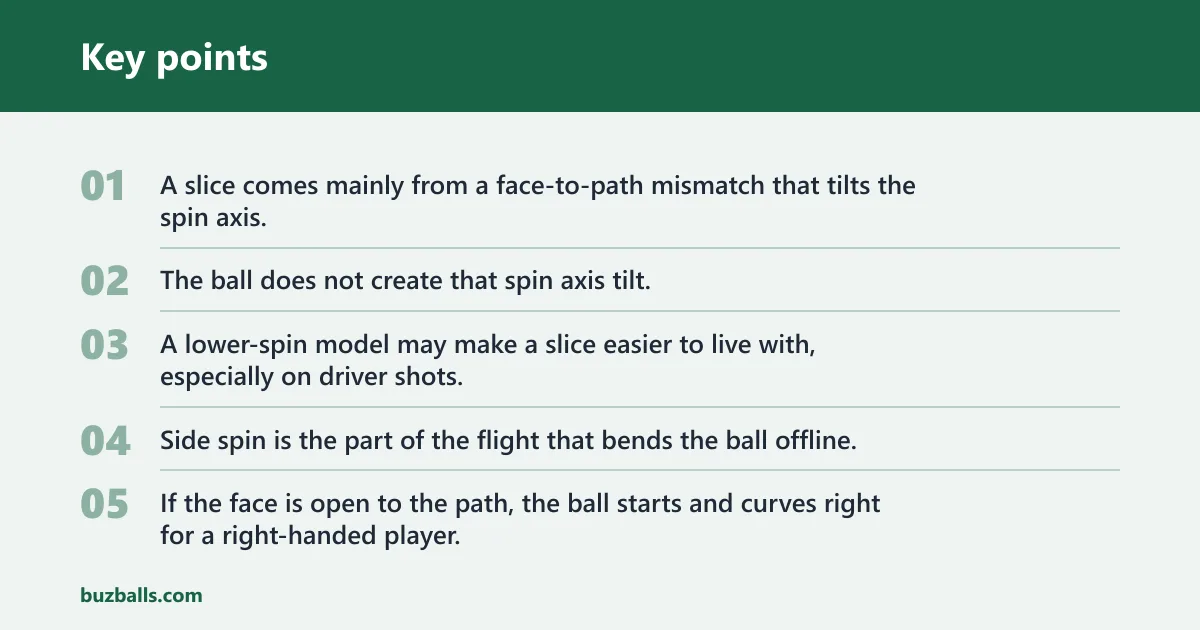
A slice comes mainly from a face-to-path mismatch that tilts the spin axis. The ball does not create that spin axis tilt. What it can change is how much the shot curves, how high it launches, how far it carries, and how much feel you get at impact.
That is why ball choice matters, but only within limits. A lower-spin model may make a slice easier to live with, especially on driver shots. It will not turn a severe cut into a draw.
Side spin vs swing path
Side spin is the part of the flight that bends the ball offline. If the face is open to the path, the ball starts and curves right for a right-handed player. That pattern is set by impact, not by compression alone.
A golf ball can slightly change spin rates and launch, which can change how much the slice shows up. It cannot repair a path that points too far left or a face that arrives too open.
Why soft feel is not a slice cure
Low-compression balls usually feel softer and can help some beginners launch the ball more easily. Many manufacturers place these models in roughly the 30 to 80 compression range, though the exact number can vary by ball. Softer feel is useful. It is not a cure for the slice.
A very soft cover may make contact feel cleaner and less harsh. That can help confidence. It does not remove the path problem that causes the curve.
Where ball choice still helps beginners
The right ball can make a beginner’s misses less punishing. Distance models often fly a bit easier off the tee, durable ionomer covers keep cost down, and alignment markings can help you aim the face more consistently. Those are practical gains. They matter when you lose balls and need more reps.
Best golf ball types for beginners with a slice
For most new players, a common default is a two-piece distance ball with an ionomer cover and a lower-compression core. That combination is usually cheaper, durable, and easy to replace. It also fits the main beginner priorities: getting the ball airborne, keeping costs down, and reducing lost-ball pain.
Low-compression golf balls
Low-compression golf balls can help some beginners launch the ball easier and may feel better on thin or off-center strikes. They are a good fit when swing speed is low and the ball struggles to get airborne. They are not a slice cure, and they can cost more than basic distance balls.
Two-piece golf balls
Two-piece golf balls are often a practical default for beginners because they are built for distance and durability. They use a large core and a simpler construction, which keeps price lower than most multilayer tour balls. For slicers, that usually matters more than extra short-game spin.
Some two-piece balls use ionomer covers, while a few use different cover blends. The important point is the same: durable, affordable, and simple enough to suit new players who need more tee shots and fewer specialty features.
High-launch golf balls
High-launch golf balls are designed to get airborne more easily. That helps players with low swing speed or low launch, and it can add carry when a beginner struggles to keep the ball in the air. Many high-launch models also use a softer core.
If your drives fall out of the sky too quickly, a high-launch model is worth considering. If your main miss is a big slice, though, higher launch alone will not stop the curve.
Ionomer cover vs urethane cover
Ionomer covers are commonly used in game-improvement balls because they are durable and affordable. They also tend to offer less greenside spin than premium tour balls, which is usually fine for beginners. Urethane covers are often softer and more spin-friendly around the green, but they tend to cost more.
For slicers who want distance and durability, urethane is usually unnecessary. A premium short-game cover does not address the main issue, and it often adds cost without much benefit for a player still working on contact and aim.
Which balls should you avoid?
Avoid premium urethane tour balls and very firm distance models unless you have a specific reason to use them. Tour balls often cost more and add greenside spin you do not need yet. Very firm balls can feel harsh and may make launch harder for slower swings.
Higher price does not mean better results for a beginner with a slice. If a ball gives you more spin, more cost, or a harsher feel without improving launch or confidence, it is the wrong buy.
Say your driver speed is modest and you are losing three balls a round. A premium urethane ball may feel nice on wedge shots, but it is a poor match if you are mostly trying to keep tee shots in play and control cost.
Does a softer golf ball reduce a slice?
A softer golf ball can make the shot feel easier to compress and may help some beginners launch it higher. That can make the slice look smaller because the ball carries better. It does not remove the cause of the curve.
Compression can influence feel, launch, and sometimes spin. It cannot fix clubface aim, swing path, or impact location. If those are the real problem, a softer ball only changes the symptoms.
What compression can influence
Lower compression can help slower swing speeds get more usable launch. It can also make the ball feel less harsh on mishits, which matters for confidence. For some beginners, that is enough to make swings feel less forced.
What compression cannot fix
Compression does not square the face for you. It does not change an out-to-in path. It does not erase the spin axis created at impact. That is why the slice remains even when the ball feels softer.
When soft feel is worth it
Soft feel is worth paying for when you have a low swing speed, want easier launch, or dislike firm contact. It is less useful if you already swing fast enough and are looking for better distance per dollar. In that case, a standard two-piece distance model is usually the better buy.
Golf ball decision table
| Beginner slice profile | Ball type | Compression | Cover | Alignment aid worth it? | Not recommended |
|---|---|---|---|---|---|
| Low swing speed, budget, distance-first | Two-piece distance ball | Low to mid | Ionomer | Yes, if you start the ball right | Premium urethane tour balls; very firm distance balls |
| Low swing speed, mid-priced, feel-first | Low-compression high-launch ball | Low, often about 30 to 80 depending on model | Ionomer or soft cover blend | Yes, if aim is inconsistent | Premium urethane tour balls; overly firm distance models |
| Average swing speed, budget, distance-first | Two-piece distance ball | Mid | Ionomer | Optional | Premium urethane tour balls |
| Average swing speed, mid-priced, feel-first | High-launch or soft distance ball | Low to mid | Ionomer | Yes, if you aim left or right often | Premium urethane tour balls unless short-game spin is a clear need |
How to choose between distance and feel
Choose distance first if you lose balls often, struggle to keep drives in play, or need cheaper practice. Choose more feel if your swing speed is low and firmer balls feel hard to launch. For most beginners with a slice, distance and durability come before extra greenside spin.
-
Check your swing speed. If it is low, start with a low-compression or high-launch model. If it is higher, a standard two-piece distance ball is usually enough.
-
Match the budget first. If you lose a lot of balls, buy a durable ionomer-covered option. Spending more on urethane makes less sense when the priority is keeping the ball in play and replacing it cheaply.
-
Decide on launch needs. If your ball flight is low and flat, choose a model built to launch easier. If you already launch it high enough, do not chase extra lift at the cost of feel or price.
-
Add alignment help if needed. Pick a ball with a line or visible marking if you often start the ball right or struggle to set the face square. That can support a cleaner routine and more consistent aim.
Picture a beginner with a 75 mph driver speed, a right miss, and a habit of lining up the clubface open. A two-piece ball with an alignment line gives more useful help than a premium tour ball, because it supports launch, aim, and budget at the same time.
What golf ball will help my slice?
The best default pick is a low-compression, two-piece distance ball with an ionomer cover. If your swing speed is low, choose a high-launch version. If you often start the ball right, an alignment aid is worth paying for because it helps setup, not because it changes the slice itself.
Best default pick for most beginners
For most beginners, a two-piece distance ball is the safest recommendation. It is durable, usually lower priced, and built for easier distance. That makes it a better fit than a premium urethane ball for someone who is still fighting the slice.
Best pick for low swing speed
If your swing speed is low, start with a low-compression high-launch ball. The goal is easier lift and carry, not more spin. A softer core can help the ball get up, while the lower price keeps the learning phase affordable.
Best pick for better aim and setup
If your main problem is starting the ball right, choose a ball with an alignment line or similar marking. That feature can help you aim the face more consistently and build a better pre-shot routine. It is a small add-on, but it can be useful for slicers.
Frequently asked questions
What are the best golf balls for a beginner?
The best golf balls for a beginner are usually two-piece distance balls with ionomer covers. They are durable, affordable, and built for easier distance. If you have low swing speed, a low-compression version can help the ball launch more easily without pushing you toward expensive tour-style spin.
What kind of golf balls should a beginner use?
A beginner should use a durable, lower-cost ball that helps with launch and keeps replacement costs down. Two-piece distance balls fit that job well. If the ball flight is too low, choose a high-launch or low-compression option instead of jumping to a premium urethane ball.
Do softer golf balls reduce a slice?
Softer golf balls can feel easier to compress and may help some beginners launch the ball higher. They do not fix the clubface-path mismatch that causes the slice. Use soft feel as a launch and comfort choice, not as a cure for the slice.
Should beginners use a two-piece or three-piece golf ball?
Most beginners should start with a two-piece golf ball. It is simpler, usually cheaper, and built for distance and durability. Three-piece balls can add feel and spin, but that is usually less important than launch, price, and keeping the ball in play.
How do I choose between distance and forgiveness?
Choose distance when you need more carry, lower cost, and easier replacement. Choose more feel only if you already launch the ball well and want a softer response. For a beginner with a slice, distance and durability usually matter more than extra short-game spin.